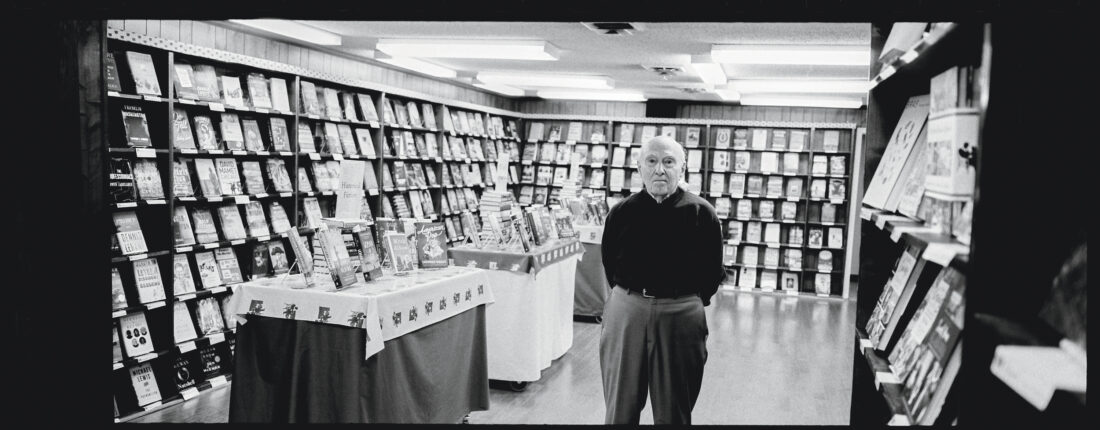
The Alabama Booksmith breaks just about every rule in the retail book business. The unassuming shop, which opened in 1999, is tucked in a repurposed house almost directly under Highway 280 in Homewood ( just south of downtown Birmingham) and carries only about a thousand titles. Rather than shelve its books with the spine facing out, it displays them so that you can see the front of the dust jacket, one copy per title, as if they are little works of art. And there are days when not a single customer walks through the door.
Yet the Alabama Booksmith is just about as successful as bookstores come, with an international clientele and a busy online business. There are two reasons for that. One is its niche: It sells only hardbacks, nearly always first editions, signed by the author and all but a few for the price on the jacket. Second, it is owned and operated by Jake Reiss, who at ninety years old defies the immutable laws of aging as deftly as he defies the unvarying rules of bookselling.
Applying adjectives such as sprightly or ageless to Reiss (pronounced Reese) would be backhanded compliments from the “He’s old but…” thesaurus. Reiss looks nowhere near his age. Beneath his gleaming scalp bounces a ponytail. He is trim, and his gait reflects little of time’s handiwork. More important, Reiss combines the enthusiasm of an optimist with the indefatigability of a salesman.
He loves people, he loves books, and he really loves authors, who love him right back. Rick Bragg, who regularly drives ninety minutes west from his farm in Calhoun County to have lunch with Reiss, refers to him as a “scoundrel.” But Bragg recognizes that Reiss’s editorial instinct is golden. “There is no doubt in my mind that some of those brief appearances on a bestseller list would not exist if he had not looked me in the eye and told me the pros and cons of my ideas,” Bragg says.
Winston Groom and Pat Conroy, both of whom have left us, were dear friends of Reiss’s. He introduced Conroy to his third wife, Cassandra King.
Ann Patchett and Reiss gush over each other. “I’m in love with her,” Reiss says. “She is so fun, so lovely, kind, generous.”
“He’s a really charming cat,” Patchett says in return. “We’re all drawn to him. He always gives me lunch. He remembers I like tuna.”
In 2023, Patchett made the three-hour drive from Nashville to Birmingham with her sister, ate her tuna sandwich, hung out with Reiss, signed five hundred copies of her novel Tom Lake, and drove home. What really makes her appreciate Reiss stems from her owning Nashville’s Parnassus Books, the mother ship of all indie bookstores. She marvels at the orderliness of Reiss’s climate-controlled warehouse, the forty different sizes of boxes he stocks. And she marvels at the business model.
“He has read all the books that he sells,” Patchett says. “Who does that? There’s no, like, ‘Well, maybe that’s good,’ or ‘I read a good review of it.’ If it’s there, it’s because he wants to sell it. And not only does he know his inventory, he knows his customers personally, so he is truly matching up the person with the book. I mean, it’s bespoke bookselling.”
Funny thing—Reiss spent the first half of his adult life as a bespoke clothier. He enjoyed it. He really wasn’t looking for something else. But his son Frank got a job in a used bookstore in San Francisco. Then Frank moved to Atlanta, and then opened his own used bookstore in 1989. A year later, Jake opened his own Highland Booksmith on Highland Avenue in Birmingham (he moved the shop to its current location and changed the name nine years later).
“Like son, like father,” Jake calls it. “I was fifty-four years old, in the custom tailoring business started by my grandfather in 1899, and had been divorced for nearly two decades. I thought, ‘If you buy books for pennies and sell them for dollars, first of all, you’ll make millions of dollars, and second, you’ll meet lots of girls.’ And that was my motivation for getting in the book business. That did prove to be accurate, except for the two main reasons.” The twinkle in his eye could light the entire city of Birmingham. “But hey, it ain’t over.”
When Frank gravitated toward new softcover books, so did Jake. When Frank started selling new hardcover books, so did Jake. Frank’s store, A Cappella Books, now sells new books and high-end used books and has become an Atlanta institution. And while Jake’s shop might have a narrower selection of books, in nearly every case, he’ll have many, many signed copies of those titles he loves.
Reiss got rid of his used books some time ago. He noticed how many books went out the door when he held a signing. He cultivated his customer base and, though he hasn’t held a piece of tailor’s chalk in more than three decades, caters to them as if they’re buying suits. “My perception of my dad in the clothing business was that, again, it was personality,” Frank says. “He got to know people who could afford custom tailored clothing, and they became friends. He didn’t have a lot of customers, but the few customers he had, he sold them a lot of clothes.”
That’s pretty much the model for the Alabama Booksmith, which opens to shoppers Monday through Saturday. Reiss has more than five thousand customers on his mailing list, and about a thousand he describes as “active.” That includes the Signed First Editions Club, whose members get a delivery every month. His Great White Whale is Stephen King, and he’s got only a few John Grisham titles, but the list of authors in Reiss’s inventory of signed books is a who’s who: Jon Meacham, Ian McEwan, Jane Smiley, Daniel Silva, Geraldine Brooks, Percival Everett, and on and on.
“There may be a handful of writers out there that don’t like Jake,” Bragg says, “but they may not like chocolate. They are not liking a pork chop.” Suffice it to say that the Booksmith is a unicorn. As is its owner.