

Arts & Culture
Behind the Curtain of Nate Bargatze’s Comedy Empire
The hottest comic on earth is building more than just a Nashville hub of humor—he’s pulling a parade’s worth of funny people behind him

Photo: PETER YANG
Coughing is one of the best stages of laughter. A part that’s contagious to listen to, the residue of a particular joke that’s accomplished way more than its humble intention. When a giggle capitulates into a coughing fit at a normal comedy show, the crowd might be forced to acknowledge it by chuckling along. It’s the kind of sound that’s totally audible at a club that has, say, 150 seats, and a curtain as its stage backdrop, and a stool for the comic to rest his or her drink. The comedian might pause to admire the kill, to appreciate the facial expression that would attach itself to such a reaction—the experience of workaday stand-up in a sonorous nutshell.
The comedy club today isn’t like that in the slightest. Nate Bargatze is performing. And more than twenty-five thousand people have purchased tickets for a doubleheader of the Nashville native’s shows here on a late-fall Saturday in Greenville, South Carolina, in a venue that offers nothing close to the kind of comedic intimacy of what stand-ups call a room. It’s a straight-up arena, with a concert capacity of fifteen thousand, a number the evening show will surpass because of all the folding chairs Bargatze’s road crew has arranged on the floor. In the day ahead, the acoustics of the state-of-the-art sound system will barely relent to total silence between jokes, much less allow the supportive echo of a single coughing fit of uncontrollable laughter to be interpreted by Bargatze and his opening comics onstage. This is just one of the weird phenomena of the historic success of Bargatze—at forty-six, the highest-grossing and arguably most popular stand-up comedian on earth, who has put out three Netflix specials, has hosted Saturday Night Live twice, has built his own company called Nateland Entertainment, has broken records with his Big Dumb Eyes World Tour, and has a film, game show, and theme park on deck: The laughs can be overwhelming when everyone is having one all at once.
Bargartze emerges from his tour bus a few hours before the first show and conducts a mic check inside Bon Secours Wellness Arena, his frame Lilliputian beneath the Jumbotron and the venue’s high ceiling, his voice circuited and echoed back to him through the hollow whine of the mic. His disk-shaped stage, where center ice would normally host the Greenville Swamp Rabbits hockey team, allows him to perform in the round, a layout that forces him to walk around during his hour-long set and try to make eye contact with some kind of focal point in the vastness of fans, so everyone can feel as if he’s speaking to them.
One of Bargatze’s jokes during the first show will begin with the modest confession that he and his wife, Laura, are in marriage counseling, only because they don’t want to “lose sight” of each other amid what has turned out to be a life that neither could’ve imagined. In the evening show, he will change the bit by substituting in a single word—amid the chaos—and when asked later about that choice, he mentions his nonstop tour schedule (Big Dumb Eyes made $15 million in October alone) and his exhaustion. Not just from the slog of the road; what the crowd doesn’t know is that between these fall tour dates he’s been bouncing from Atlanta to L.A. to Nashville, shooting scenes for his first film, a comedy called The Breadwinner, out March 13, and screening it with his cast (which includes Mandy Moore, Will Forte, and Kumail Nanjiani); filming episodes of his new ABC/Hulu game show, The Greatest Average American (named after his second Netflix special), which premieres February 25; planning a Nashville theme park; and even doing a little unofficial recruiting for Vanderbilt football, appearing as the guest picker on ESPN’s College GameDay for the Commodores’ matchup against Missouri.
His speaking voice is, understandably, strained. “As a comedian, you’re afraid to take time off, at least for me,” Bargatze says of his schedule. “I very much believe I’m not owed this. The audience doesn’t owe it to me to come. So it’s something you got to go earn every single show, every day. It gets exhausting. Some days you can sleep on the bus and some days you’re riding in the middle of nowhere and—you know, my bus driver is an amazing driver, but the roads are the roads. Right?”
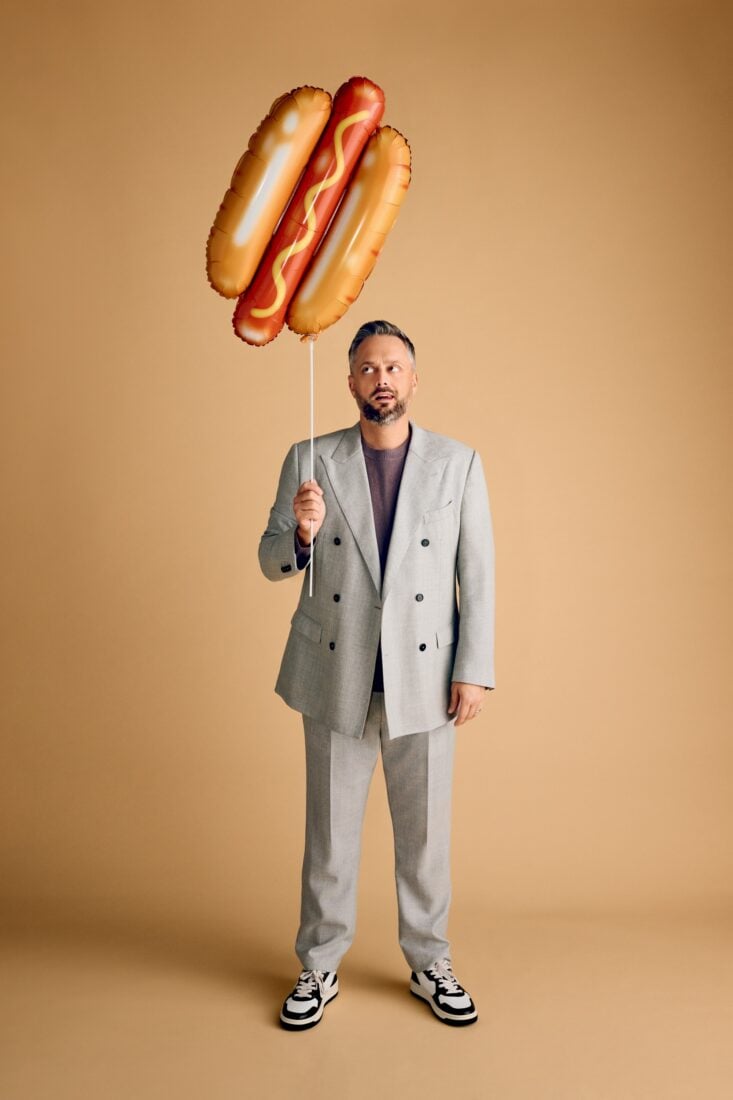
Photo: PETER YANG
Hotdogging in a Dolce & Gabbana suit and Autry sneakers.
His comedic voice, however, is healthy. He’s been working on his particular brand of embellished self-deprecation since he was a small-town comic in big New York in his late twenties, scrubbed of profanity and purposefully apolitical. Raised in a Christian family, Bargatze writes in his memoir (also called Big Dumb Eyes) that the closest anyone got to cursing in his household was shouting the word dadgummit, though they did all use idiot as a term of affection. An outgoing kid who was good at imitations of Urkel and Jim Varney’s Ernest character, Bargatze helped his magician dad, Stephen, in circus-clown and magic acts but also fell into normal jobs at Opryland and Applebee’s (where he met Laura), and, before stand-up, as a meter reader at a water company, where his life might’ve settled into middle age. “I thought, ‘Oh, he got a job at the water company! He’s going to have a great job and get a family and have a house with the little white picket fence and all the things,’” recalls his mom, Carol. “Then that’s when he started talking about going off and doing comedy, and he quit that job. And we helped him. We sent him the little bit of money we could send him.” Bargatze first lived in a rat-infested basement room in Chicago and took comedy classes while working at a bar; then performed for years in the Big Apple perfecting how to tell jokes, alongside dirtier comics who ended up loving him. He ultimately moved back to Nashville to a cul-de-sac outside the city to try to give his wife and daughter, Harper, a semblance of a normal life.
Bargatze’s humor resonates because he knows and shares himself, and polishes his work down to the literal syntax choice of where to drop an elongated breath; but his comedy is also the kind that stands out as a palatable respite in a divided America, stripped of discourse about violence or political destitution. And while that didn’t exactly translate during what turned out to be an awkward Emmy emcee stint last fall, when his devoted audience gets in front of him, many of them feel as though they already legitimately understand a lot about his life. That he gave up drinking years ago because it was impeding his larger ambitions; that he’s a workaholic who achieved unfathomable success partly from the sheer grind of doing it for twenty-one years. Though he has a Southern accent and once called himself the Tennessee Kid (which he used to title one of his Netflix specials), his act is nothing like the bumbly pandering of the Blue Collar Comedy Tour of yesteryear; other comics know that beneath his facade is the acute intelligence of a scholar of stand-up comedy. Bargatze fan Jimmy Fallon once had a sleepover with Bargatze and other comics on one of the tour buses, and they all stayed up till 2:00 a.m.—not partying, but listening to Bargatze play a comedy album by one of his favorite stand-ups, Dave Attell.
Crowds at Big Dumb Eyes stops also know all about the foibles of Stephen and Carol; can relate to Bargatze’s American honesty of never reading books and maybe feeling kinda dumb about it; laugh about his revelation that his wife is the brains of the operation; nod along as he recounts the bumps in the road of trying to raise a daughter in the modern world; and of course understand poking fun at a brother and sister, which he does in a variety of stories he tells onstage.
“It’s all a thousand percent true,” Stephen Bargatze says of his son’s routine. “I think that’s what makes him so relatable, because people know it’s true and they all have a family member like that. Or a weird uncle like me. I think we’re honestly a funny family. We see comedy in everything and we’re not afraid to say it. If somebody falls down, we’re all going to laugh. If we make it into one of Nathan’s jokes, we’re never upset. It’s awesome.”
Bargatze’s friend and fellow Nashville comic, and the cohost of his Nateland podcast, Brian Bates, performs at times on the tour, too. “People who come to see him, and the people who watch his specials—they know him so well that he can skip all the preamble,” Bates explains. “The first time I saw him, to this day, I’ve never been more blown away. Because every comic up until then that I had encountered, with some exceptions, was very dirty.”
“I see the audience,” Bargatze says. “And it’s all different. You see different religions out there. You see different political, like, whatever it is—it just doesn’t matter. I want families to laugh at me. I want them to feel safe when they go there, and can all be together. You should be able to trust that I’m gonna be that relief for whatever you need.”
The waning daylight begets a bottleneck at each arena entrance between shows, the lines for the seven o’clock performance weaving into the distance of the parking lot and into stalled traffic. Bargatze slips out of the nice tan jacket he wore during his first set and into a comfortable tee with a sweater over it, and then walks down the long hallways in the estuarial stomach of the arena to the greenroom, puts his feet up on a coffee table, and grabs the TV remote. The four comedians who open for him—Julian McCullough, who also acts as Nate’s emcee, working the crowd and introducing the comics; the youngest on the tour, Steven Rogers; tall, bearded Nick Thune, who plays the guitar as a soundtrack for his comedy and wears cowboy boots and athletic pants onstage; and Joe Zimmerman, a Last Comic Standing alum whose first comedy special Bargatze directed—join him as he turns on a recording of Vanderbilt’s football game versus Kentucky. It’s already in the third quarter, but he starts from the beginning, pausing the video and hooting after Vandy quarterback Diego Pavia throws one of an eventual five touchdown passes against the Wildcats. Though Bargatze himself flunked out of Western Kentucky, he’s a lifelong Commodores fan. He even hosted Pavia at his home last year and jokes that the player will get a statue, even if Bargatze has to pay for it himself.
Celebrity stand-ups are known for being what another successful comic refers to as lone wolves, hesitant to reveal any truth about their personal lives or locking themselves away while on tour. Bargatze does the opposite, instead surrounding himself on the road with his favorite comics and friends he’s grouped under his Nateland Entertainment banner (see sidebar). They ride go-karts together; play golf, laser tag, and Wiffle ball; hike the Blue Ridge Mountains; and in Charlotte, the stop before Greenville, they all played basketball in the Hornets’ arena and met the team mascot, Hugo. Bargatze started Nateland, partly, to provide a leg up for younger comics and those yet to establish themselves.

Photo: PETER YANG
“I want everybody to be involved on the road,” he says. “It’s like, we should all be friends and, you know, we always joke—we got a couple guys, they’re younger, but they’re really big into anime. They wanted to watch an anime and the rest of us were like, I’m not watching it. But one day I need to watch anime with them, just because.”
That largesse extends beyond Nateland, too. “Most people at the highest level might be like, I don’t want to bother with being around lower-level comedians,” says Lucy Sinsheimer, the talent booker for Zanies, the Nashville comedy club where Bargatze often tries out material. “When he is here, he’s generous with his time and his kindness for open mic-ers and up-and-coming comics. Recently we were doing a clinic with a bunch of comics, and he happened to be recording the podcast next door. He came and talked to everyone for twenty-five minutes. Just giving advice.”
Fans seem to intuit this genuineness—another reason they’re snaking out into the distance beyond the arena this evening. “Most comedians before Nate would say arenas don’t work for stand-up comedy,” Bates, his podcast cohost, explains. “Small, intimate settings are the place for it. But it does work. He somehow has pulled off making stand-up comedy in an arena seem like an intimate discussion you’re having on your couch with your family or your neighbor or whatever. There are major, major stand-up comedians, household names, who’ve never performed in front of nearly that many people.”
What Bargartze doesn’t hear during either show is what sounds like a smokers’ convention of tickled wheezing that accentuates his performance, no matter where one happens to be standing. From the folding chairs on the floor, from the exit rows, from the faraway suites with their windows open to the expanse of the arena, from the tundra of the rafters where those seated have to gauge Bargatze’s facial expressions by watching him on the Jumbotron.
Bargatze begins with the half mumble of an introduction, “We’re doin’ it,” as though he accidentally wandered onstage and found himself in front of the microphone. As he continues, the laughter approaches him as one big sound, fathomless and coming from nowhere, everywhere. He says “GreenVILLE” in the voice of a Northerner, then corrects himself quickly with Greenvull, the way a local would say it, to the audience’s delight. At the end of the performance, he takes a bow. Then he introduces the comics who opened for him by name as they come back onstage and says, “I know I don’t deserve this, so thank you for coming out…”

Photo: PETER YANG
Bargatze sports a Golden Bear jacket and Theory sweater.
The wall of laughter finally melts into something easier to absorb as the comics jog offstage. Bargatze raises his hands as he passes through the audience and brushes them along rows of outstretched palms. Through a long tunnel shuttered with curtains, the comics file after one another into a hallway—the noise breaking through when the curtains part and muffling again when they close—and then immediately huddle in a semicircle to debrief. “Right when you get offstage, it’s almost like you’ve been alone for an hour,” Bargatze explains. “You’re in your own thoughts. You want a sounding board.”
A couple of the comics take out notebooks. Bargatze leans against the concrete wall and asks them what they thought of a particular joke that he’s pretty sure, even standing onstage in front of so many people and trying to position his thoughts mid-act, got too big of a laugh, which impeded his timing. This is part of his success, too: a prolific attention to detail. The other comics go over their material as he listens, Bargatze with his right foot curled behind him and a black boot against the wall, and the sound, still out there, softening into a few individual laughs now, behind them.
Watch: A Nate Bargatze Sampler
Plus: Meet the Cast of Nateland
To be a Nateland comic—or one of “Nate’s Friends,” as the company bills them, whom he brings on tour, hosts on his podcast, showcases at Zanies in Nashville, you name it—a stand-up needs to do two things: make Bargatze laugh, and use clean material. Beyond that, they veer in every direction and include both seasoned pros, like the bespectacled, trucker-hatted Dusty Slay, and rising talent. Here’s a sampling.

Illustration: JESSICA BROMER
Joe Zimmerman
In his Nateland-produced special, Cult Classic (which Bargatze directed in Asheville), Zimmerman comes across as professorial, calm—hilariously harmless. The Davidson grad has been featured on Conan and The Tonight Show Starring Jimmy Fallon, and says of his comedic persona, “I give off the energy of an emotional support animal. Which is unfortunate because I am going full throttle—this is a thousand percent of my energy.” And Asheville? “It’s the only place where I’ve seen a redneck and a hippie, and it’s the same person.”
Paula Kosienski
Kosienski moved from North Dakota to Nashville a few years ago to join the city’s burgeoning comedy scene. Her pensive look onstage belies a wry humor and an uncomfortably hilarious proclivity for pausing a bit too long. Kosienski regularly appears at Zanies and also opens for such comedians as Dusty Slay, killing with her deadpan delivery. Here’s just one example: “I hate to say it, but married people—y’all are the worst spokespeople for marriage. Y’all act like you were tricked into it, like it was an Old Navy credit card.”
Derrick Stroup
This Alabama native, who recently recorded his first Netflix stand-up special in Birmingham, has the onstage presence of someone who is both overtly Southern and borderline aggressively mad—as he calls it, “the cadence of an angry auctioneer.” And that’s all part of his charm. He recently admitted on The Tonight Show Starring Jimmy Fallon with a kind of sigh: “I love sodium. I love it, man. Sometimes I’ll buy bologna and just suck on it. When I get done eating dinner, I want to take my socks off, and it looks like I still got ’em on…”
Mia Jackson
A Georgia-born comic who started her career in Atlanta, Jackson jokes about “clairvoyant biscuits” and what life is like at six feet tall, and says about her sometimes intimidating vibe, “I found out that I have human resources energy. So, I don’t know if you see it, but the haircut does not help. I tend to stress people out, that’s what happens. I get onstage and people are like, This lady has fired me!” Jackson’s credits include Comedy Central specials, writing for TV shows Life & Beth and I Love Us, and opening for Amy Schumer.
Want more laughs? Find more stories from our comedy issue:
>> Six Razor-Sharp Southern Comedians Who Are Keeping Us in Stitches
>> Five Comedy Clubs to Seek Out
Justin Heckert is a writer based in Charleston, S.C. His stories have appeared in Vanity Fair, WIRED, Garden & Gun, ESPN The Magazine, Esquire, GQ, The Economist, The New York Times Magazine, Slate, the Oxford American, and numerous other publications. He was twice named Writer of the Year by the City and Regional Magazine Association and in 2023 received the Knickerbocker Award for Journalism from the New York Video Game Critics Circle.
Garden & Gun has an affiliate partnership with Bookshop.org and may receive a portion of sales when a reader clicks to buy a book. All books are independently selected by the G&G editorial team.
Related Stories:
G&G Weddings
The three-day affair fused the color of an Indian bazaar with the classic elegance of the Swan House
Year in Review
A look back at thirty-five of our favorite shots from the pages of the magazine this year

Arts & Culture
The brand captures her hometown’s laid-back allure
Trending Stories:
Land & Conservation
The future of conservation in the South just got a little bit brighter—and not just for salamanders
Land & Conservation
The mounds may look insignificant, but they’re the craftsmanship of local crustaceans called lawn lobsters
Arts & Culture
The drawls are receiving a lot of flak across the internet, but a North Carolina linguist argues they’re actually pretty accurate