

Recipe

Tex-Mex Smoked Brisket

Pitmaster Brandon Hurtado shares how he achieves perfect slices across the board

A hand holds sliced meat

Photo: Mason Griffin


Barbecue is incredibly subjective, and what one might deem delicious could be seen by another as overly smoky, not smoky enough, too tender, or too tough. For me, there’s one simple determining factor as to what makes a great brisket—the flat, or the lean part. There’s much more forgiveness (and fat) in the point or “moist” part of the brisket, making it easier to cook. The flat, though, is particularly difficult to master because it has less intramuscular fat and, depending on the grade, may have little to no fat at all, making it easier to dry out. But after cooking thousands of briskets, I’ve found a few checks and balances to ensure both the point and the flat turn out smoky, tender, and, most important, moist.

Pro tip: You’ll know your briskets are done when the butcher paper is completely saturated and has a “nutty,” or even sweet chocolate, smell to it.
Get Our Bourbon Newsletter!
glass of bourbon with ice
Distilled is our newsletter about the South’s favorite spirit.

This site is protected by reCAPTCHA and the Google Privacy Policy and Terms of Service apply.

A note on the spices: Generally speaking, it’s easier to measure spices in tablespoons or cups, but it’s far more accurate to weigh them in grams to ensure your blends are correct. I’d highly suggest investing in a small kitchen scale for all your rubs and sauces. —Brandon Hurtado, from Barbacoa: The Heart of Tex-Mex Barbecue.

Read our Q&A with Hurtado here, and get his recipes for smoked salsa two ways, brisket migas (a great use for your leftover brisket), and Hatch chile mac and cheese.

Tex-Mex Smoked Brisket

For the brisket

    • 1 (12–15 lb.) Prime-grade packer brisket

    • 8 oz. yellow mustard

    • 2 oz. pickle juice

    • 1 ½ cups Hurtado Beef Blend (recipe follows)

    • 1 cup #30 coarse-ground black pepper

For the beef blend (yields 12 oz., enough for one whole brisket)

    • 1.6 oz. restaurant-style ground black pepper

    • 1.4 oz. coarse black pepper

    • 1.4 oz. kosher salt

    • Scant 1 oz. light chili powder

    • Scant 1 oz. light brown sugar

    • Scant ¾ oz. seasoned salt

    • Scant ½ oz. granulated garlic

Preparation

  1. Make the beef blend: Place all the ingredients in a shaker bottle, cover, and shake until combined well. This will keep for roughly 12 months at room temperature once opened, and 2–3 years unopened.

  2. Make the brisket: Preheat a smoker to 180°F. If cooking on an offset smoker, create a “Lincoln log” fire with 4 or 5 splits.

  3. Start to trim the brisket by removing the hard deckle fat underneath. Note: I typically use a slicing knife (not serrated) to achieve cleaner cuts versus a boning knife. The hard fat is usually around 2½ by 4 inches in size and lies underneath the “point” or fatty part of the brisket. In one smooth slicing motion, cut it off the brisket without cutting too far into the meat.

  4. Remove the “mohawk” from the top of the brisket (the part with the fat cap). Note: This is on the opposite side of where you just removed the hard deckle fat. Contrary to the deckle fat, the mohawk is more soft and pillowy, full of marbled protein from the point of the brisket, and can be used for burnt ends, or even barbacoa. The mohawk can be identified by where it sits on the brisket—on top of the point (the fatty part), and on either side, depending on whether it’s a left or right brisket (from the left or right side of the cow). It may already have a “mohawk” shape to it, but you can exaggerate it by pinching the meat between your thumb, index, and middle finger to see how much you need to remove. Again, using your slicing knife, remove the mohawk in one smooth slicing motion. The reason for removing this is so it doesn’t burn up during the cooking process, and it makes your brisket more aerodynamic for a more consistent cook.

  5. Using a boning knife or filet knife, round the edges of the brisket flat (the lean part) and carefully remove any additional fat from the cap, leaving roughly ¼ inch of soft, pillowy fat across the flat and point.

  6. In a squeeze bottle, combine the mustard and pickle juice. Cover and shake to combine well. Squeeze a thin line of mustard across the bottom side of the brisket, then gently massage it all over. Do the same to the top of the brisket.

  7. Starting with the bottom part (not the side with the fat cap), sprinkle the black pepper across the brisket first. This helps create a stellar bark and helps “catch” the beef rub in between the pepper so it doesn’t rub off easily during the cooking process. Liberally season the brisket with the beef blend until all sides are covered.

  8. Flip to where the fat side faces upward and repeat.

  9. Place the brisket in the smoker, fat-side up, with the point facing the firebox.

  10. At this point, focus on fire management. Do not open the cooking chamber until the 4–6-hour mark. This will help maintain temperature control and create a more even cook.

  11. After 4 hours at 180°F, gradually increase temperature to 250°F. Keep the fire at 250°F until the 10-hour mark, or until the brisket reaches an internal temperature of 185°F between the point and the flat.

  12. Once the bark is set (does not rub off easily when you touch it), wrap the brisket tightly with butcher paper. Place the brisket back onto the smoker with the flat facing the firebox (the opposite of how we began) and cook for 2–3 hours longer, or until the flat reaches an internal temperature of 205°F.

  13. Begin feeling the bottom of the brisket to ensure it’s “soft” and probe the sides—they should feel like butter. When done, pull the brisket and let it rest in an oven or warmer set on low until ready to serve.

  14. To slice the brisket, I like to start on the lean side (the flat) and cut the first portion about 1¼ inch thick from the edge. Then, I take those pieces and cut them crossways 3–4 times for burnt ends.

  15. Then, cut pencil-thick slices (about ¼ inch of lean brisket), focusing on consistent thickness in your slices. The brisket should drape over your finger without falling apart, but easily pull apart without much effort.

  16. Once you’ve cut roughly half of the brisket, you should see the grain in the meat start to change directions, meaning you’re getting close to the fatty part. Since you want to always cut against the grain, turn the brisket 180 degrees and begin slicing the fatty section the opposite direction. This is the “point” of the brisket and will have more savory, decadent slices of brisket.


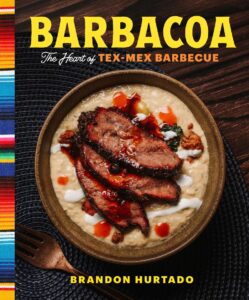
Barbacoa cookbook cover

Text and images excerpted with permission from Barbacoa by Brandon Hurtado, published by Harvard Common Press, (c) 2025. Images by Mason Griffin.


Garden & Gun has an affiliate partnership with Bookshop.org and may receive a portion of sales when a reader clicks to buy a book. All books are independently selected by the G&G editorial team.

tags: