When I was ten years old, my father and two friends of his bought a small lake in the country some forty-five minutes from Birmingham, Alabama, where we lived. They purchased the lake and eighty acres surrounding it in November, and over the winter my father supervised the building of a two-bedroom cabin on its shore, which, along with his demanding business, kept him too occupied to take himself or me fishing in the lake.

“Water’s too cold anyway,” he said to mollify me. “We’ll go in the spring when the bass are on the beds.”
So it is a mid-March day, my first outing on what my mother has named Lake Tadpole, though at fifteen acres it is more a large farm pond than a lake. My father is in the stern of our new jon boat, manning the electric motor, and I am in the bow with my first fly rod, an Abercrombie & Fitch Banty bass rod, burnt umber in color and eight feet in length, my father’s Christmas gift to me that winter. He is fishing a bait-casting rod with his favorite topwater lure, a Dalton Special. He is catching bass and I am not, largely because I have only the dimmest idea of what to do with my new fly rod. Despite hours of casting lessons from my father in our backyard, my yellow popping bug continues to fall either in the bushes or too far from the bank. But the air is mild and full of birdsong; the woods around the lake are abloom with dogwood, redbud, and wild azalea; and I am, after all, finally fishing on Lake Tadpole.
At the north end of the lake is a small, shallow bay with a dead tree lying across it. My father turns off the electric motor and we drift toward the tree. In a voice so certain he might have practiced it for months, he says, “Put it as close as you can to the end of the tree, Skip.” It is not as close as it should be, but the popping bug only touches the water before a bass blows up on it.
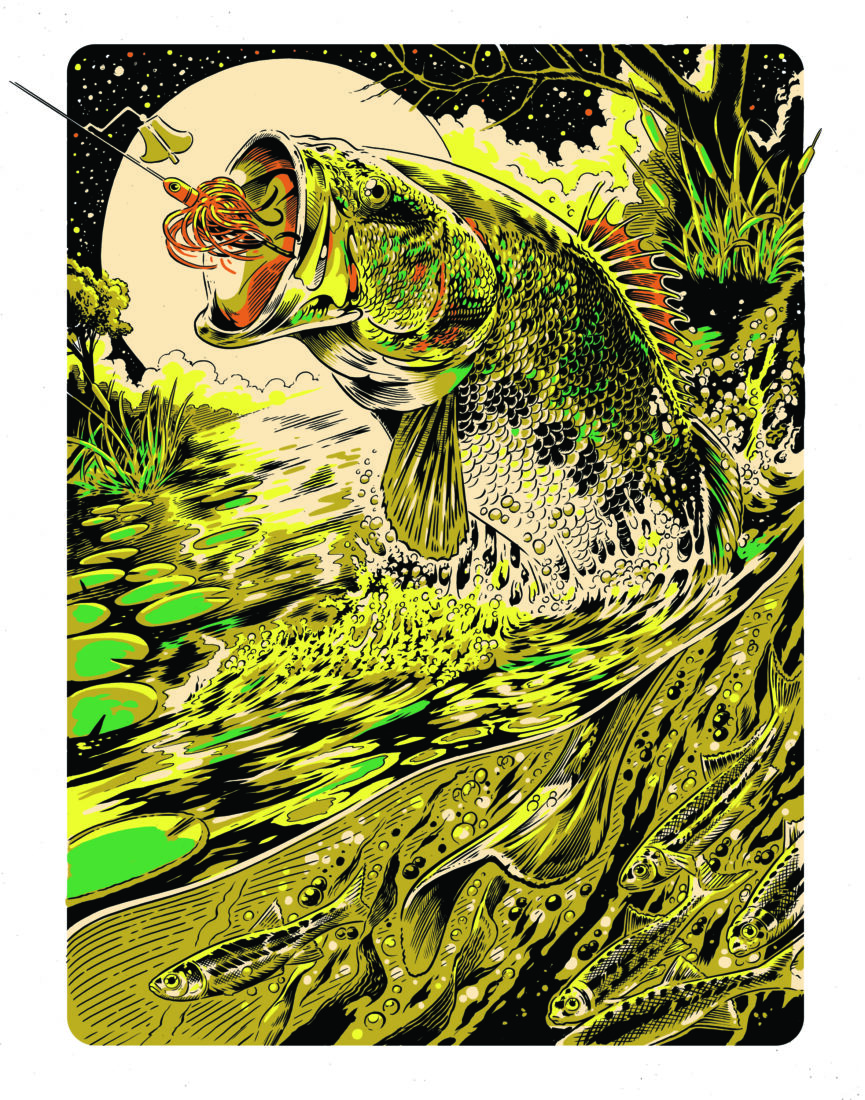
Somewhere I still have a photo my father took of me holding up my first bass by its lower lip. It was a female, portly with eggs, about two pounds. We released her, but from that moment on I remained hooked for life on largemouth bass.
Now, seventy-three years later, I live for half the year on Lake Tadpole and couldn’t begin to estimate how many bass I have caught there since that first one. I have also had the good fortune to fish for largemouths all over the Southeast and Midwest, in southern Canada, Mexico, and Cuba. I have fished for them not only with fly rods but with buzzbaits, swimbaits, and crankbaits, with Texas and Carolina rigs, with live minnows and night crawlers, and once even with hatchling robins. I have pursued them in rivers, creeks, and giant impoundments like Mexico’s Lake El Salto, possibly the best trophy bass lake in the world, and in countless farm ponds. No question there are spiffier species, and I have run around the world chasing most of them, but the bigmouth’s pure brio and generous, unfinicky character have made it what I always come home to—my querencia in the fishing world.
Here is an example of the largemouth bass’s irresistible largesse: When we were in the graduate writing program together at the University of Iowa, my great pal Dick Wentz and I discovered the Platonic ideal of a farm pond one day while driving around looking for pheasant covers. The pond belonged to a pig farmer named Rath, and he gave us permission to fish it, which we did for at least two days a week in the fall and spring. At about an acre and a half, the pond was covered with water lilies at one end and had a nice shoreline weed bed at the other. It had sloping banks, was deep enough not to winter-kill, and held some truly porky bass, fattened on the myriad frogs populating the water lilies.
Vance Bourjaily, my mentor and thesis adviser in the creative writing program, called me one April morning to say that a visiting writer was on campus to give a reading and he wanted to go fishing: Would Wentz and I take him to that secret pond we had? I would have done almost anything for Bourjaily since he was allowing Wentz and me to miss class whenever we wanted to fish or hunt and to put our “field notes” together as our MFA theses.
“Of course!” I said. “Who is it?”
“Ralph Ellison,” Bourjaily said. “He is dying to catch his first bass. He even brought a rod with him.”
Author of the great American novel Invisible Man, Ellison was an icon to us graduate writing students, and Wentz and I determined to do whatever we had to do to get him a good bass. We arrived at the pond an hour before Bourjaily was to drop him off there, bringing with us a tackle shop’s inventory of lures and flies for any sort of rod Ellison might have—except for the one he had. It was a collapsing ten-foot bamboo pole with about twelve feet of heavy monofilament tied to the end of it: no reel, no guides.
The three of us talked for a while, sitting on the bank in Wentz’s camp chairs. Ellison was a gracious, soft-spoken man with a world of stories, and he immediately dispelled the unspoken anxiety Wentz and I were feeling about how to catch him a bass on his cane pole, one, he told us, he had only used a couple of times for panfish in Massachusetts. He also had with him a plastic bag of hooks and a bobber. Maybe, he said, we could dig some worms?
“I’ve got a better idea,” Wentz said, and he often did. “Just wait here a minute.”
Ellison and I watched him wade out into the lily pads almost to the top of his hip boots and commence poking his hand down into them. In a few minutes he was back, holding a squirming, world-record-sized bullfrog. Hooking the frog under the tough skin on its back, he led Ellison down to the lily pads and instructed him to toss the frog into a little opening in them…
The rest, brothers and sisters, is angling history. With an inexhaustible supply of bullfrogs and just as many bucketmouths generously obliging to eat them, it was the best afternoon of bassing that Ralph Ellison, or almost anybody else, ever had. Five years after that day, Bourjaily told me the great novelist was still talking about how he came to fall in love with largemouth bass.
See the other articles in our For the Love of the Game collection:
In Pursuit of the Ancient Tarpon of the Everglades, by Monte Burke
The Heart-Pounding Rapture of a Wood Duck Morning, by T. Edward Nickens
Man vs. Turkey: The Quest to Outsmart a Gobbler, by David Joy
Chasing Chinook—and Family Memories—in the Waters of Alaska, by Kim Cross
A Quail Hunter’s Ode to the South’s Signature Game Bird, by Russell Worth Parker