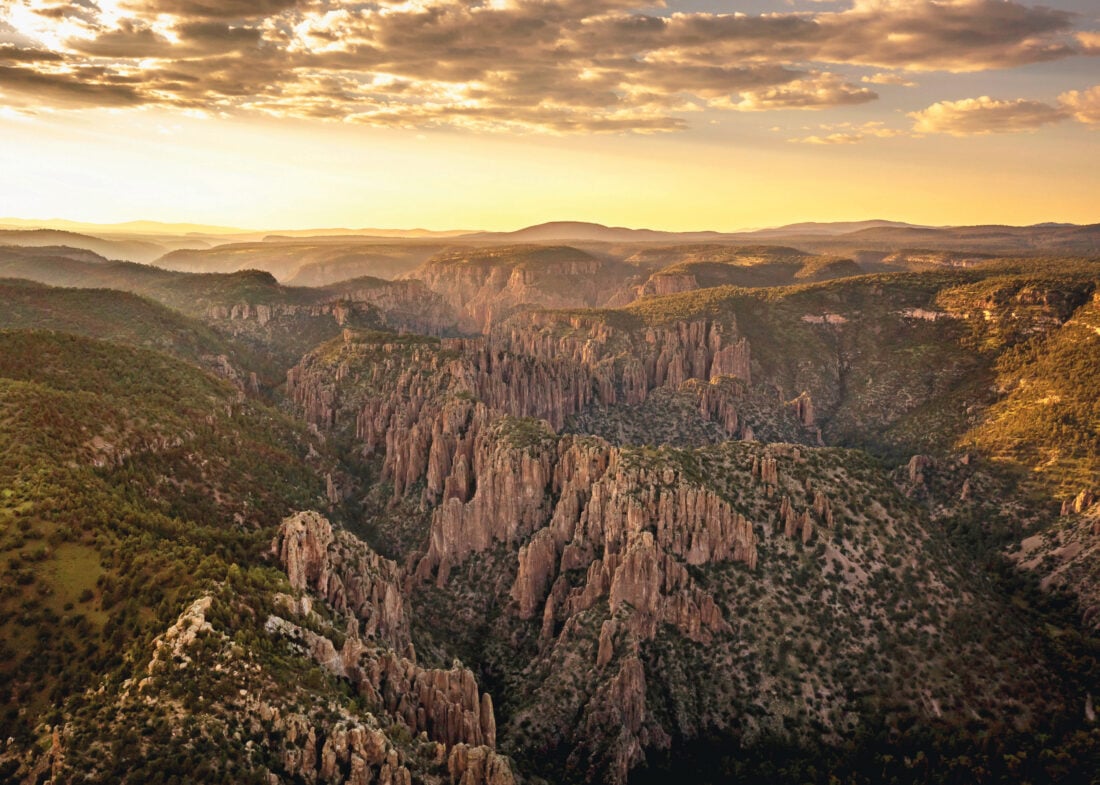
I stood in the mouth of a cliffside cave in New Mexico, looking out at a narrow canyon of welded volcanic tuff and rugged sedimentary rock. Behind me rose the Gila Cliff Dwellings, the ruins of a village the Mogollon people built in the 1200s. Below ran a tributary of the Gila River, at whose headwaters Geronimo was born. I couldn’t help but imagine boy-Geronimo staring up at these ruins, abandoned even in the heyday of Apachería. The wind soughed through the canyon. It seemed a haunted site, though not unkindly so.

This was my first taste of the Gila Wilderness, the nation’s (and world’s) first legally designated wilderness area, and a place that would draw me back and back again. It’s “an area where the earth and its community of life are untrammeled by man,” the Wilderness Act describes, “where man himself is a visitor who does not remain.” No vehicles are allowed, not even a bicycle; all visitors must enter on foot or horseback, as humans did for centuries.
But it was a bad set of wheels that got me here in the first place. Though I was raised on the Georgia coast, I’d fallen in love with the West as a boy, thanks to road trips with my family. So, amid the pandemic, I decided to drive my GMC camper van from my home in Savannah across the country, only for the aging rig to break down right on the edge of the Gila. It was to be my most fortuitous mechanical malfunction yet. I camped on an active ranch, feeding fresh-fallen apples to the horses, and sought out a mechanic in the nearest town, Silver City. I rode the back roads on my two-wheeled “dinghy”—a dirt bike I kept on the rear bumper of my van. As I spoke to local hunting guides, rangers, and outdoor enthusiasts, a new novel set its teeth into me. In fact, much of Wolvers was written with the dirt of the Gila still on my skin. I hiked to hot springs, waded across forks of the Gila River, explored ghost towns, and marveled at the high walls of Whitewater Canyon—an old hideout of both Geronimo and Butch Cassidy. All the while, I kept my eyes peeled for that most elusive of Gila creatures, the Mexican wolf.
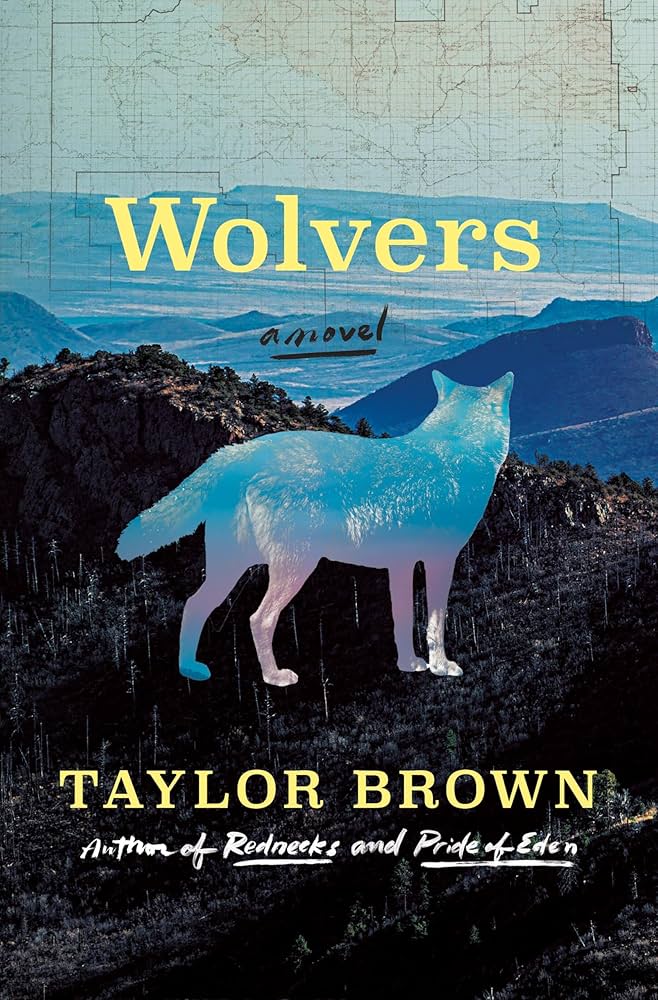
The Gila Wilderness—and the greater Gila National Forest that encompasses it—is home to the most endangered gray wolf subspecies in the world. Fewer than three hundred “lobos” remain in the wild. In fact, it was a Mexican wolf that inspired the naturalist and author Aldo Leopold to seek protection for the area. In 1912, Leopold, working as a Forest Service ranger in New Mexico, shot a Mexican wolf from the high rimrocks above a white-water river. Years later, he memorialized the experience in his classic text, A Sand County Almanac:
We reached the old wolf in time to watch a fierce green fire dying in her eyes. I realized then, and have known ever since, that there was something new to me in those eyes—something known only to her and to the mountain. I was young then, and full of trigger-itch; I thought that because fewer wolves meant more deer, that no wolves would mean hunters’ paradise. But after seeing the green fire die, I sensed that neither the wolf nor the mountain agreed…
As Leopold watched “wolfless” mountains “wrinkle” with new deer trails, trees and bushes browsed to death, and inflated deer herds die of famine, he realized that stripping predators from the landscape upset the natural order of entire ecosystems. He was also an early witness to the loss of wildlands to development of every stripe. In 1921, he proposed setting aside 755,000 acres of the Gila National Forest as a “stretch of country preserved in its natural state, open to lawful hunting and fishing, big enough to absorb a two weeks’ pack trip, and kept devoid of roads, artificial trails, cottages, or other works of man.” In 1924, with the Forest Service’s approval, the Gila Wilderness was born.
My first visit was several summers ago, but now, ahead of my new book’s release, I’ve returned again to the Gila. This time I want to reach the fire tower atop Bearwallow Mountain, one of the highest peaks in the area and a setting in the novel. It will be no easy feat—a fifty-five-mile round trip of rough road and rocky trail. Fortunately, I’ve brought an ace up my sleeve: “Bowser,” my 1985 Honda XR350R, a vintage dirt bike I’ve hauled cross-country in the back of my truck, permitted only because Bearwallow stands outside the Wilderness itself.
It’s July, and I have to wait out several wildfires before I can enter the forest. Finally, I take an old ranch road, weaving high into the Mogollon Mountains. I turn onto Copper Creek Road, which, true to its name, is no more than a creek bed so rough I’m nearly bucked from the foot pegs for mile after jarring mile. Inevitably, the bike and I take a hard tumble and fuel floods the engine, causing it to stall. A storm is moving in, and visions of flash floods fill my head—there’s ample evidence this dry creek could become a torrent.
With a proper mix of curses and pleas to the darkening heavens, I kick Bowser back to life and reach the summit just as the storm hits. Rain lashes, thunder cracks, and a voice booms down. It’s the fire lookout hollering from the tower, telling me to take shelter on the porch of the cabin where she lives during fire season. Once the threat of lightning passes, I climb the tower’s steep metal stairs and pass through a small hatch in the floor of the seven-by-seven-foot “cab,” which gives a 360-degree mountain view. The lookout’s name is Rázik, and she’s served in the Gila for thirty-five years. She wears a wide-brim hat, circular black-rim glasses, and a nose ring. Her face has a friendly glow that warms my cold bones. Around us, the mountains have become a great sea of storm cells and wildfires.
Between radio transmissions, Rázik shows me how to work the ancient Osborne Fire Finder—a brass-sighted device developed in 1915 to determine the azimuths of distant smoke columns. Together we watch a helicopter thunder low over the mountains to pull out a team of specialized “helitack” firefighters. As it turns out, they’ve just extinguished a start-up along a less rocky return route, which Rázik outlines for me.
Riding down through the rain, I’ll pass a smoke-stained firefighting crew who apprise me of the creek levels ahead. Later I’ll help a man with the improbable name of Yorick—just like the “fellow of infinite jest” from Hamlet—raise a wall of his remote cabin outside the ghost town of Mogollon.
But before I say goodbye to Rázik, our talk turns to wolves. A light rises in her eyes. She describes hiking in the Gila not long after the U.S. Fish & Wildlife Service reintroduced the first Mexican wolves back into their ancestral range in 1998. She’d taken a rest along the trail when she felt eyes on her back and turned to find a she-wolf staring at her. The animal’s radio collar confirmed her as a Mexican gray.
Rázik felt no fear. Most seasoned hikers and hunters know that wolves pose no danger to humans despite the villainies ascribed to them—never in recorded history has a wild wolf killed a person in the Lower 48. Rather, she related a sense of wonder and kinship, almost like the borders between species had become fluid. I’ve heard such stories of recognition when people make eye contact with wolves, lions, even whales—as if the souls inside these creatures long to touch our own. Tears filled Rázik’s eyeglasses as she told me the story. Later I couldn’t help but think of that line from Hamlet: “There are more things in heaven and earth, Horatio, than are dreamt of in your philosophy.”
Taylor Brown is the author of In the Season of Blood and Gold (Press 53, 2014), Fallen Land (St. Martin's Press, 2016), The River of Kings (2017), Gods of Howl Mountain (2018), Pride of Eden (2020), Wingwalkers (2022), and Rednecks (2024). You can find his work in The New York Times, The Wall Street Journal, and The Bitter Southerner in addition to Garden & Gun. He is a recipient of the Montana Prize in Fiction, a Georgia Author of the Year, a three-time finalist for the Southern Book Prize, and the founder of BikeBound.com. He lives in Savannah, Georgia.
Garden & Gun has an affiliate partnership with Bookshop.org and may receive a portion of sales when a reader clicks to buy a book. All books are independently selected by the G&G editorial team.