

Travel
All Aboard Amtrak’s New Mardi Gras Service
Riding the revived line from New Orleans to Mobile (or vice versa) takes about four hours. But for a dedicated and hungry train-iac, it’s also an opportunity to explore the Gulf Coast flavors along the way.
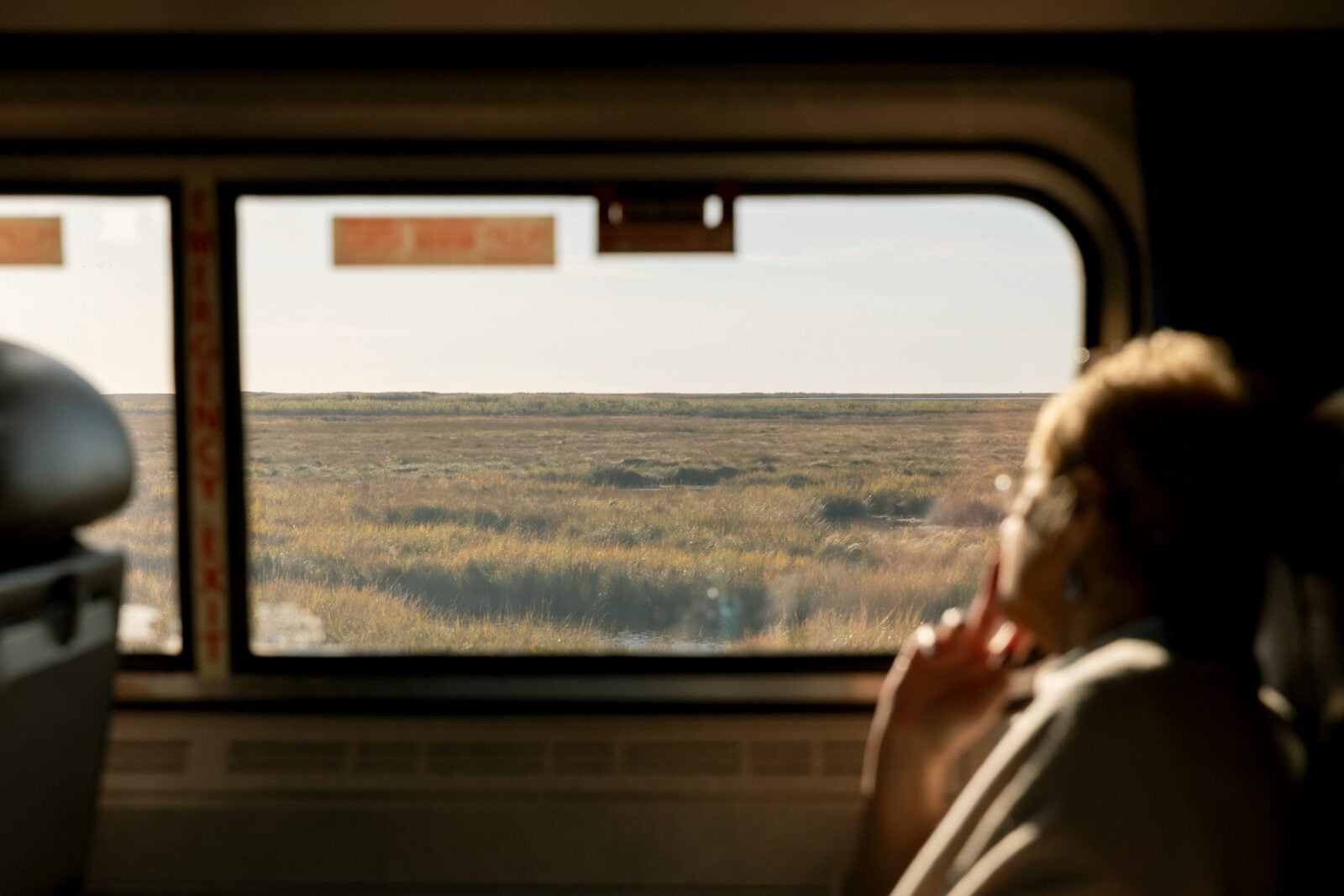
Photo: CEDRIC ANGELES
A window-seat view.
Train 24: 7:35 a.m.
New Orleans to Pascagoula
One of the best things about a train journey is how it begins: no hubbub, no ceremony. You walk on, sit down, and, when the time comes, you simply begin to roll. Forward. Out into the world.
So it was one early fall morning at New Orleans’ Union Passenger Terminal. Train 24’s engineer gave two short toots of the horn, and the platform began to slide past the window. Soon we were rocking gently as we crawled past the Superdome, its purple lights cross-fading into the lightening morning sky. We creaked past the jail, a tire yard, a seafood plant, and the miniature metropolis of an aboveground cemetery, picking our way through the sleeping city. Then, all of a sudden, we were free and picking up speed, gliding across marshland and open water toward Mississippi. I thought of the opening line of Paul Theroux’s classic train travelogue, The Great Railway Bazaar: “Ever since childhood, when I lived within earshot of the Boston and Maine, I have seldom heard a train go by and not wished I was on it.” I was very happy to be on this one.
Last August, Amtrak debuted the Mardi Gras Service, running between New Orleans and Mobile. (The name reflects a supposed rivalry over Mardi Gras ownership between the two cities, which is a matter of great importance to Mobilians and great amusement to New Orleanians.) Resurrecting a line that had last operated before Hurricane Katrina, the service marked Amtrak’s first return to the Gulf Coast in twenty years.
Rail buffs, who haven’t had a whole lot to celebrate this century, greeted the new train as something of a miracle. In less than four months, some forty-six thousand riders climbed aboard, doubling the number Amtrak had anticipated. For special occasions, like Saints home games, an extra car had to be added. A kind of fellowship of the rails sprang up. Riders posted pictures of their favorite conductors. They traded tips and answered questions (an excessive number of them about the temperature in the cars and parking at the stations). Meanwhile, a mini-ecosystem of greeters, bike shares, golf cart rentals, and other train-adjacent businesses began to arise at the new route’s stations. In between its endpoints, the line stops in four coastal Mississippi towns: Bay St. Louis, Gulfport, Biloxi, and Pascagoula. My plan was to explore all four, with a special eye toward what one might find to eat in each one.
My corollary to Theroux’s opening line is that I’ve seldom been on a train ride that I didn’t wish was just a little bit longer. And here lay the problem: The entire route from New Orleans to Mobile takes about four hours, with some stops barely more than twenty minutes apart. That’s too short even for a train nap, which everybody knows is the greatest nap of all. There are only two trains per day in each direction—early morning and early evening—which meant I would need to get a little creative to hit each town, especially at mealtimes.
Sitting down with a timetable and map, I plotted out a back-and-forth itinerary, hopscotching up and down the coast for three days. It might not be Theroux’s four-month odyssey, but at least I could have my own epic rail journey.
Now we were shooting across the eastern edge of Lake Pontchartrain, the train and the track so matched in width that it seemed as if we were hovering over the open water. Sportfishermen bobbed in small boats below; a dolphin arced briefly and disappeared; on each pylon of an otherwise long-washed-away dock, a single pelican sat watching us.
Soon we came to the first stop, Bay St. Louis. I would disembark here on my way back, but for now, I was going on, all the way to Pascagoula. This left me hungry, but I had devised a solution: When I was a child, my parents often played me the Kingston Trio’s “Charlie on the M.T.A.,” a mock protest song about a man stuck on the subway because the fare has been raised by five cents. Every day, as he rides through the stations, his wife passes him a sandwich through the window. (“Why doesn’t she pass him a nickel?” my father used to ask.) Ever since, I have wanted a sandwich handed to me through a train window.
I found willing accomplices in Shannon Arzola and her chef-husband, Octavio. The couple own Tavi’s Salumeria, a sandwich shop just a few blocks from the next station, Gulfport. Octavio is Spanish, but his menu roams Europe, lingering longest in Italy. I was tempted by the sandwich called Dante’s Inferno, which includes hot capicola, spicy ’nduja, hot olive salad, and several other ingredients honoring its namesake, but, given the hour, I decided on a more breakfast-friendly option, a version of a Parisian jambon beurre.
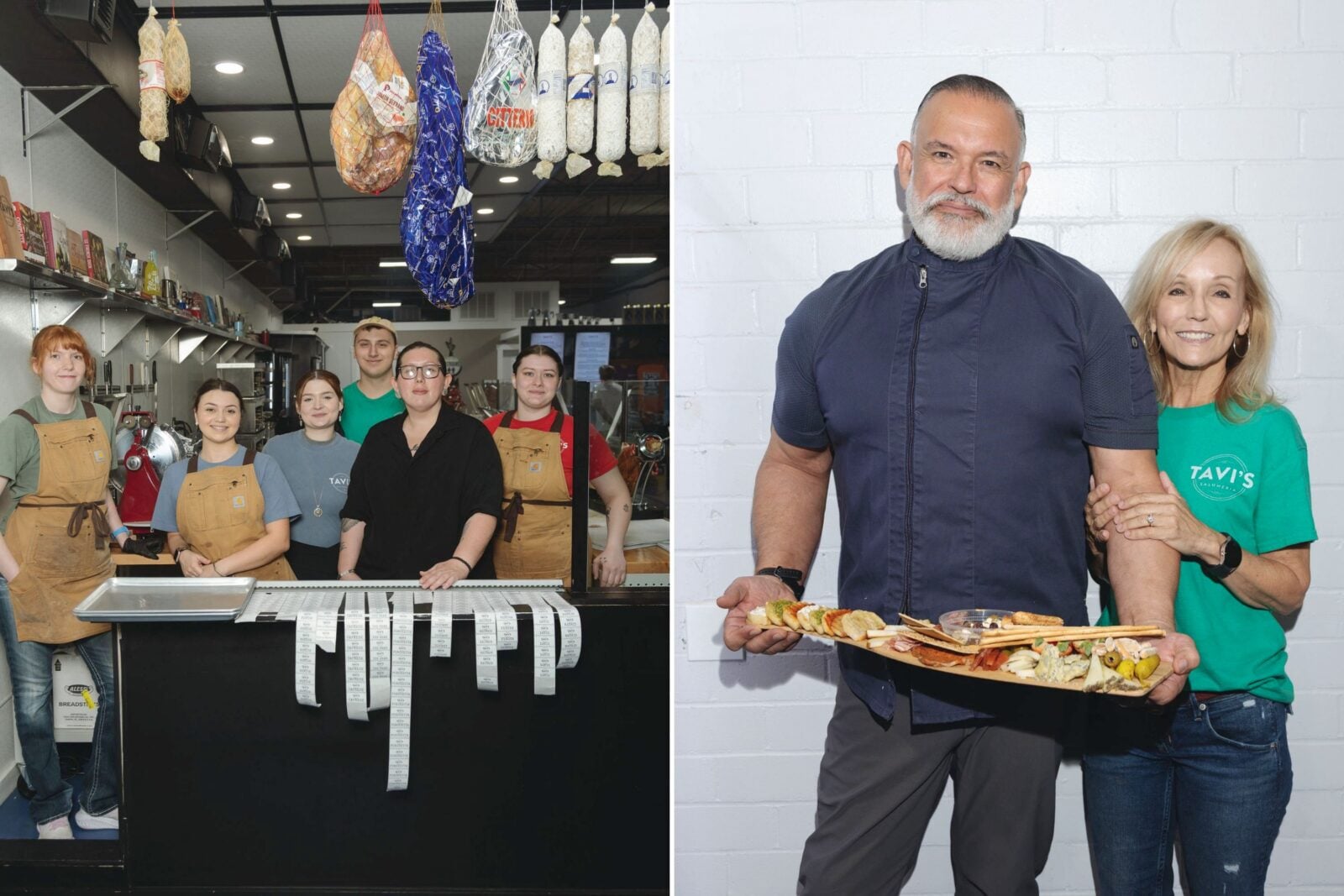
Photo: CEDRIC ANGELES
The staff at Tavi’s Salumeria; Octavio and Shannon Arzola, the owners of Tavi’s.
It turns out I had missed a crucial detail: Amtrak’s windows don’t open. I waited anxiously as we pulled into Gulfport and the conductors, Chelsea and Ray, lowered the boarding steps. Stepping down onto the platform, I saw a few riders waiting to board, but no sandwich in sight. I glanced at the time; Chelsea glanced at me. Then a figure appeared hurrying alongside the track, holding a white paper bag. Out of breath, Shannon arrived and pressed the bag into my hand just as Ray called out, “All aboard.”
“Is that from Tavi’s?” Chelsea gasped as I climbed into the car. “Their foie gras potato chips are amazing.”
“And that portobello mushroom sandwich is for real,” Ray agreed.
Pascagoula was quiet. Eerily so. I crossed the empty street from the station and set my bag down on the patio at the District Coffee Company, located in an attractively remodeled bank drive-through, and thought about how I might spend the six and a half hours before my next train.
District Coffee’s owner, Warren Collmer, told me that Pascagoula has not yet enjoyed the boom that neighbors like Ocean Springs have seen in recent years, in part because it largely sits in a designated flood zone. He and other local business owners hoped the train might help speed things along. The 121-year-old depot itself is being renovated by Gulfport’s Chandeleur Island Brewing Company, and will soon house a new brewpub.
I rented an e-bike from a local bike share company called Tour de Coast—it rousingly played the theme from Rocky each time I started out—and pedaled through the small downtown and then down along the beach to where I could see the massive profile of the Ingalls Shipbuilding plant across the water. White mansions and heavy live oaks, dripping with Spanish moss, lined the road. The houses were mostly new, built since Katrina wiped out almost everything along this coast; the trees had somehow survived that, and probably worse.
Having worked up an appetite, I biked a short way out of downtown toward Bozo’s Grocery & Grill, a local institution so popular that its owners keep having to add on to it: There’s the retail and po’boy shop, which opened in 1957; Bozo’s Too, a sit-down seafood restaurant; and finally an outdoor oyster bar with a music stage called Bozo’s 2.5. At the original space, which still sells grocery items on a handful of shelves, I ordered a cup of gumbo and a four-inch shrimp po’boy, an innovative and perfect size seemingly designed for those eating multiple lunches.
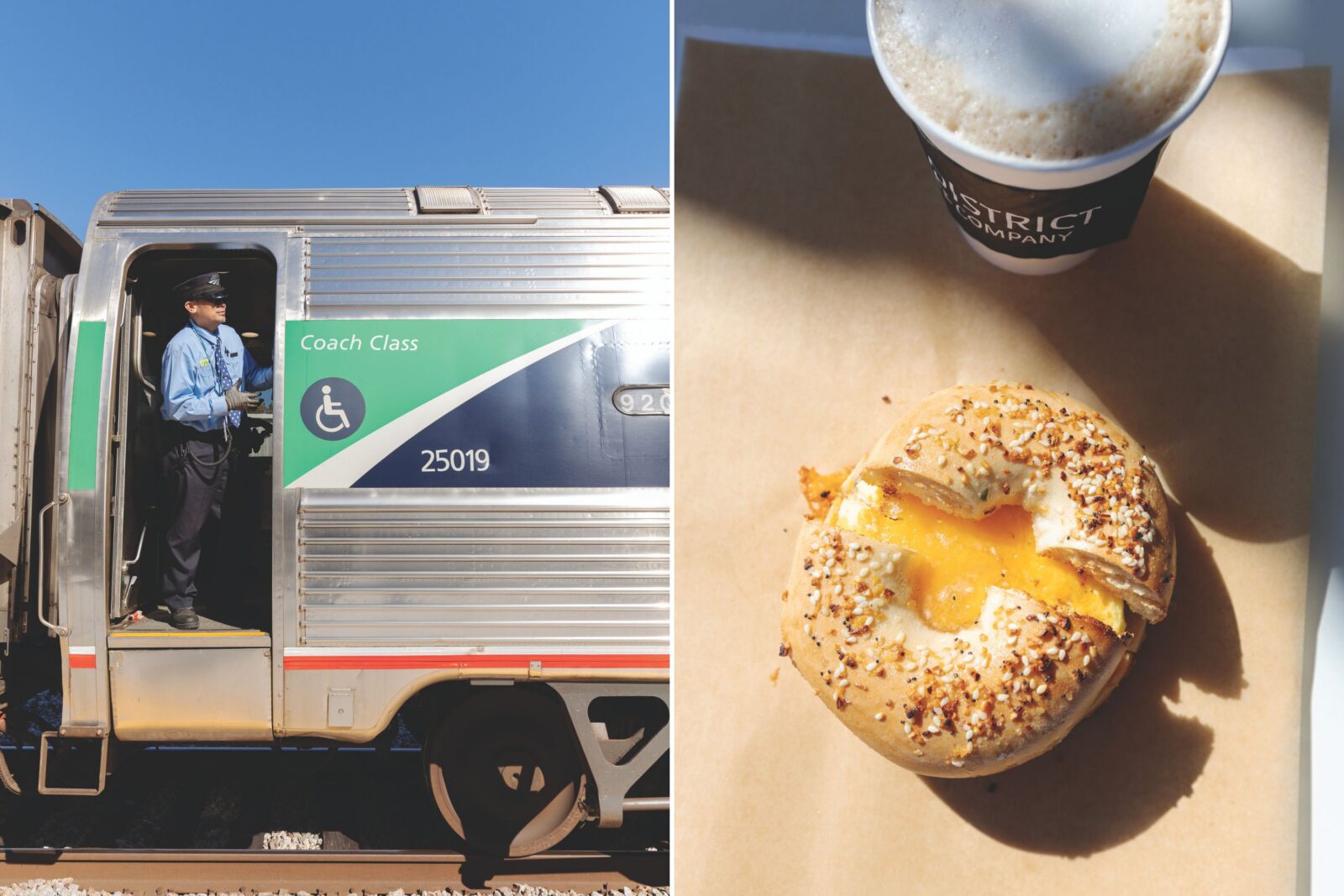
Photo: CEDRIC ANGELES
An Amtrak conductor aboard the Mardi Gras Service; a breakfast bagel at the District Coffee Company.
In the back of the store sat a fish counter with basins of raw shrimp on ice. A handwritten sign stressed that everything (aside from a small amount of Argentine red shrimp) came from the nearby Gulf. This was a new development that I would see several versions of over the next few days. Thanks to a number of recent well-publicized scandals and new legislation, the subject of seafood fraud has been pushed into the public consciousness throughout the Gulf South.
At Czak’s, back near the train station, the blackboard menu listed tripletail—one of the Gulf ’s most delicious and least-seen fish. When I casually confirmed that this was so, a wiry man with a mustache charged out of the kitchen, offering to show me “the damned invoices to prove it.” I assured him I didn’t need them, and he introduced himself as chef and owner Joshua Walczak. Full of energy and conversation, he said that he opened his restaurant last April, after years of cooking at another seafood place down the street, the cause of some mild neighborhood tension. He went back into the kitchen and returned with a photo of the tripletail on his phone, for my approval. Soon after, I was enjoying it as a lovely and simple grilled fillet, with a side of new potatoes in crab boil spices.
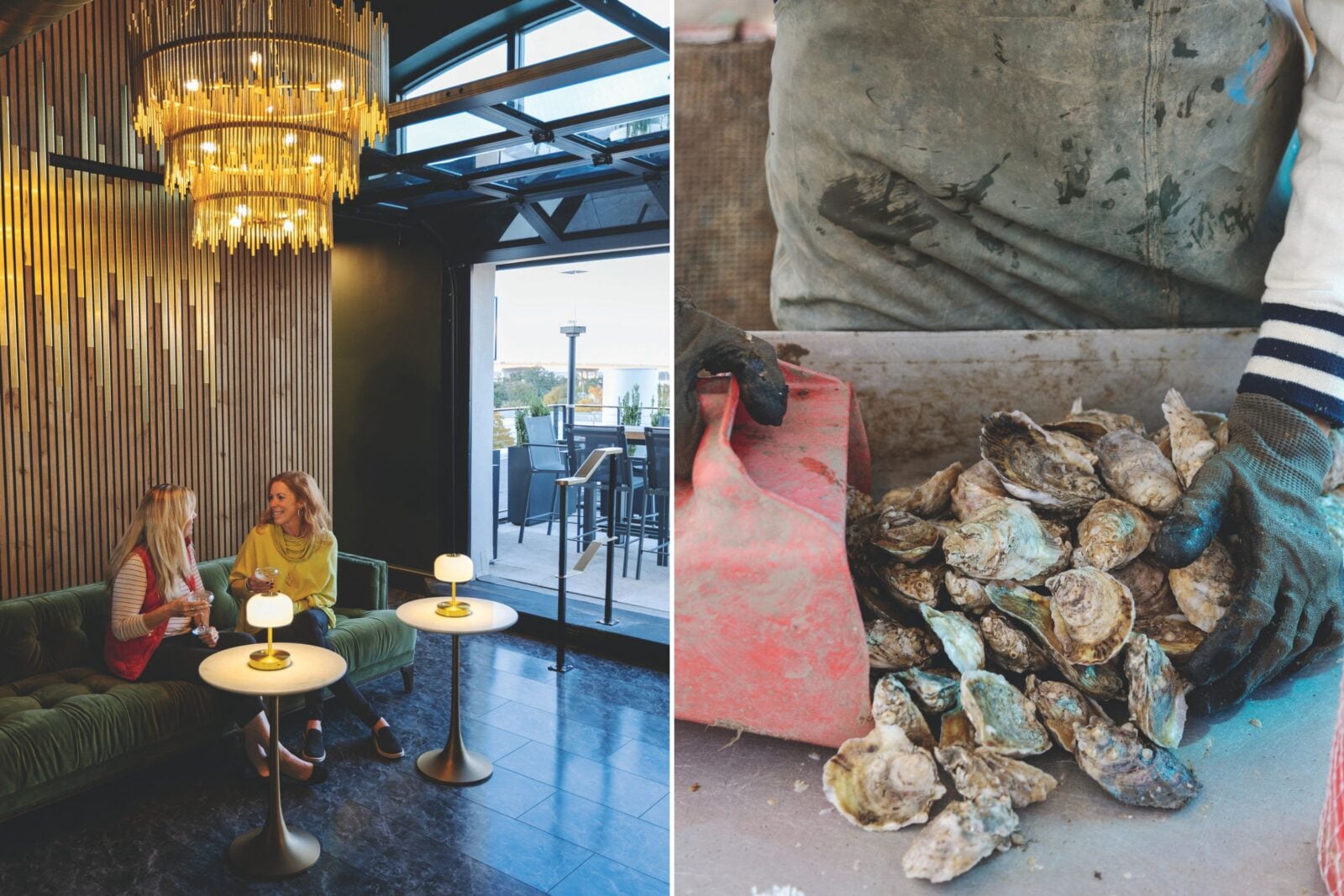
Photo: CEDRIC ANGELES
Guests at the Hancock rooftop bar in Pascagoula; local oysters.
By now the afternoon was winding down. I dashed up to the Hancock, a bar on the roof of the former Hancock Bank building, City Centre. The view took in the entirety of downtown, an expanse of the deepening blue Gulf, and the long strip of railroad track stretching into the distance. I ordered an old-fashioned in a go-cup and considered grabbing one of the charcuterie boxes, assembled by the local Blind Butcher Shoppe. It would have made a nice train snack, but I had dinner plans at a speakeasy back in Gulfport.
Train 25: 5:13 p.m.
Pascagoula to Gulfport
I could hear the westbound train before I saw it—the warning bells at each successive crossing getting closer and closer, until the engine and three passenger cars slid into the station. My morning conductors had remained in Mobile, but the dining car was still manned by Ms. Dee, who was heading home to New Orleans. An Amtrak veteran, she said she’d spent years working both the Crescent, to and from New York, and the famous City of New Orleans connection to Chicago. (My family and I once celebrated July Fourth on the “City,” as the conductors call it, watching fireworks flash in the night as we sped through small Mississippi Delta towns.)
Amtrak has made some gestures toward local flavor in the dining options. Zapp’s potato chips are on offer, along with pralines and Community Coffee. There’s also a muffuletta, which is Ms. Dee’s favorite, though she tries to limit herself to just one a week.
Each train has its own character, she told me: The New York route gets ruder the farther north you head. On the southbound City, things get rowdy around Memphis, in anticipation of letting the good times roll in New Orleans. The Mardi Gras Service, she said, has been all good vibes so far.

Photo: CEDRIC ANGELES
The train at Union Passenger Terminal in New Orleans; water all around.
I could feel them for myself. Part of it was simply how exotic train travel is for most Americans. The passengers made their way to their seats with the look of kids boarding a merry-go-round. They gazed out windows, wide-eyed; they kept track of our velocity on their phones. I met one Mobile couple who were riding to Gulfport just to visit TrainTastic, which bills itself as “the world’s largest model railroad museum.” The man had been a train freak ever since getting a short ride on a freight locomotive as a kid, but this was his first passenger journey. When the train pulled up in the station, he saluted.
The sun was setting as we passed back through Biloxi. Down each street, you could see straight to the Gulf, a brief flash of open water, glowing pink and orange. My eyes began to droop as the car rocked, but then we were pulling into Gulfport.
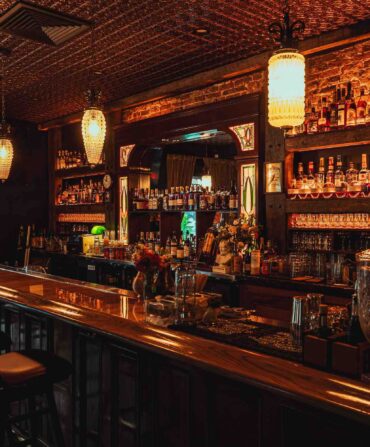
The word speakeasy has been much overused in recent decades. But it feels appropriate to the experience of coming in off Gulfport’s quiet streets into the small Hotel Vela, pushing open a door, and finding oneself in the upholstered, tropical jewel box that is Siren Social Club, which Mississippi natives and Biloxi restaurateurs Austin and Tresse Sumrall opened in late 2024. I settled into an expertly made rum Manhattan, a crystal goblet of crab ravigote, and what was almost certainly the only (or at the very least the best) slice of beef Wellington being served on the Mississippi Gulf Coast that night. Then it was off to one of the Vela’s cozy rooms, itself reminiscent of a railroad compartment. I could almost feel it rocking.
Train 24: 9:31 a.m.
Gulfport to Biloxi
For years I’d heard the rumor: Hidden away in one of the casinos that dominate the Biloxi skyline, there exists a secretly fabulous spot for pho, the classic Vietnamese noodle soup. This made sense; Biloxi and its surrounding area have long had one of the highest concentrations of Vietnamese people on the Gulf Coast. Still, the prospect of a mysterious soup genius, minding his bubbling stocks and broths somewhere deep inside a soulless casino, seemed too tantalizing to be true.
So here I was, at 11:00 a.m., wandering amid slot machines and empty game tables in the stale-smoke air of the Scarlet Pearl Casino Resort, in nearby D’Iberville. I was waiting to doorbust a restaurant called Chopstx, which a little detective work suggested might be the place.
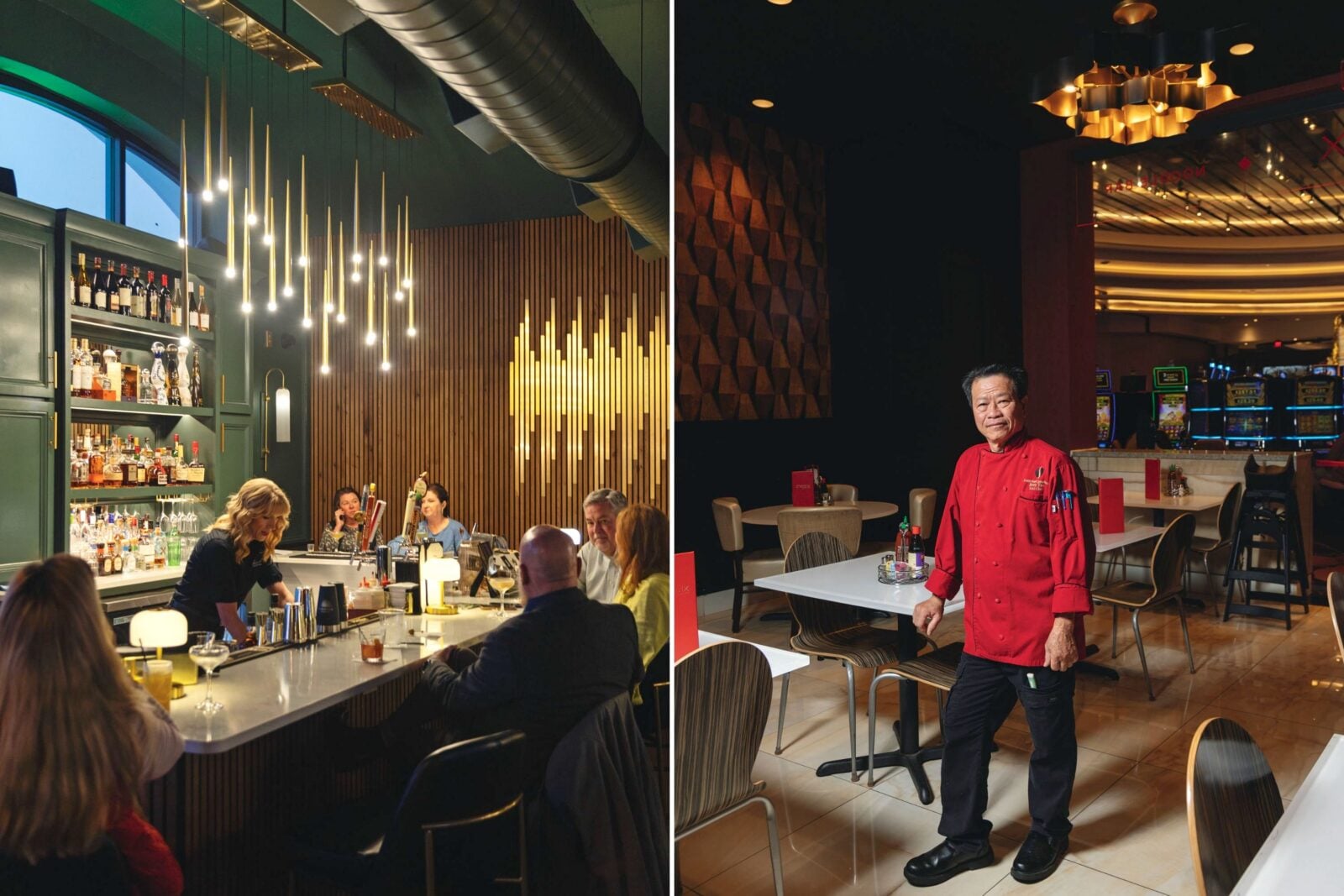
Photo: CEDRIC ANGELES
Lead bartender Angela Robertson at the Hancock; Chopstx chef Khuong “Jimmy” Tran.
Earlier that morning, Ms. Dee, on her way back to Mobile, had poured me a cup of coffee as I boarded the train heading back east. In Biloxi, I’d checked into the Bella Downtown, a hotel a block from the station and featuring suites that you might call aggressively designed, each with a musical theme (I was in the “Rocker’s Rhapsody,” with a Bono throw pillow and a portrait of Jim Morrison). At the hotel’s stylish café, BrewPaddle, I’d had a fine chocolate croissant before jumping into a rideshare to the Scarlet Pearl.
Now a server finally moved the stanchion that had been blocking the Chopstx entrance, and I took a seat at the counter. The combination beef pho came out fragrant and steaming, with a deep meaty flavor and bouquets of fresh green herbs on the side. The slices of brisket were lush and beefy, the meatballs firm and peppery. From the nearby casino floor I heard a clatter of ringing bells: jackpot.
The person in charge of making the pho is sixty-five-year-old sous chef Khuong “Jimmy” Tran, who soon appeared behind the counter. Tran came to America at fifteen, in the first wave of Vietnamese refugees following the fall of Saigon. He had worked as a shrimper, a welder, and a handyman, but never a cook, until eight years ago, when he helped cover a friend’s shift at the Scarlet Pearl. Since then, he has developed his signature broth, which takes twenty-four hours to cook. He makes 135 gallons of it twice a week, as well as other stocks: a rich, lemongrass-infused base for bun bo hue, and a more delicate and warming chicken broth. Meanwhile, the excellent handmade pork and shrimp dumplings are the work of one of the servers, Khac Thanh. The other server, it turned out, was an aspiring social media food star, under the handle Brenda Can Eat. “If I didn’t work here,” she said, “I would definitely put it on my TikTok.”
Sloshing a bit, I rideshared back to Biloxi, then rented another e-bike to traverse the windy causeway into Ocean Springs. More than any other Mississippi coastal town, Ocean Springs has been the beneficiary of a new artsy energy (and second-home money) from New Orleans and elsewhere. It is anchored by the wonderful Walter Anderson Museum of Art. At CRAVE Food Hall, which opened last year as part of a hotel development in the center of town, I ran into a familiar face: Wilfredo Avelar, the onetime executive chef for Emeril Lagasse who nearly ten years ago opened Mawi Tortillas in suburban New Orleans. I knew that Avelar had added a branch of Mawi at the food hall but not that he had also relocated his family to Ocean Springs. In addition to Mawi, with its popular birria and other Mexican and Central American specialties, he has a stall called Shorelines Coastal Kitchen, highlighting Gulf seafood in dishes like a rich gumbo, a blackened drum sandwich, and a fried oyster BLT.
After downing a plate of deviled eggs topped with trout roe, I asked Avelar if he wanted to tag along to the French Hermit Oyster Company. We hopped in his SUV and drove across a bridge to the edge of an estuary, just outside of town. French Hermit turned out to be unlike any business I’d ever seen. The company farms bright, briny oysters at a spot just south of nearby Deer Island. Then it sells them at a building overlooking a picturesque expanse of marshland, at which you can eat them. You might think this is the description of a “restaurant,” but—and I suspect this is an important legal distinction—French Hermit is not one. Instead, you buy sacks of oysters and then rent a “kit,” which includes such items as an oyster knife, a safety glove, the makings of cocktail sauce, and ingredients for chargrilling. Whatever you choose to do from there, you are made to understand, is not French Hermit’s concern—though if you happen to be inclined to take your oysters, along with some beers, out onto the deck, where there just happen to be builtin shucking stations, hand towels, hot grills, and every other accoutrement you might need for oyster consumption, well, who are they to stop you?
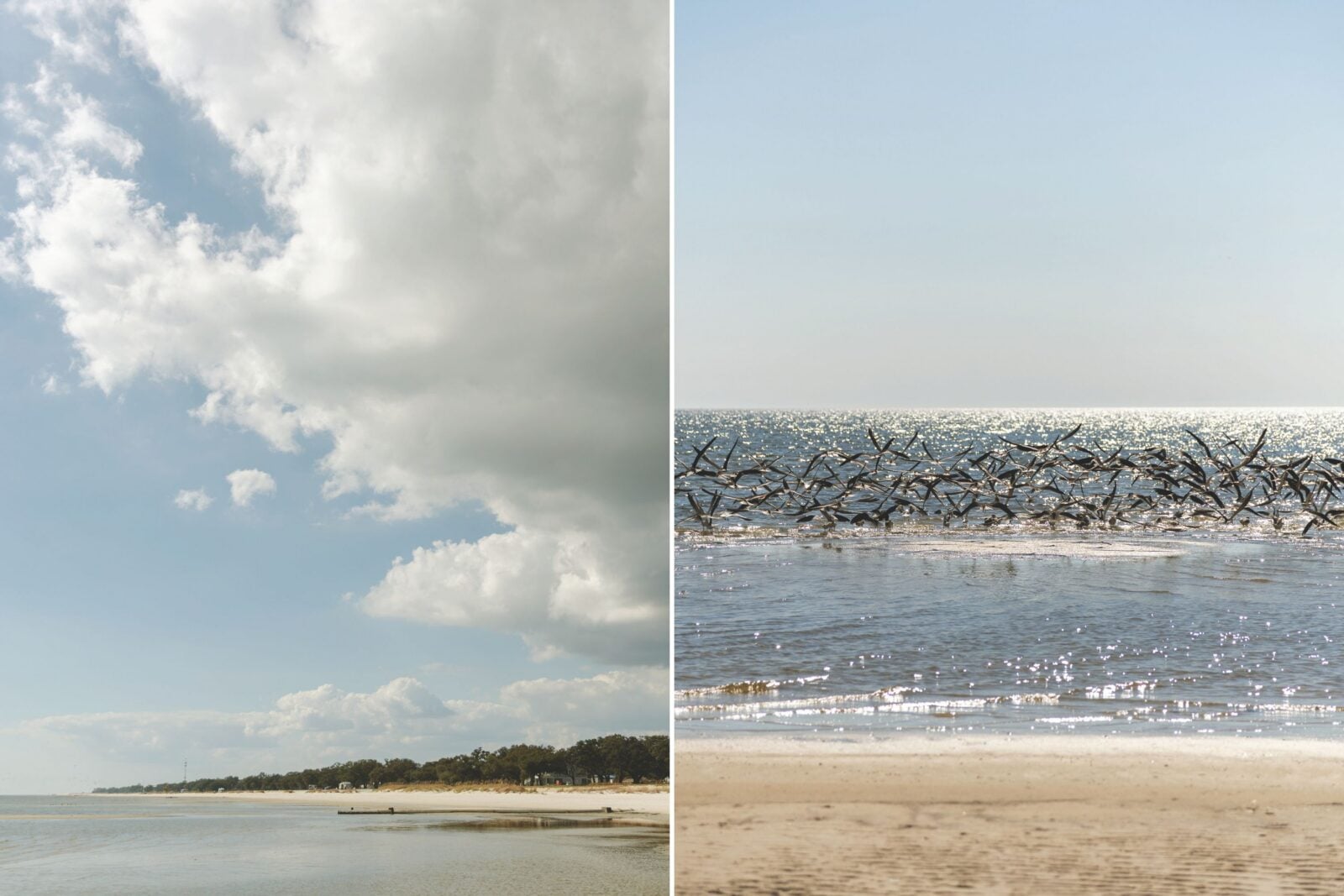
Photo: CEDRIC ANGELES
A view of the coast.
Luckily, I’d brought a chef. Avelar deftly shucked a few dozen oysters, topped half with breadcrumbs, shredded Parmesan, and garlic butter, and soon we were alternating grilled and raw slurps while gazing out at mullet jumping in the blue water, great blue herons flying by. It was the kind of place where one could suddenly look up to find that darkness had fallen and five hours had passed.
Instead, I pulled myself away for dinner at Vestige, Alex Perry and Kumi Omori’s justly praised restaurant in downtown Ocean Springs. When national acclaim began rolling in, shortly after Vestige adopted a tasting-menu format during COVID, it was easy to imagine that the improbability of the restaurant’s location might be playing an undue role. Six years and several James Beard Award finalist spots later, the setting is still improbable, but the food speaks clearly for itself. The best of Perry’s dishes are precise, layered marriages of local and cosmopolitan—a square of black sea bass, for instance, set atop a creamy matsutake-mushroom-studded congee and capped with a disk of jellified matsutake: modernism up top; comfort down below. Or a bowl of chawanmushi, Japanese steamed egg custard, that was not quite set but still delicious in its smoked tea broth and topping of both Burgundy truffle and pickled local magnolia strands. For all those fireworks, a simple square of red mo-chi cornbread, baked by Omori as part of a midcourse bread basket, may have been the best single bite I had my entire trip.
Train 23: 7:48 a.m.
Biloxi to Bay St. Louis
And so, westward once more! Bay St. Louis is a kingdom of golf carts. Whittney Taylor, of Coast E Cruizers, which rents them as well as e-bikes, was waiting for me with one at the station. “You can’t get lost,” she assured me, handing over the keys. Indeed, within ten minutes, I felt as though I had the town pretty well mapped.
I rode past the courthouse, past the line of raised bars advertising Bushwackers, overlooking the bay, past the Mockingbird Café, a community hangout that was the only sign of life at this hour. I learned that when you’re in a golf cart, people wave at you and dogs bark. The next train, back to New Orleans, didn’t come till 6:42 p.m.; I entertained the thought that I could probably walk home by then. But, as Theroux put it in another train book, “It was my good fortune to be wrong: being mistaken is the essence of the traveler’s tale.”
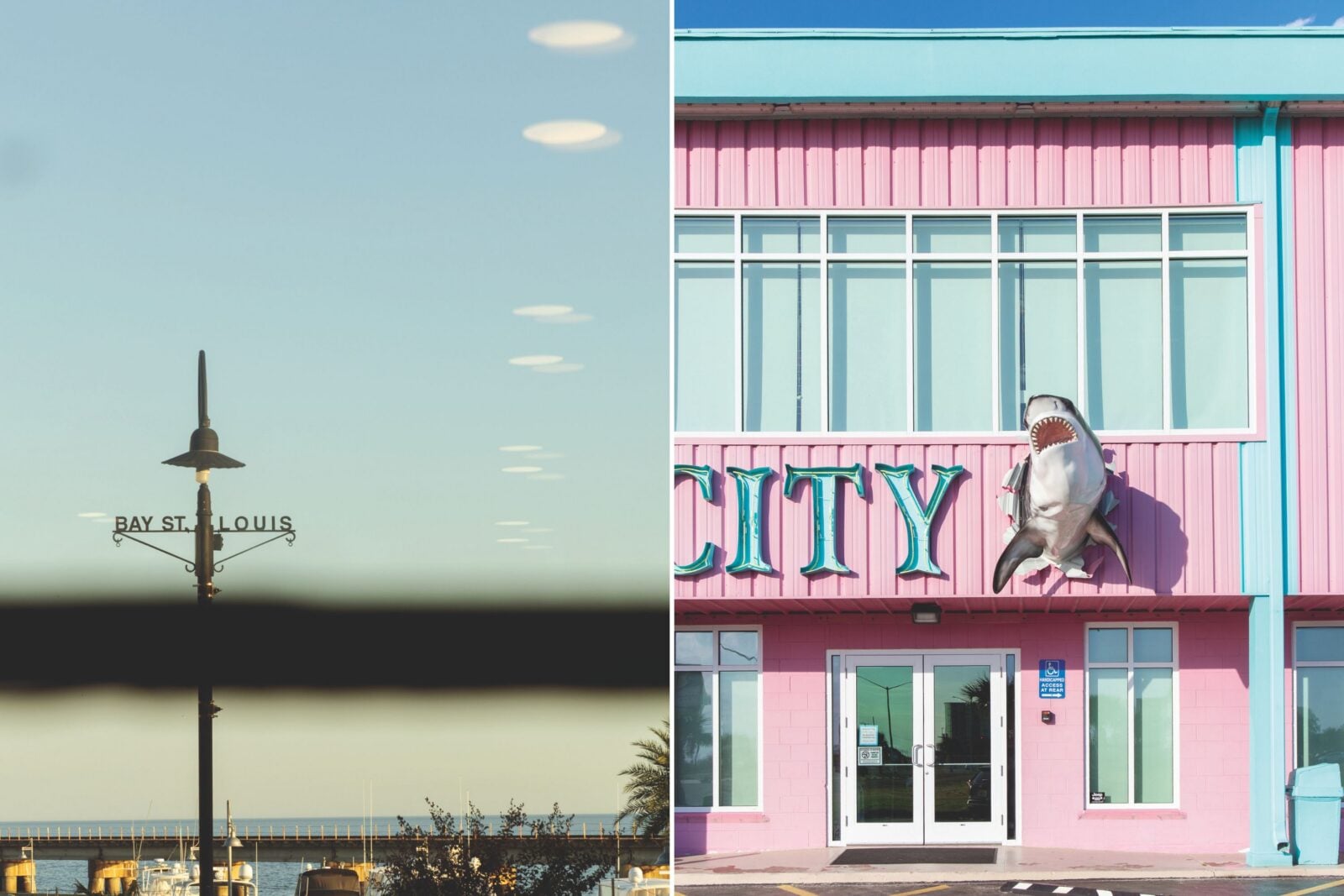
Photo: CEDRIC ANGELES
Looking out from Thorny Oyster; a souvenir shop in Biloxi.
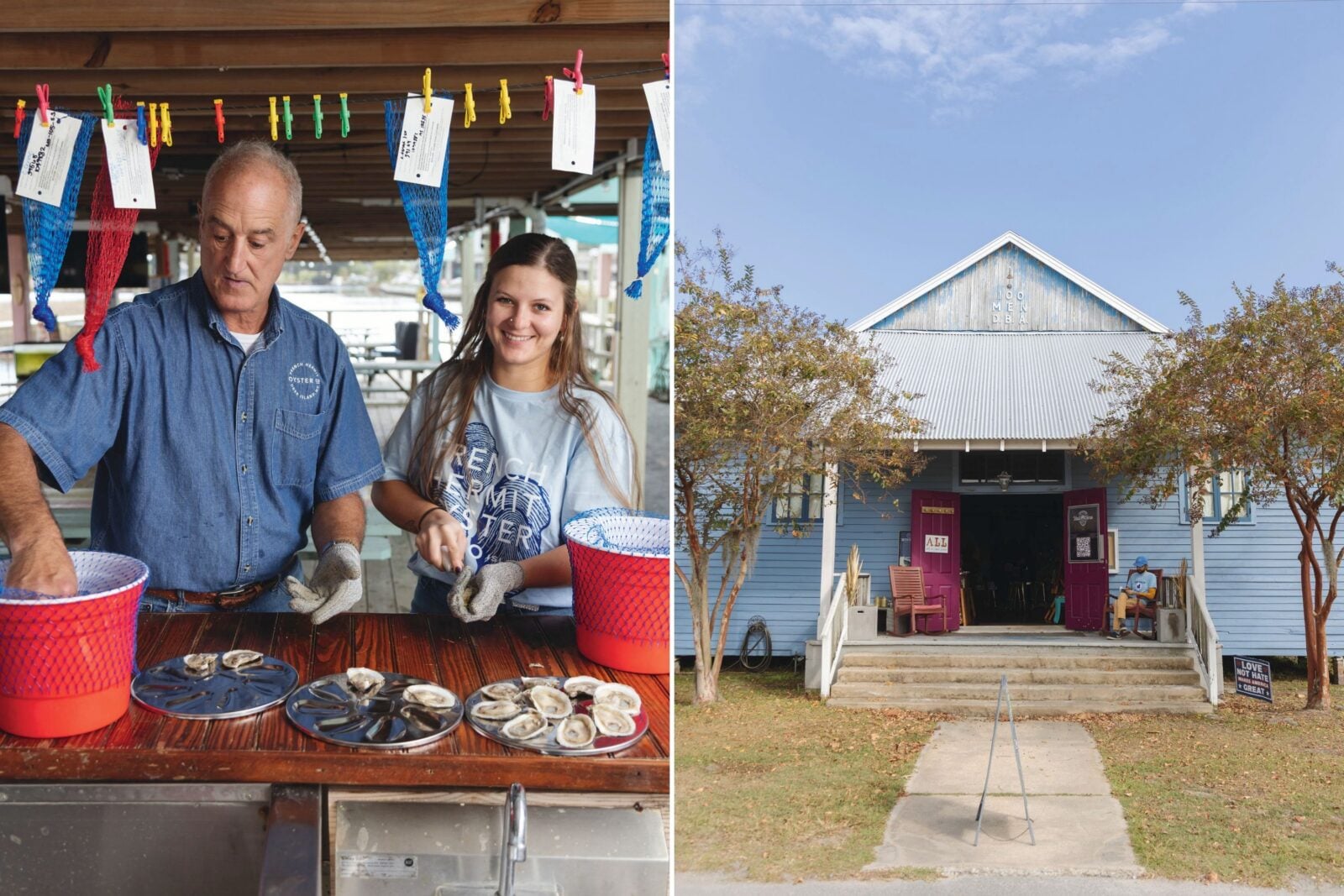
Photo: CEDRIC ANGELES
Shucking at the French Hermit Oyster Company; The 100 Men D.B.A. Hall in Bay St. Louis.
On my way into town, I had noticed an odd building by the railroad tracks. It had wood siding, a pointy roof, and a colorful mural on its side depicting Black musicians, with the legend “Chitlin Circuit.” A plaque outside informed me that this was the 100 Men D.B.A. Hall, built in 1922 as a social club, music venue, and center of Black life in Bay St. Louis. The organization that founded the club disbanded in 1982, and the building had passed through several hands before Rachel Dangermond, a New Orleanian, bought it in 2018. I found her nearby, trying to fish a plastic bag out of a drainage ditch. We sat inside, surrounded by folk art, a good portion of it devoted to the New Orleans pianist James Booker. The Hall, she told me, hosts an annual Booker Fest, along with other festivals and music shows throughout the year. When she bought the place, neighbors started telling her stories: about sneaking in as a kid to catch a glimpse of Sam Cooke, and standing at the door to listen to Etta James. When I excused myself to the bathroom, Dangermond called after, “Remember, you’re peeing where James Brown once peed!”

Photo: CEDRIC ANGELES
A tiki drink and seafood at the Thorny Oysters.
Later, on the patio of Thorny Oyster, an upscale seafood restaurant at the Pearl Hotel, I drank a glass of Sancerre and watched butterflies flit through pots of lantana. I ate a tostada piled high with tuna and a bouillabaisse that may have been more of a tomato stew but was filled with plump shrimp and perfectly cooked mahi-mahi. I was beginning to enjoy the Golf Cart Lyfe—waving at people, smiling at dogs indulgently. I rode back to the 100 Men Hall for its weekly happy hour party. A DJ spun records, and a local artist poured drinks. Somehow, I lost track of time. After grabbing my bag and hightailing it across the rail yard to the platform, I could already hear my ride rushing toward the station.
On Train 25, the 6:42 to New Orleans, my seat faced backward, but in the darkness it was hard to tell which direction we were headed—just that we were moving. A foursome of day-trippers behind me murmured about souvenirs they had bought in Mobile as we crossed the inky black lake. And by the time we pulled into Union Terminal, with a bump and a sigh, I was finally fast asleep.
Related Stories:

Food & Drink
Ten years after his tragic death, Sam Beall’s farm-to-table vision and gospel of Southern hospitality continue to resound across—and beyond—the resort, now celebrating fifty years of family ownership
Travel
Just in time for the Spring Meet, the storied track is welcoming back visitors with four stunning dining rooms and a rooftop bar
Travel
Interior designers, tastemakers, and locals share all their favorite shops, boutiques, and venues for epic small-town Texas treasure hunts
Trending Stories:
Recipe
Garlic, white wine, and a hint of umami from anchovies kick up the childhood comfort food in a new cookbook all about butter
Distilled
Where to belly up for “dusties” in the South and beyond

Home & Garden
Let ’mater master Frank Hyman narrow the field to a delicious quartet