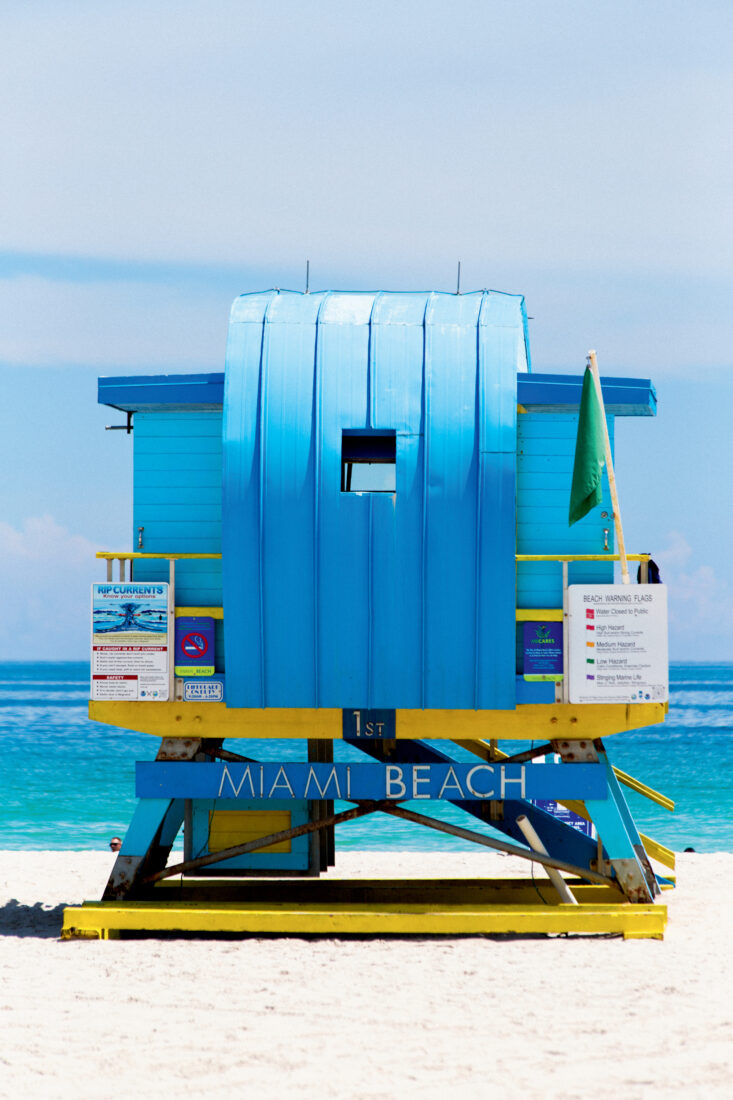
Don’t call it a comeback. Miami Beach has always been there. Even before my first visit as a teenager in the eighties, I knew the vibe of the place. Betty Grable and Robert Cummings live and in Technicolor at the piano under palm trees in Moon over Miami. James Bond getting a massage at the Fontainebleau before crossing paths with the diabolical Auric Goldfinger, a dirty cheat at gin rummy. Frank Sinatra, a sly Tony Rome in a captain’s hat, investigating at the Corsair Hotel and cruising Collins Avenue in a convertible Ford Galaxie. Murph the Surf and crew, picking up wealthy women only to steal their diamond necklaces. I heard the Beatles waded into the shallows at the Deauville. A young boxer named Cassius Clay trained down at the 5th St. Gym with Angelo Dundee and my old pal, Ferdie Pacheco, his fight doctor.
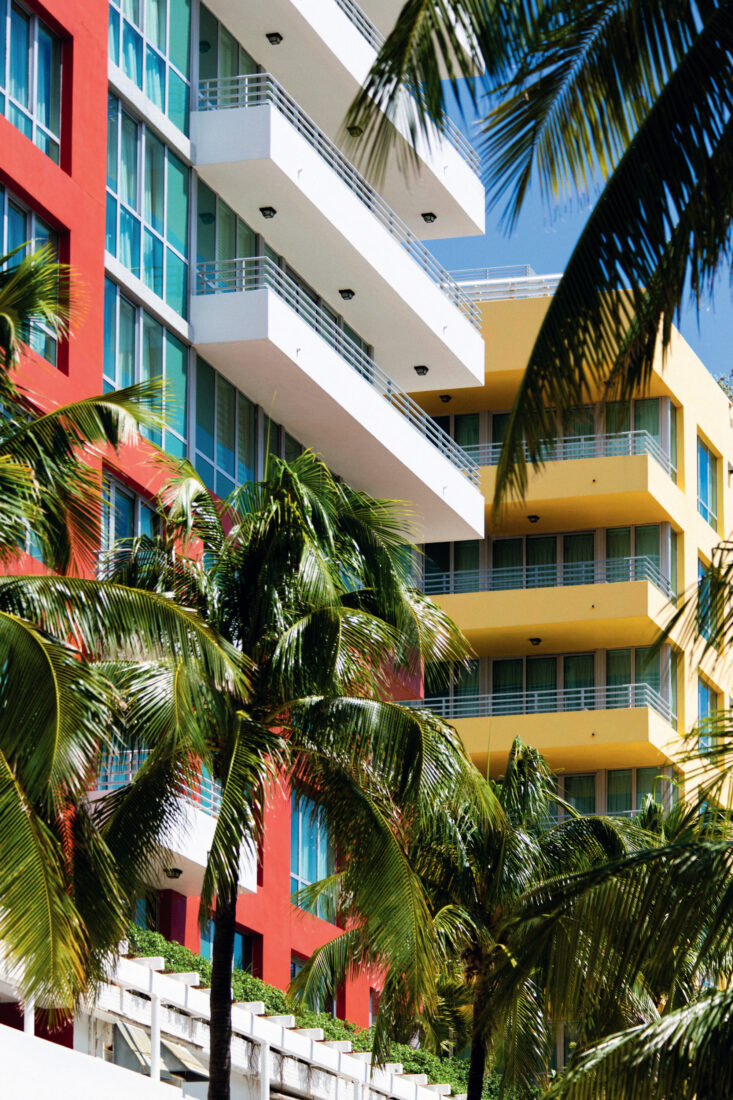
Miami’s downtown would ebb and flow, as would my interest in it. It’s the land just over Biscayne Bay, the distinct barrier island city of Miami Beach, that continues to fascinate me. If you’re heading to the area for Art Basel in December or January’s college football national championship game, I suggest you also turn your attention there. It faces the Atlantic with no buffer, which is perhaps why it guards its characters so tightly—the artists, the architects, the chefs—but also makes room for newcomers who themselves bring world flavors, new ways of thinking. Miami Beach technically starts just below the small town of Surfside, then runs along Collins to its heart. Ocean Drive takes you down to South Beach, a jewel of 1930s art deco architecture. That area became a slightly shabby God’s Waiting Room in the seventies and eighties. I recall seeing hundreds of old folks sitting in aluminum beach chairs, walkers positioned on patios, watching sports cars coast Collins as the neighborhood transitioned from retirement village to hip and cool playground for beautiful people. Soon there were art galleries and nightclubs. Gloria Estefan opened an upscale Cuban place on Ocean. Michael Caine owned a bistro on Lincoln.
Joe’s Stone Crab has seen it all come and go. The famed restaurant has been around since 1913, when Joe Weiss came down from New York for relief from his asthma and opened a lunch counter at Smith’s bathing casino. James Bond, as told by Ian Fleming, preferred cold pink Champagne with his piles of crab, but any local will tell you to get the fried chicken at the to-go shop next door to the fancier joint.
The Miami I first knew personally came out of an MTV fever dream, all glass blocks and a rainbow of neon. The streets of Miami Beach, particularly South Beach, were familiar from watching Miami Vice every Friday night: Don Johnson and Philip Michael Thomas battling drug dealers in white linen suits and zooming over the causeway to Phil Collins.
In the 1990s, it seemed like everybody was in Miami Beach: Madonna, George Clooney, Lenny Kravitz. Gianni Versace was shot and killed after a coffee at the News Café. I recall great breakfasts and slow mornings at that café reading magazines and visiting the Books & Books on Lincoln with its shelves full of best-selling Florida crime writers like Carl Hiaasen, James W. Hall, and Les Standiford. You could get cheap perico scrambled eggs and a tall café con leche at the legendary Puerto Sagua on Collins. Or pay twenty bucks for a vodka martini (a truly outrageous price in the nineties) at the Delano. After a few, you might get lost in the billowy white drapes of Ian Schrager’s iconic hotel.
This was the land of six-foot-tall, stick-thin models who looked as if they’d stepped off a spaceship, plus rock stars, athletes, actors, rappers. Everyone, absolutely everyone, wanted to be in Miami Beach. Not to mention all the movies shot on location: Miami Blues, The Birdcage, Bad Boys, and my personal favorite, Out of Sight.
Fast-forward a couple of decades, and tourists, club-goers, and celebrity chasers have flocked to shinier, taller, and more expensive hotels and restaurants in the Brickell neighborhood downtown. For me, Brickell is as strange, exciting, and futuristic as anything Walt Disney might’ve imagined. The original concept of Epcot by way of Dubai. The tallest skyscraper in the Southeast, the Waldorf Astoria, is arising not far from the open-air Brickell City Centre mall. Dolce & Gabbana is opening a hotel. While eating mushroom-crusted grouper at the River Oyster Bar last year, I met a twenty-something who got paid in crypto to run social media accounts shilling for the Russian government. He proudly explained how much he made from the scheme as I shook my head and sipped on an old-fashioned.
That isn’t the Miami of my dreams. I come for that drive across Biscayne, leaving the mainland for the island. I come for the Cuban food. A cafecito at an open window of a friendly neighborhood café. A hand-rolled cigar from one of the many tobacco shops. I mainly come, as generations have before me, to see the ocean and walk the wondrous beach. I might just run into the ghost of Jackie Gleason or even Travis McGee. Or any number of other characters. When I was leaving Joe’s last year, an old man in tattered clothes stopped me to point at the sunset lighting up the clouds over Biscayne Bay. “Look at that horizon,” he said. “Isn’t it amazing?”
While smoking a wonderful cigar from El Titan de Bronze, that legendary Miami tobacco-rolling company, in my Oxford, Mississippi, office, I contemplate what’s next for Miami Beach. I call my friend, the Miami journalist and filmmaker Gaspar González. Gaspar and I share a passion for Miami history and culture, but he also loves SEC football, so we speak both languages. “Right now, there is a continuing battle for the soul of Miami Beach,” he tells me. He starts listing too many famed places long gone now: Wolfie’s deli, the Americana Hotel, the original 5th St. Gym location that’s now a CVS. “The Delano has been closed so long I can’t even remember it being open,” he says. “The Delano used to be the place. A metaphor for all of Miami Beach.”
It’s huge news, then, that the Delano will return soon after a major restoration, continuing a trend. Another historic Miami Beach hotel, the Shelborne, just reopened after a $100 million overhaul, and the Raleigh, a gem designed by Lawrence Murray Dixon and opened in 1940, is set to book stays again as a Rosewood hotel.
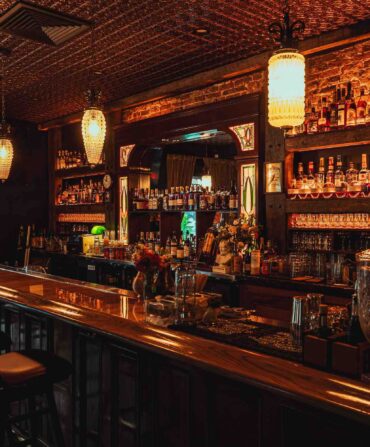
Although I am a creature of habit, I’m tempted by the fresh round of restaurateurs bringing exciting food to Miami Beach. I hear amazing things about MILA Omakase off Lincoln Road, a ten-seat Asian Mediterranean wonder run by a twenty-six-time Michelin chef. MILA serves Wagyu beef any number of ways, but also black cod in a spicy miso, or a whole branzino with shiso chimichurri, all on a rooftop overlooking South Beach. That doesn’t sound too bad. And the Joyce on historic Española Way is new but embraces the traditional; it’s both a classic speakeasy and an old-school steak house. The head chef trained at Le Cordon Bleu in Chicago and worked at my favorite steak house in that city, Bavette’s. I am a sucker for prime steaks and great cocktails, so the Joyce has moved to the top of my next-time list. And I’d be remiss not to mention the growing dining scene in North Beach. Gaspar endorses both George’s Italian Restaurant and New Campo Argentino, a very popular spot catering to the exploding numbers of Argentinean transplants.
That’s what comforts me regardless of fickle tastes and trends. No matter how long I’ve been gone, Miami Beach always welcomes me back in unexpected ways. Whether it’s corned beef at a Jewish deli, a medianoche at a Cuban café, or high-end Asian fusion at a rooftop bar, both the classics and the newcomers await. For this Deep Southerner, it doesn’t get any better than a handmade cigar, a copy of Elmore Leonard’s LaBrava, and a poolside seat at the Essex House hotel: the neon illuminating the gentle curves of the art deco buildings, the wind off the ocean rustling palms and curtains, and everywhere you go, Latin music, dancing, food, drinks, life.
See more: G&G’s Guide to Miami Beach
Ace Atkins is an award-winning, New York Times best-selling author who started his writing career as a crime beat reporter in Florida. Don’t Let the Devil Ride is his thirtieth novel. His previous novels include eleven books in the Quinn Colson series and multiple true-crime novels based on infamous crooks and killers. He lives in Oxford, Mississippi, with his family.