

Land & Conservation
Get to Know the South’s Mighty Mussels
Why the region’s secret—and imperiled—freshwater ecoweapons deserve your respect
If you think a freshwater mussel is little more than a rock with gills that sits sedentary on the bottom of a stream, let Paul Johnson disabuse you. “Mussels are very, very far from boring,” says the Alabama Aquatic Biodiversity Center (AABC) malacologist (that’s someone who studies mollusks). “Things get very weird, very fast.” Johnson should know; he’s spent his career helping to demystify and conserve mussels, which are not only among the country’s most crucial cleaners of waterways, but are also its most endangered group, period.

Seven Fascinating Southern Species
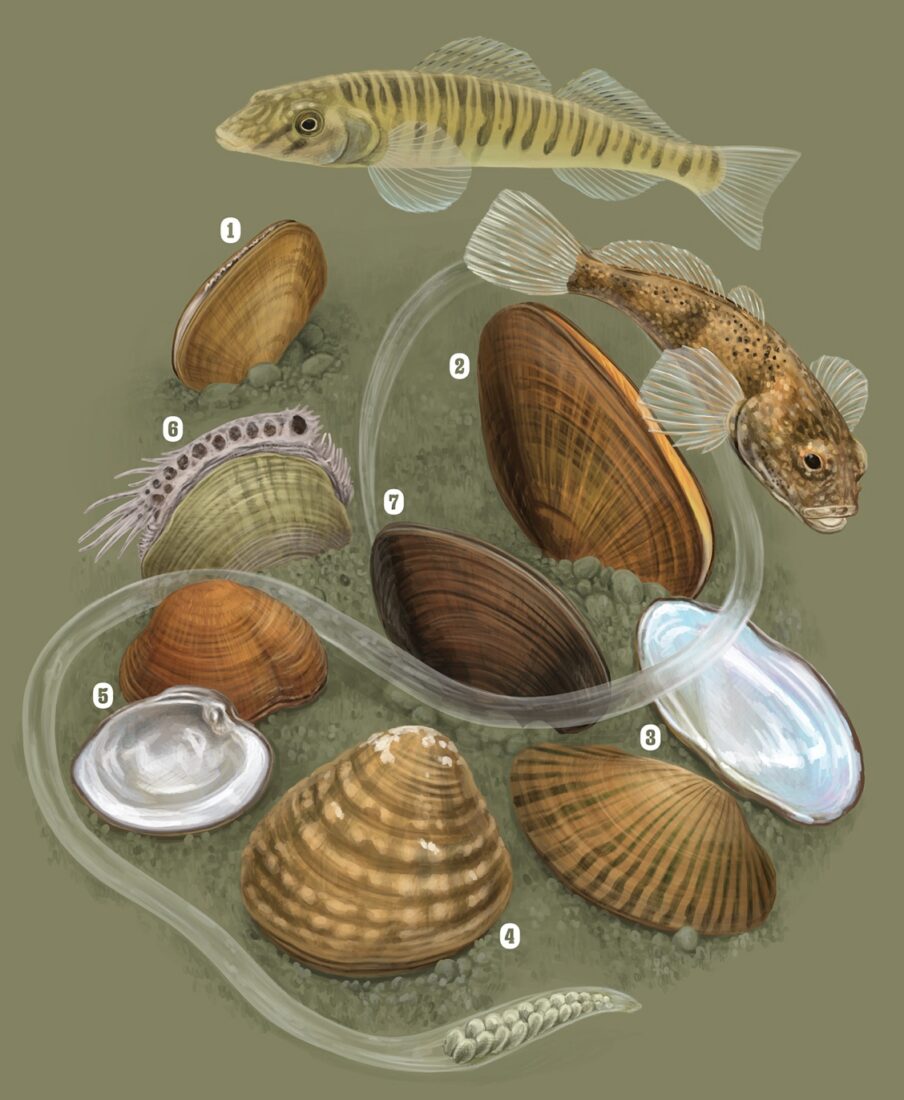
Photo: ZOE KELLER
1. Coosa Moccasinshell
An eight-mile stretch of the Conasauga River in Tennessee holds the last population of Coosa moccasin-shells. Since so few remain in the wild, Paul Johnson is carefully growing batches of them at the Alabama Aquatic Biodiversity Center lab for reintroduction to select tributaries of the Cahaba and Coosa River basins.
2. Appalachian Elktoe
In 2024, Hurricane Helene nearly drove the green-striped, neon orange–footed Appalachian elktoe to extinction, and biologists are still rescuing survivors from streams to propagate in a North Carolina hatchery—highlighting the risk of one catastrophe causing a species already on the brink to vanish completely.
3. Shinyrayed Pocketbook
The genus of this species, Hamiota, means “female fisher.” Like its close relative the orangenacre mucket, the shinyrayed pocketbook extends a long strand of mucus, at the end of which two “minnows” appear to dance in the current to attract the host fish. Once, this federally endangered mussel existed all over the Apalachicola River basin; today only about ten wild populations remain.
4. Fanshell
Only one population of the fanshell is hanging on in Alabama, at the twenty-five-foot-deep bottom of the Tennessee River at Muscle Shoals, making the individuals difficult to find. To attract their host fish, the females put out what Johnson calls a “downright wacky” lure that looks like a bloodred worm.
5. Southern Combshell
Just twelve miles of habitat in Mississippi’s Buttahatchee River still hold Southern combshells, which once thrived throughout the Mobile River basin. Last year, Johnson’s team introduced 3,500 specimens into three watersheds in hopes of establishing new populations.
6. Wavyrayed Lampmussel
This Tennessee River basin species is as charismatic as a mussel gets—a single female can produce offspring with two different types of lures, one that looks like a fish and another that resembles an aquatic insect, to attract the host fish: largemouth and smallmouth bass.
7. Orangenacre Mucket
Johnson and his team spent years propagating and establishing a reproducing population of orangenacre muckets in the Locust Fork of Alabama’s Black Warrior River watershed after they went extinct there in the 1970s. In total, only twelve pockets of these female fishers remain in their once widespread range.
Lindsey Liles joined Garden & Gun in 2020 after completing a master’s in literature in Scotland and a Fulbright grant in Brazil. The Arkansas native is G&G’s digital reporter, covering all aspects of the South, and she especially enjoys putting her biology background to use by writing about wildlife and conservation. She lives on Johns Island, South Carolina.