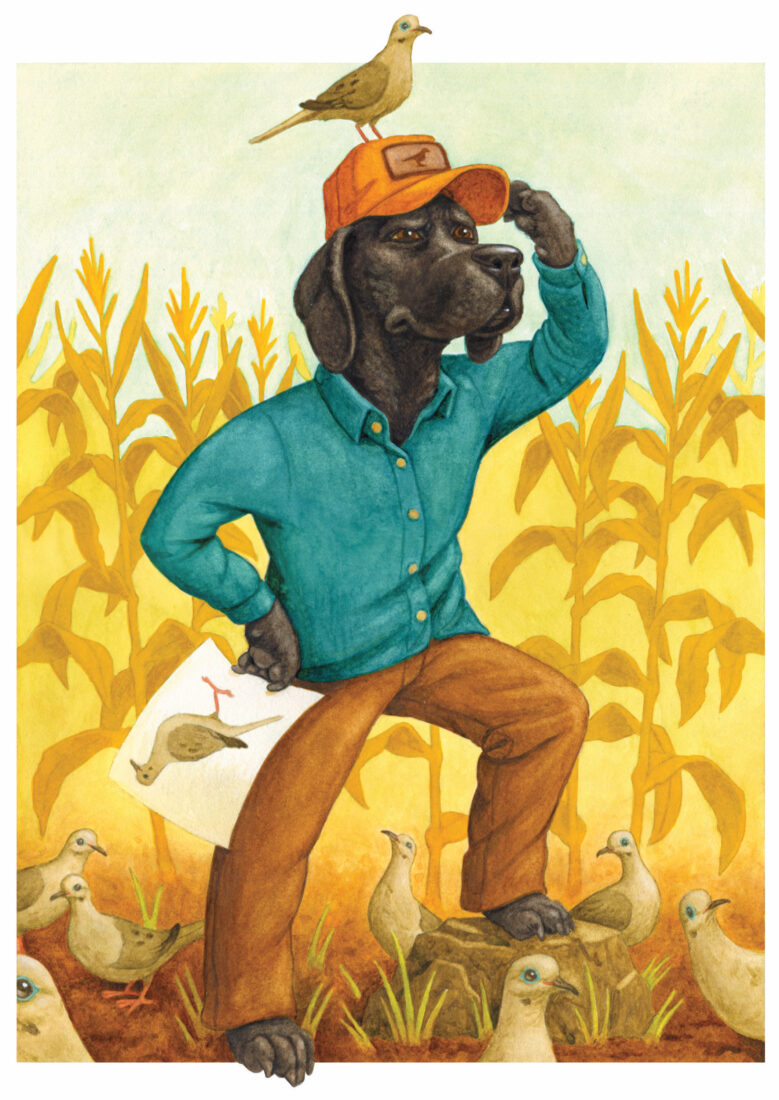
The summer before last, a college friend invited me to his annual Labor Day dove shoot. I had a new dog, a ten-month-old black Lab named Billie, and though I’d been working with her in our backyard and at our local Wildlife Management Area outside of Knoxville, I doubted she was ready for the field. Especially not on this particular occasion. There would be serious hunters in attendance and professionally trained dogs. Not to mention that my friend lives at the regal Mount Airy property in Warsaw, Virginia, the house built in 1764 and occupied by his family ever since. George Washington shot waterfowl on the grounds. That is not a joke. I worried that Billie would make a fool of herself and me or, worse, ruin somebody else’s hunt in this history-rich setting. It sounded like too much pressure, too many ways for things to go wrong.
To be clear, I am not a serious hunter, nor do I know anything about training a dog beyond what I’ve read in books, but I did once train a pretty fair retriever. I was young and single, an MFA student renting a tenant cottage on a farm with lots of acreage, nothing much to do out there but read and write and work with the dog, his natural instincts channeled into something akin to purpose. He was not just a dog; he was a hunting dog and I was his hunter and he knew it. This dog had gravitas. I met my future wife in my second year of grad school, and she will confirm this assessment. She fell in love with the dog, she’ll tell you, long before she made up her mind about me.
There have been other dogs since, all adored, all excellent companions for our two daughters, all gone on to greener pastures, but nary a hunting dog in the bunch, and when my wife discovered that a colleague bred Labradors as a side hustle, it felt a little bit like fate. Our daughters were mostly grown, the younger off at college, the older working her first adult job. Our nest was empty in the most clichéd sense. After a couple of visits to the kennel, we settled on a female with serious, attentive eyes, not the runt of the litter but close. We decided to call her Billie Holiday, the first name selected by my daughters because they liked the tomboy ring of it, the surname added by yours truly because I am a fan of Lady Day and because we brought her home on Christmas Eve.
I live in a neighborhood now, a far cry from the ample acreage of my grad school days. I’m also thirty years older, my reflexes not what they used to be. In his book Hey Pup, Fetch It Up!, the trainer Bill Tarrant stresses how vital it is not to mess up your dog’s first outdoor retrieve. But when she was about twelve weeks old, I led Billie out into the yard, hyped her up, and tossed the dummy, and she took off after it and pounced—she has plenty of “drive,” as the real bird-dog trainers call it. She headed back my way full tilt, then did a nifty last-second juke. I missed her as she passed, and suddenly she was playing keep-away, a lousy habit reinforced right out of the gate.
I teach at the University of Tennessee but tried to work with Billie for at least a few minutes every day, even if that meant nothing more than tossing the dummy in the living room when I got home. I’d forgotten how much patience it requires, how much of training is feeling each other out, the dog learning how to please its human, the human grasping how the dog learns best. I had to remind myself on occasion, for both our sakes, that this was supposed to be a pleasure, not a chore. Billie learned to stay (sometimes), to heel (sometimes). We added blind retrieves and the gunshot blast of a dummy launcher to her routine. I learned that she prefers to be asked, rather than told. The first time I raised my voice to scold her, she tucked her tail and retreated to her crate, where she remained for two hours. Eventually, my wife coaxed her out, but Billie refused to speak to me for the rest of the day. Even now, the only way to ensure that she’ll deliver a dummy to hand is for me to squat down to her level, as if making a request, a concession real bird-dog trainers might shake their heads at.
She was still a work in progress, to put it generously, when my friend texted about his Labor Day shoot, but I was curious to see what she could do, so I texted back with a counterproposal. My dog wasn’t ready for prime time, I explained, but if he was willing, we would be grateful to drive up the following weekend for a low-stakes outing with his teenage sons. Though he worried there wouldn’t be as many birds or enough shooters to keep them flying, he was kind enough to agree.
Mount Airy delivered a cool September morning in a well-tended sunflower field surrounded by rows of uncut corn. My friend needn’t have worried; there were plenty of birds. The problem, predictably, was me. I missed my first two shots, and both times Billie bolted, swiveling her head, wondering what exactly she was supposed to retrieve. The third dove, however, came whirring out from behind us, flying in a straight line across the field, the easiest shot there is. I managed to knock it down, and Billie saw it fall. I asked her to fetch it up, and in no particular hurry, she trotted over to where it lay and gave it a sniff and turned it over with her paw. Then she picked it up and brought it back and just like that, I had a hunting dog again.
I don’t mean to suggest that some genetic gear clicked into place for Billie. She chewed cornstalks and dug holes, couldn’t stop fidgeting in the stand, and scared birds away. She broke a few more times. But my friend and his sons, all much better shots than me, were rooting for her, forgiving her mistakes—and my bad aim—and letting her retrieve their birds now and then so she could get in the extra practice.
I won’t bore you with a shot-by-shot recap, but I would like to mention one more retrieve. Later in the morning, I dropped a dove deep in the corn, and Billie couldn’t see where it went down, the stalks high enough that even I wasn’t sure where to start looking. I had my doubts but sent her in blind and watched the tassels shaking as she passed. For all I knew, she was goofing off in there. After a minute, she poked her head out, wagging and grinning, clearly having a ball, but empty-mouthed. I sent her in again, and again she set off rustling through the corn and emerged without a bird. One more time I sent her back. A minute passed. Two, three. I was just about to go in after her when she came prancing out, bird in her mouth, visibly proud of herself. But not half as proud as me. I taught her that persistence. Afternoons in the backyard, mornings at the WMA. I would pay good money to have a photo of that moment, Billie’s lips and tongue plastered with feathers, but I was so busy showering her with praise, I didn’t think to reach for my phone.
Garden & Gun has an affiliate partnership with Bookshop.org and may receive a portion of sales when a reader clicks to buy a book. All books are independently selected by the G&G editorial team.