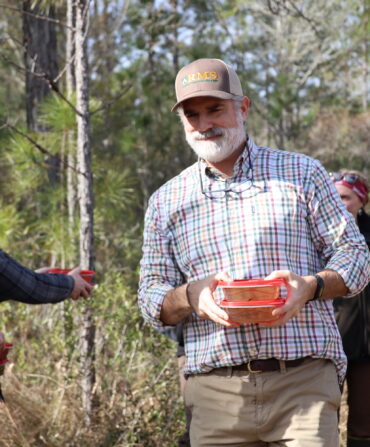
It all began with a plastic flask. Chris Shepherd, at the time the owner and chef of the acclaimed Houston restaurant Underbelly, was attending a dinner as a nominee for the James Beard Awards in 2014. He happened to be seated at the same table as whiskey legend Julian P. Van Winkle III, who asked him, “What are you packing?”
“I didn’t even know what that meant,” Shepherd recalls. Van Winkle then clarified: “‘What’s in your flask?’ And I was like, ‘Oh, I don’t have one.’ So he literally pulled from his pocket a plastic flask filled with a barrel sample and handed it to me.”
Shepherd doesn’t recollect the specifics of that barrel, but it was good. Very good. “And I remember asking, what else should I be drinking? He said to just buy all the Weller 12 you can, because it’s going to disappear. I ended up buying quite a bit. That started the movement for me. I was more of a wine person then, but I wanted to know more.”
Shepherd became something of a road scholar, regularly visiting shops around Houston and during his more far-flung travels. “I started looking through all the liquor stores and finding my honey holes,” he says. And, like any good collector, he found “a guy”—a retailer who supplied hipster dive bars in Houston. “He got all the cool stuff ” and would tip him off to new arrivals.
Shepherd’s search broadened. He began hunting for unusual and extinct bourbons—bottles no longer produced but still tucked away in liquor shop back rooms, gathering dust by the month. He also learned that a lot of American whiskey got exported overseas during boom years but ended up unsold. “I started finding bottles at German and Italian markets, and getting into these online auction sites,” he says.
He was especially drawn to older whiskey, appreciating the idea of finding bottles that predated genetically modified corn and computers entering the distillation process. “There was a weird art to it,” he says of those bygone days. “It’s one of the only things from American history that we can taste, especially if you can find stuff from the pre-Prohibition era.”
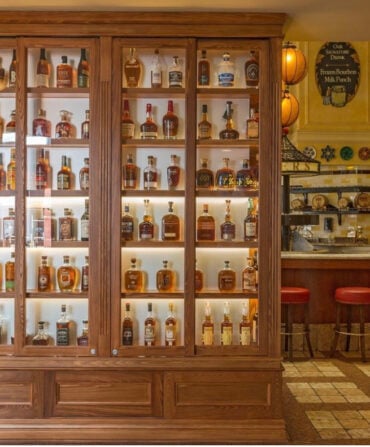
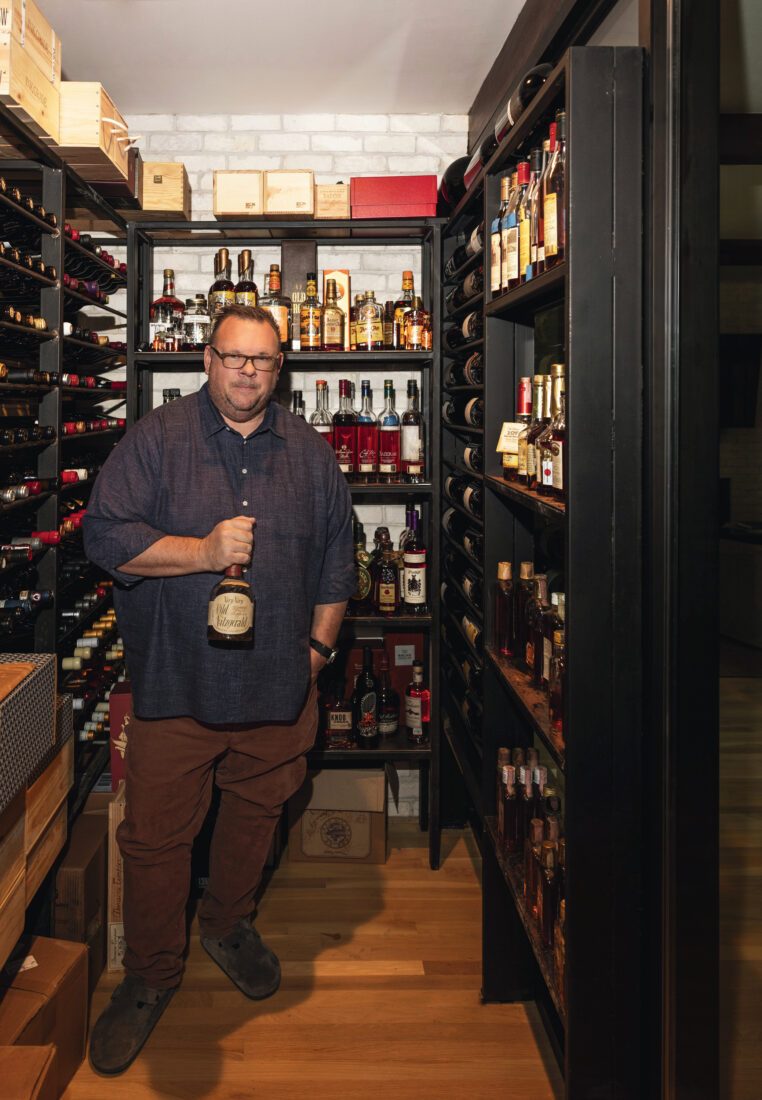
Shepherd, who with his wife, Lindsey Brown, now directs Southern Smoke Foundation, the nonprofit they started to aid food and beverage workers, is not a spreadsheet-style collector. He doesn’t know exactly how many bottles he owns, or precisely where they all are. Yet the hundreds of bottles are inescapable at the couple’s home in Houston’s Montrose neighborhood, which they share with their two cats. Just off the kitchen is a narrow glassed-in room, like a cigar humidor but filled with an assortment of wine and whiskey.
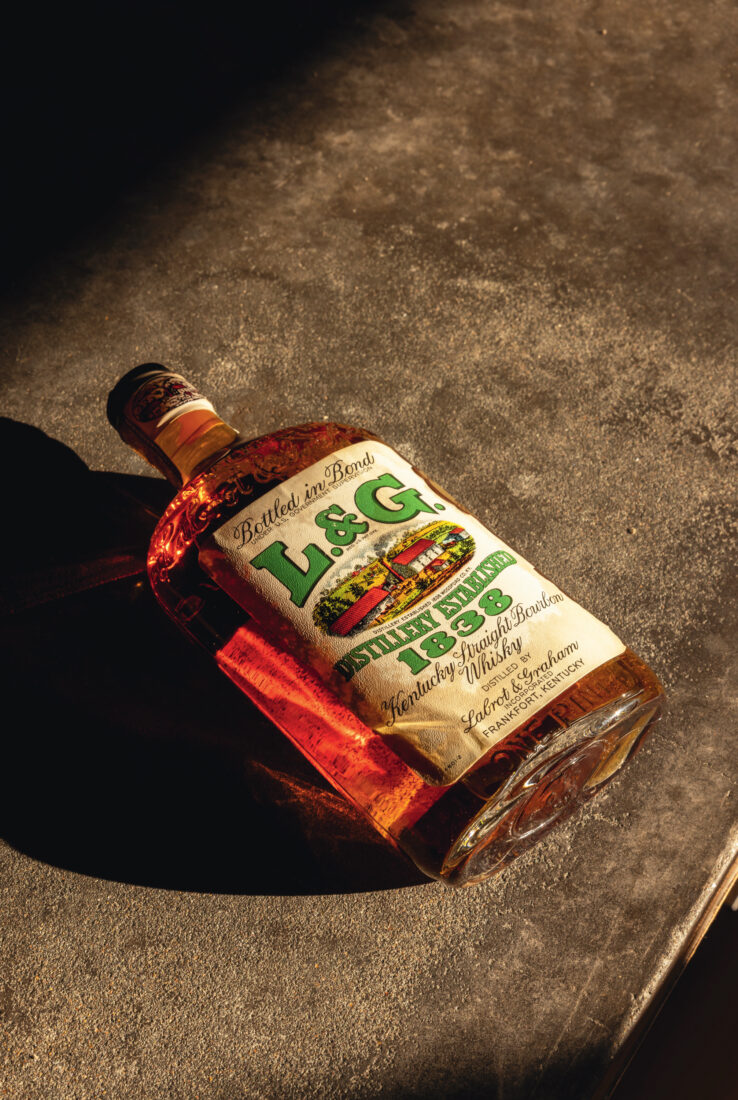
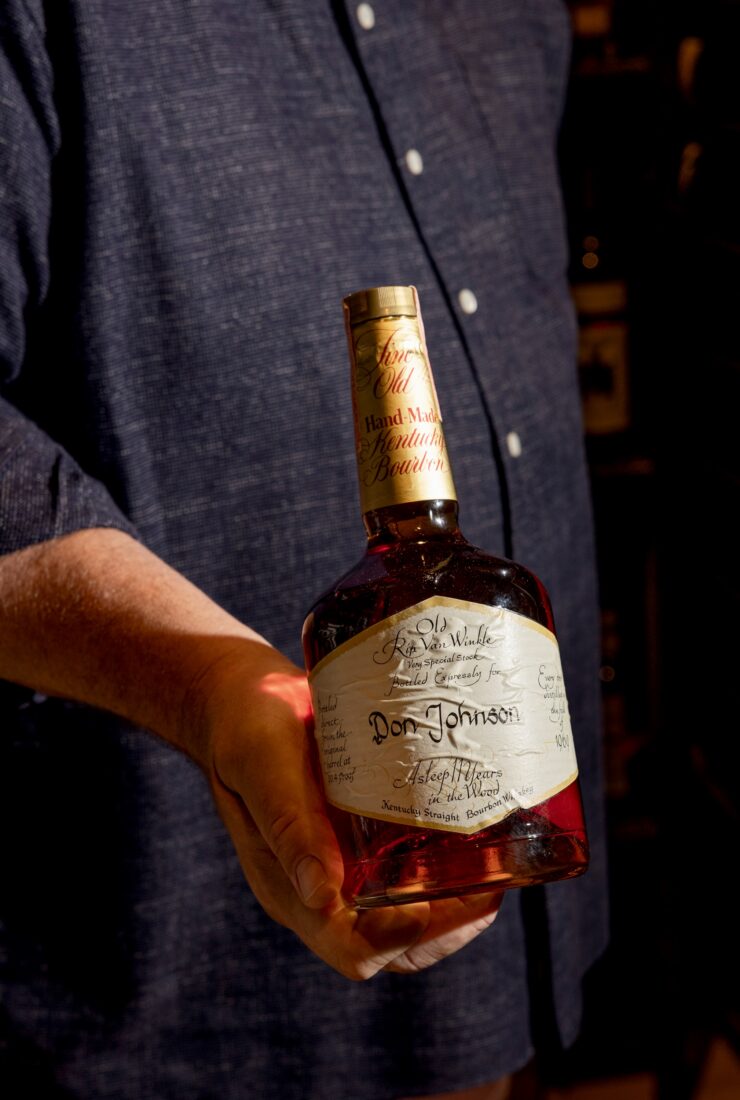
Looking out from the room sits a shelf of Van Winkle bourbons—Family Reserve Private Stock, Pappy Van Winkles of various ages, and an Old Rip Van Winkle “Bottled Expressly for Don Johnson” that was distilled in 1970 and bottled in 1981. “That was a gift from a friend who said, ‘Yeah, don’t ask,’” Shepherd says. He points to an older bottle, this one from Labrot & Graham. “This is from 1938,” he says. Established in the 1800s, the historic Versailles, Kentucky, distillery is now home to Woodford Reserve.
Upstairs, another room, tucked under low eaves and painted black, holds the bulk of Shepherd’s private single-barrel releases, along with a robust collection of unique bottlings from Charleston, South Carolina’s High Wire Distilling—Bradford watermelon brandy, for instance—and bottles he forgot he even had. “We built this room, and I thought, I’m going to sit up here and drink whiskey. And I never have. It’s too far from the rest of the house.”
Heading to the garage, we wander around an array of gray plastic totes, scattered randomly and filled haphazardly with bottles of old whiskey, their labels frayed and worn. These came from an estate sale: A “barbecue guy” Shepherd knew walked in, found dozens of unopened bottles for sale, and called him. The deceased had apparently run a liquor store in the seventies and eighties; when it closed, all stock went to his garage, and when he died, his son wanted to get rid of it. Shepherd told his guy to buy it all, which included vintage Seagram’s 7 and half-pint flasks of I.W. Harper Kentucky bourbon, a brand established in the 1870s by brothers and German Jewish immigrants Isaac Wolfe Bernheim and Bernard Bernheim. Today bottles sit awaiting attention, like rare books waiting to be catalogued in the back room of a library. Shepherd picks up one of the dusties and says, “I should probably drink some of this at some point.”
There are three kinds of liquor collectors: those who hoard, those who flip for profit, and those who share. Shepherd is firmly in the last category. He enjoys watching guests savor rare and forgotten whiskey—I confess to going home less steady than when I arrived. He donates bottles for charity auctions and cracks open others to pour at special events.
“It all tells a story, right?” he says. “That’s what’s really interesting about whiskey. I always think that I’m going to get into other spirits. And then I just don’t.”
Wayne Curtis is the author of And a Bottle of Rum: A History of the New World in Ten Cocktails and has written frequently about cocktails, spirits, travel, and history for many publications, including the Atlantic, the New York Times, Imbibe, Punch, the Daily Beast, Sunset, the Wall Street Journal, and Garden & Gun. He lives on the Gulf Coast.