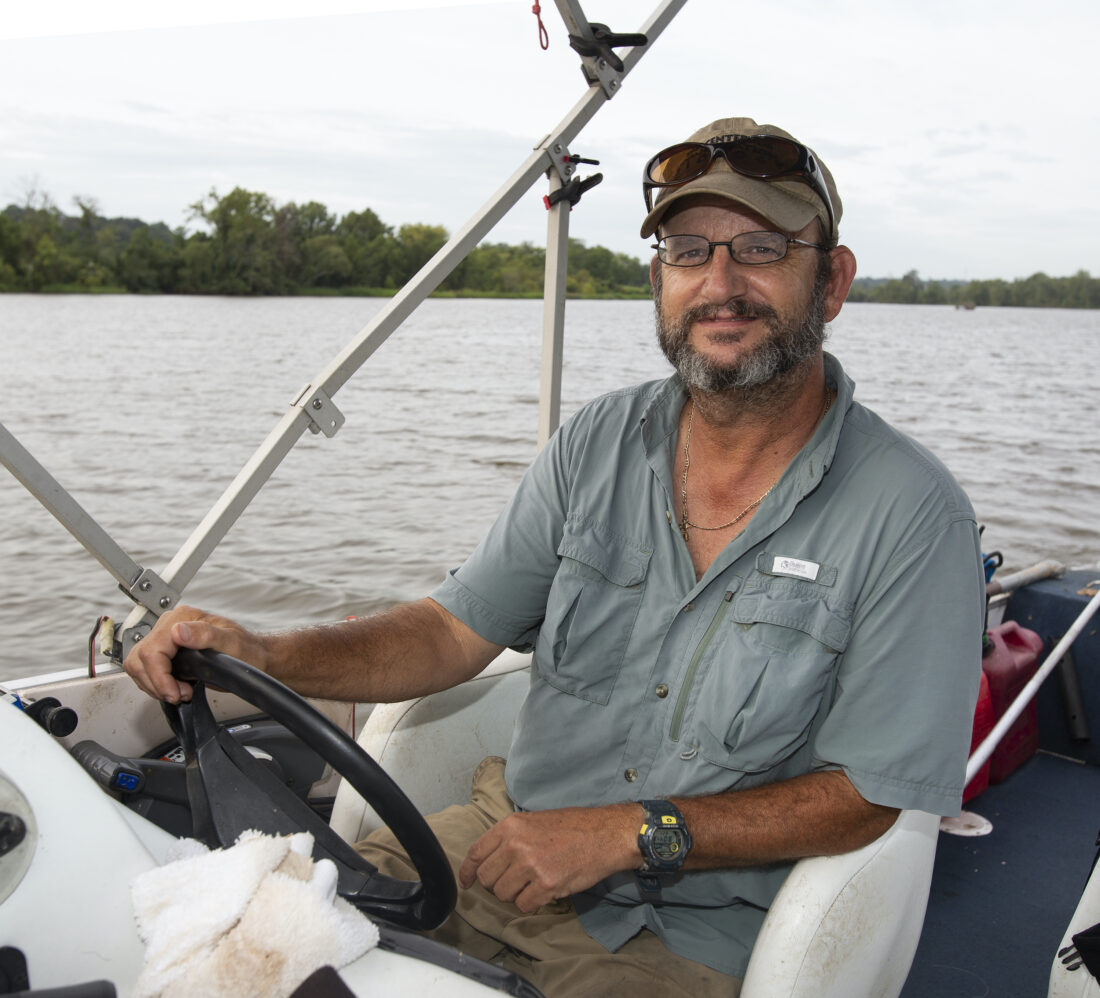
The twenty-four-foot-long pontoon boat cuts through the broad James River flatwater, throwing clockwork sprays of mist that crackle bright and prismatic in the early morning sun. Low whorls of fog drift along the tree-lined banks. Autumn foliage blazes, painted by the season and sunrise.

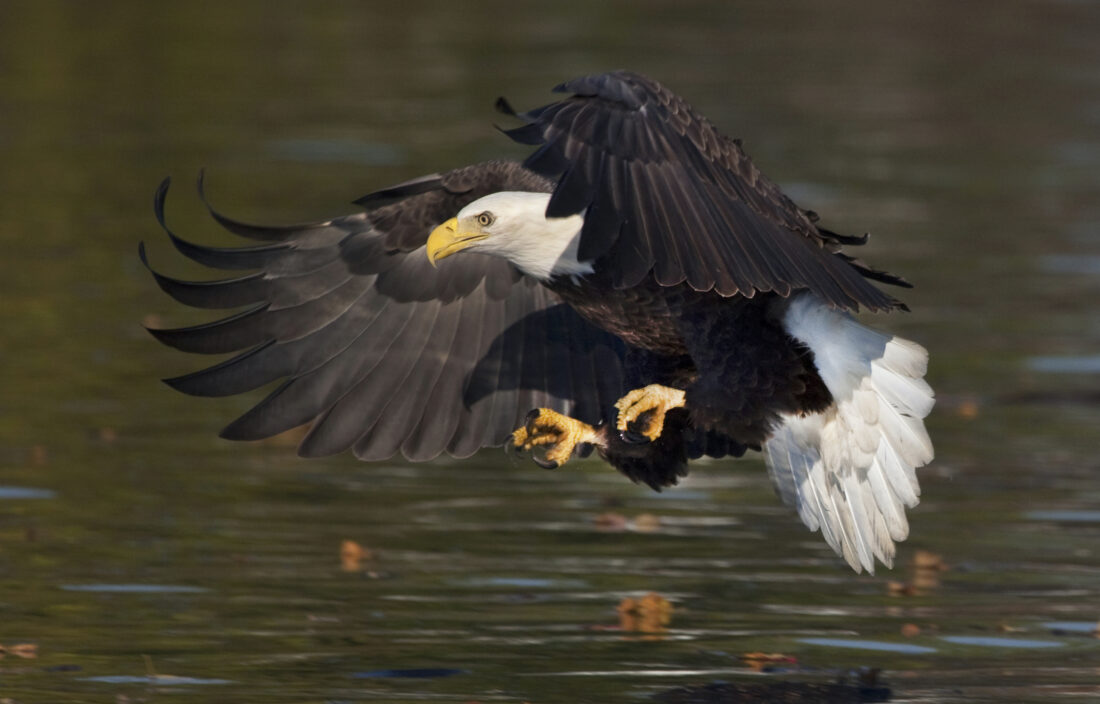
The boat slows, turns into a narrow portside bifurcation, and drifts quietly along the wooded banks of Hatcher Island, a private wilderness area. Captain Mike Ostrander points to a cluster of tall sycamores, and the four passengers swing into action. Digital cameras fitted with telescopic lenses sweep the canopy. Whispers erupt as we spot a huge nest woven from branches, moss, dirt, lichen, and pine needles. Shutters machine-gun as the feathery white head, lemon beak, and dark brown wings of a bald eagle rise above the nest.

“This is Bandit,” says Ostrander, sixty-one. The mature female eagle plays a starring role in his Richmond, Virginia–based Discover the James nature tours, and he’s been observing her almost daily for sixteen years. “I joke that I know this bird better than my neighbors and even some of my friends,” he tells me later.
Ostrander averages about five days a week on the water from early spring to late fall. The small-group adventures last about four hours and carry patrons to and fro on a seven-ish-mile tract of river. The waterway is rarely more than 1,000 feet wide and is home to one of North America’s densest populations of breeding bald eagles. Nests average about 150 yards apart, and that density lets visitors glimpse a smorgasbord of seasonal behaviors: mating, feeding, fledging, or, say, a male’s crazed, acrobatic attempt to tear a fresh-caught fish from the talons of a hunting osprey. “I’ve been doing this for twenty-five years, and I feel like I learn something new every time I go out,” Ostrander says.
But the tours are about more than avian eye candy. They’re an educational journey that uses Bandit as a springboard to tell what William & Mary University Center for Conservation Biology founding director Bryan Watts calls one of “the greatest wildlife management success stories of all time.”
“It’s hard to imagine,” Watts says, “but in 1977 there were no bald eagles nesting anywhere on the James River, and less than thirty existed in the entire state.”
Conservationists sounded alarms when the birds began disappearing en masse around 1960. Aerial surveys taken two years later documented a sobering reality: Bald eagles were careening toward extinction. “The guys that flew those missions talk about how eerie it was to cover the full length of the James and not see a single one,” Watts says.
The first culprit was the toxic insecticide DDT, which made eggs thinner and more likely to shatter during incubation. Largescale illegal dumping of a roach killer called Kepone into the James brought bioaccumulation in fish and killed or effectively sterilized most eagles that ate them. The deadly one-two combo collapsed populations across the South.
The information and related outrage helped inspire a federal ban on DDT in 1972, with Kepone soon to follow. By 1978 bald eagles gained endangered or threatened status throughout the Lower 48. But the iconic predator’s survival was far from guaranteed.
“No one knew for sure if it was possible to save them, much less achieve a self-sustaining population,” Watts says. The effort “felt like a long shot at best. But damned if we weren’t going to try.”
An ambitious partnership between state and federal agencies, local governments, nonprofit groups, and avian researchers like himself and mentor Mitchell Byrd ensued. It yielded aggressive habitat conservation strategies, protections for the birds, and harsh penalties for anyone that didn’t comply. And spoiler alert: It worked.
By the time Ostrander launched Discover the James in 2001, the Hail Mary comeback was underway. Bald eagle populations climbed toward critical thresholds, and both the federal and Virginia endangered species lists dropped the species by 2012. The state is now home to more than 2,000 breeding pairs—and 25 percent of them nest along the James. That meant Ostrander had a front-row seat to what Watts calls “a miraculous recovery.”
“There are always new birds migrating and trying to move in, challenge, or even split territories into smaller segments,” Ostrander says, calling the competition “wonderful but a little bittersweet.” His melancholic undertone stems from the fact that bald eagles have a twenty-to-thirty-year lifespan in the wild, and Bandit is in the middle part of that range.
“This bird has been a part of my life for so many years,” he says. “I know it’s the cycle of life, but it does make me sad to think about the day I show up and she’s no longer there.”
He takes solace in the comeback story Bandit represents—and the possibility that a few of her fully grown fledglings may return to take her place.