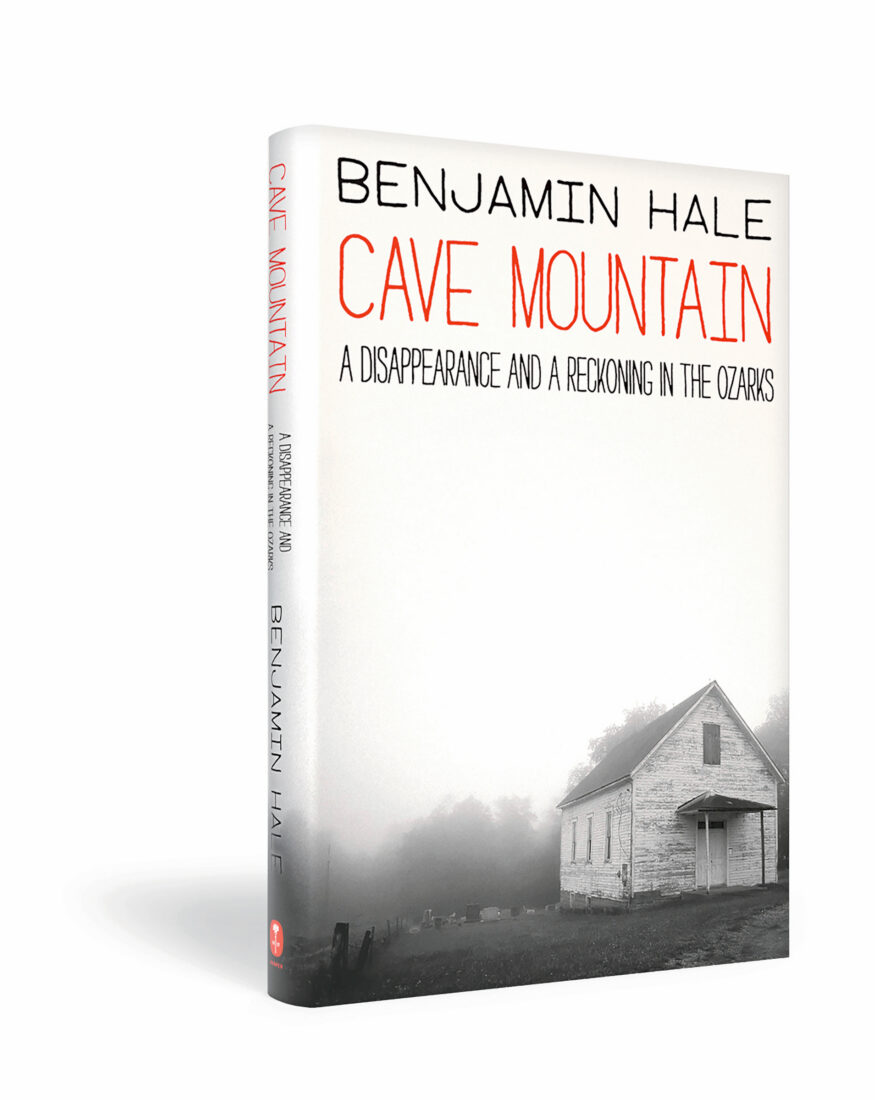
In the spring of 2001, novelist Benjamin Hale’s six-year-old cousin, Haley Zega, wandered from her grandparents during a hike in the Buffalo River National Wilderness in the Ozarks. Her grandparents hollered, they searched, they mashed 911. As day darkened into night, sheriff ’s deputies and volunteers combed the woods; emergency vehicles rumbled up and down the steep dirt roads while heat sensor–equipped helicopters buzzed the valleys; and what would eventually become one of Arkansas’s largest search-and-rescue operations began taking shape. Another day passed. Haley’s mother, Kelly, waited for news inside a tiny backwoods church converted into a command center. As hounds tracked Haley’s scent to a local highway, where it seemed to disappear, Kelly fielded a call from an Arkansas mother whose six-year-old daughter had been abducted six years earlier, in a notorious cold case, reaching out to offer advice. Another night passed.
It spoils nothing of Hale’s Cave Mountain to disclose that Haley Zega was not abducted or grievously harmed. On the third day, she was reunited with her family and is alive and well today. Hale is essentially done with that story, as a story, by page sixty-two. What he’s far from done with, however, are all the portals—psychological, geographical, metaphysical, historical, theological, and more—cast open by Haley’s vanishment. Trying to make sense of all the fear, guilt, and varieties of faith, he probes every one of them. Cave Mountain becomes a book of rabbit holes: fascinating, maddening, maundering, and often electrifying.
Chief among those portals is the eerily aligned disappearance of another girl, three-year-old Bethany Alana Clark (a pseudonym Hale explains), whose fate in those same mountains, twenty-three years earlier almost to the day, was the obverse of Haley’s. Bethany was shot multiple times by members of a Christian doomsday cult with, prosecutors claimed, the tacit approval of her mother, and buried in a plastic bucket. What sends Hale down that grisly rabbit hole is something Haley told her parents: that a dark-haired, incorporeal girl with a flashlight named Alecia had guided her through the woods. Bethany had often made a play on her middle name, “All I see,” which sounds like Alecia, and, frightened of the dark, slept clutching a flashlight. Goose pimples become hard to suppress.
Hale isn’t interested in ghost stories, however—at least not this one. “At worst this paranormal element is just stupid,” he writes, “and at best there is something interesting in it about the moment when the rational mind turns a corner.” It’s that turn that captivates him: the one Bethany’s mother made when as an abused twenty-year-old she put her faith in a ragtag Louisiana cult, or the one made by the cult’s “prophet”—seventeen at the time he ordered Bethany’s murder—when he cast off the cult’s doctrines during a forty-year prison sentence. Haley made a wrong turn on a hike, while others in this book made wrong turns in their minds and lives. Hale maps them all: “When you walk along a path through the woods”—or through life, I’ll add— “you move along a line of living animal energy. A trail is made by all the bodies that have traveled it before you, and every pathway is a streamline of ghosts.”
When we liken someone’s life to a “fairy tale,” we’re usually invoking romantic fulfillment, wealth, safety, or some other dreamy ending, which just goes to prove how little we know (or remember) about fairy tales. Stories by the Brothers Grimm and others abound with cruelty and fear and abandonment; lost children in the woods, like Hansel and Gretel, like Snow White, figure in bedrock scenarios. The literature of fairy tales is one rabbit hole Hale doesn’t explore in Cave Mountain, but I kept hearing its echoes as I read. Those tales prey on the oldest anxiety we know: the terror of being unprotected in a world that’s indifferent at best and predatory at worst. Lost in the woods with only an imaginary companion to steer her to safety, Haley Zega lived one kind of fairy tale. Forsaken by her brainwashed mother, and thrown to figurative wolves, Bethany Alana Clark lived and died another. What Cave Mountain explores is the spectral space between them, and how twenty-five or fifty-some years later that space can still haunt us.
Plus: Three Buzzy New Reads Span Genres

The South’s landscapes have shaped some of history’s most cherished authors, and these three modern literary matriarchs are prodding that legacy forward. Lauren Groff cemented her place as a short-fiction master with 2018’sFlorida, then went on to write two novels and open a bookstore, the Lynx, in Gainesville. She returns with Brawler (Riverhead), a gorgeous collection of stories traversing time, class systems, and the nation. In nonfiction, former poet laureate of Mississippi Beth Ann Fennelly delivers The Irish Goodbye (W.W. Norton), a spare-no-punches assortment of “micro-memoirs” dealing with death, love, and bribing her kids to kill slugs in her garden. Settle in for a beautiful long read with the Georgia-grown Tayari Jones’s latest novel, Kin (Knopf), a deep dive on friendship and family ties across the Deep South. —CJ Lotz Diego
Garden & Gun has an affiliate partnership with bookshop.org and may receive a portion of sales when a reader clicks to buy a book.
Jonathan Miles, a Garden & Gun contributing editor, has been the magazine’s books columnist since 2012. He is the author of three novels, including Anatomy of a Miracle, which was a finalist for the Mississippi Institute of Arts and Letters Award in Fiction. A former resident of Oxford, Mississippi, he is currently Writer-in-Residence at the Solebury School in New Hope, Pennsylvania.
Garden & Gun has an affiliate partnership with Bookshop.org and may receive a portion of sales when a reader clicks to buy a book. All books are independently selected by the G&G editorial team.