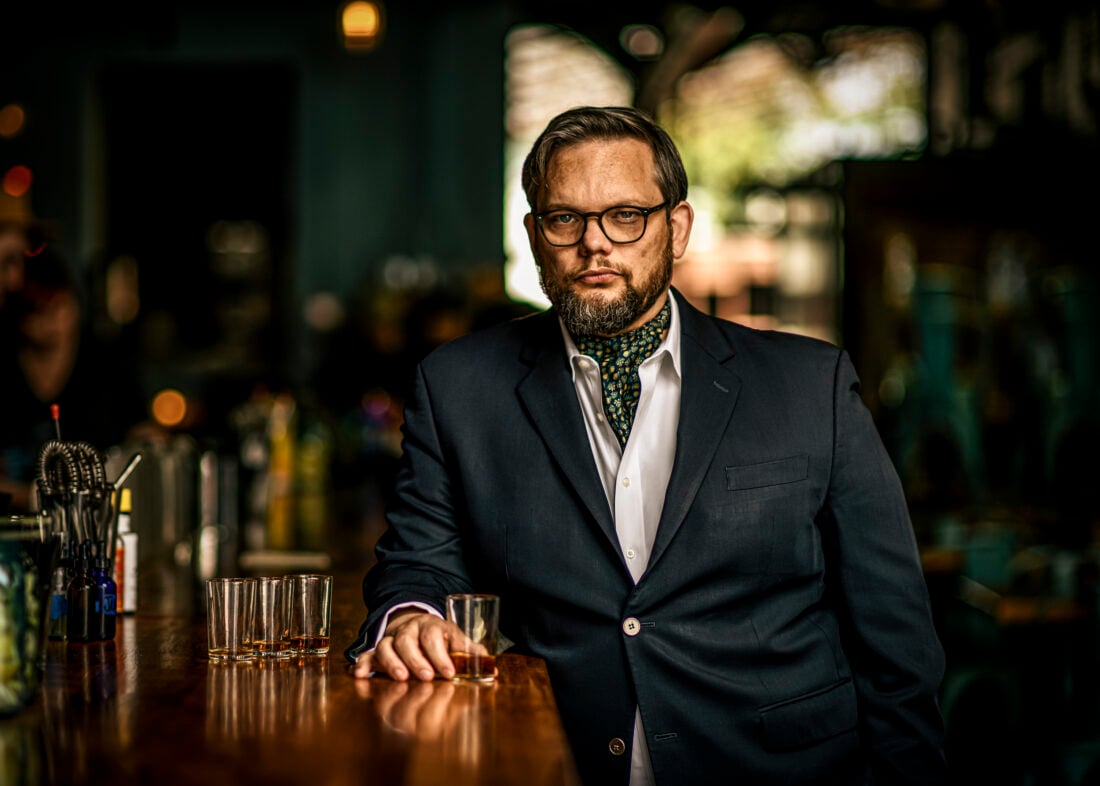
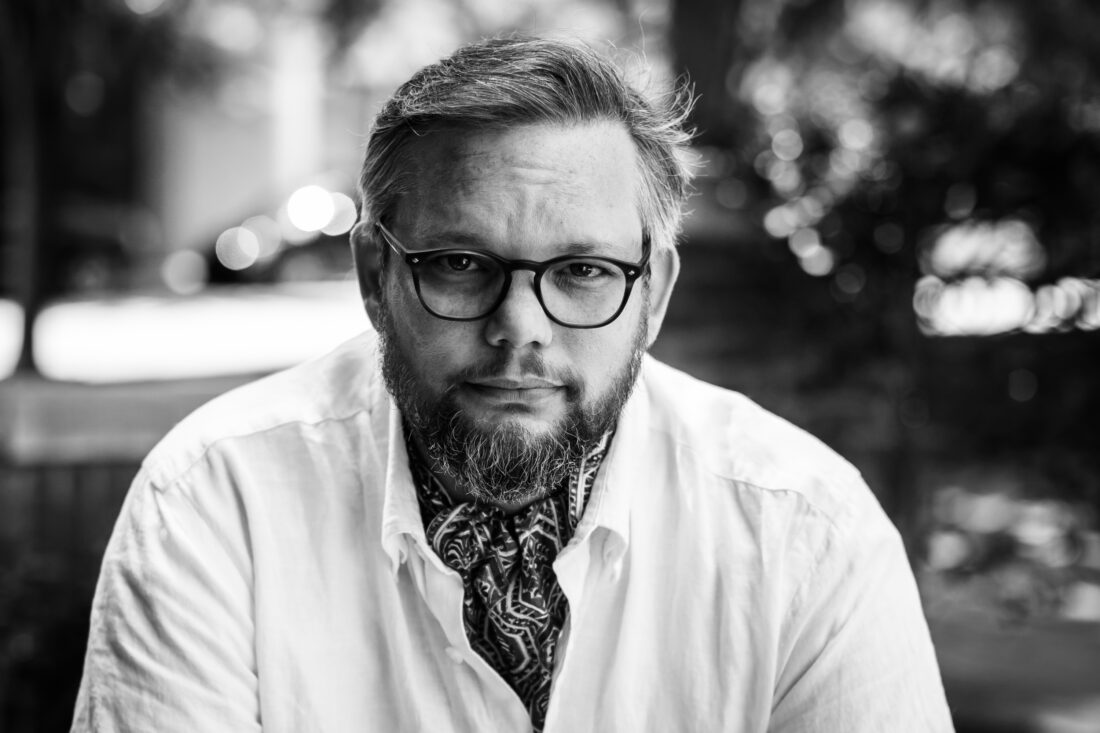
Fred Minnick is one of the best-known names in bourbon. He’s written several books and hundreds of articles on the subject, cofounded major festivals including Louisville’s Bourbon & Beyond, launched podcasts and tasting events with celebrity friends like Dierks Bentley and pro football Hall of Famer Jared Allen, and created the ASCOT Awards for bourbon and other spirits. But while even casual whiskey fans recognize Minnick and his influential palate, few know the role bourbon played in helping bring him back from the brink of despair.
Minnick touched on the subject during a Today show appearance in late 2021. Speaking remotely from his Louisville studio and wearing one of his signature ascots, shelves behind him crowded with bottles, he spoke about the psychological toll of his experiences as an Army photojournalist in Iraq. He recalled a June day in 2004 when, while on patrol, his unit was ambushed and a rocket-propelled grenade landed near his feet. “I thank God that that RPG was a dud,” Minnick said. “If it had gone off, I wouldn’t be here.”
That moment was one of several close calls during his deployment that followed him home, leading Minnick to seek therapy through the Department of Veterans Affairs and to an eventual PTSD diagnosis. Those experiences also contributed to his focus on bourbon, though not as an escape. What started as sensory-based therapy evolved into his four-point tasting method, in which he uses mindfulness techniques to systematically analyze a whiskey’s color, body, aroma, and flavors. It’s an approach that has made him one of the most-respected reviewers in bourbon and set him on the path to his remarkable whiskey career.
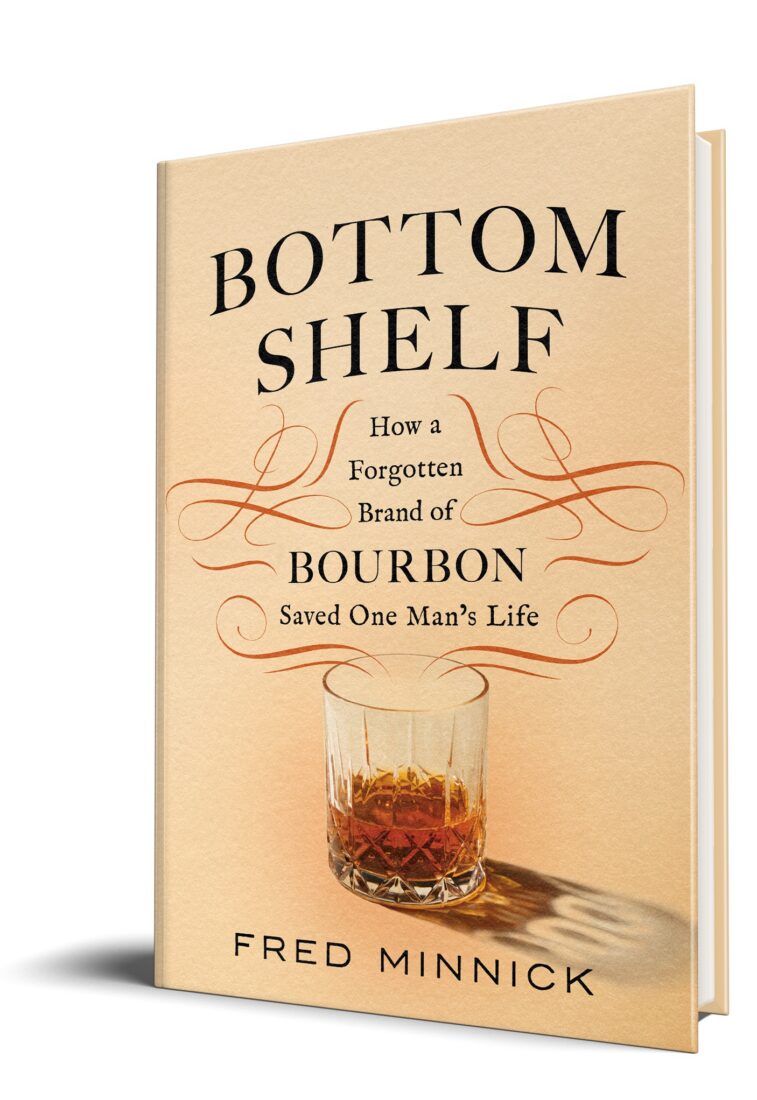
Minnick details this journey in his new book, Bottom Shelf: How a Forgotten Brand of Bourbon Saved One Man’s Life. Part memoir and part historical investigation, the book examines his wartime trauma, his struggles once he came home, and how an infatuation with a vintage bottle of Old Crow led him to a deeper appreciation of the modern bourbon revival. We spoke with Minnick to learn more about writing this decidedly personal book and how he found his way to whiskey stardom.
Your time in Iraq was clearly an inflection point. When did you enlist, and what drew you to the military?
I enlisted in 1996 and went to boot camp in ’97. 9/11 hadn’t happened yet, of course, but I was influenced by my grandpa who served. I grew up playing with G.I. Joes, and I wrestled and played football when I was younger. Today, I’m into jiujitsu. I’ve always liked physical challenges, and I was really intrigued by the idea of being pushed. The GI Bill paying 100 percent of my tuition didn’t hurt either.
You were deployed as a staff sergeant and photojournalist. What did that role entail?
The best comparison is Joker in the movie Full Metal Jacket. One day I’d be with an infantry platoon clearing streets and knocking down doors, the next with special forces training Iraqi soldiers. Sometimes I was sent into combat zones specifically to document the conflicts. I was sent all over the country, often just waiting to get shot at so I could photograph who was doing the shooting.
Bottom Shelf opens at an incredibly dark moment in your life, a suicide attempt just a month after you were married. Why was it important to start there?
I can’t fully tell this story unless I talk about what I nearly did and how hard it was for me to get to that point. No one knows how I got there outside of my wife [Jaclyn] and my therapist. This is the first time I’ve written about it, but I have a feeling there are a lot of people out there like me—people who didn’t feel like they had anything left worth living for. I just hope that sharing how I was able to get to where I am helps them, too. I try to be as explicit as I can about the idea that, if it’s not bourbon, find something else to focus on—something that can help you.
What role did the VA play in your recovery and when did mindful tasting enter the picture?
The VA saved my life. It gave me the tools I needed to live the next day and the next, and then suddenly you’re looking at it from the next week and the next month. Still, there were times when I’d look around and think, “Is there a sniper over there? Is that bag of trash an IED?” It wouldn’t necessarily ruin my day, but it kept me from being fully happy.
I was talking about this with my therapist, and she said, “You’re a foodie—let’s try something with your senses.” It started with a quarter. Anytime I had an issue, I’d touch a quarter. I’d think about how the ridges feel, how Washington’s head feels. I’d focus on that instead of whatever was bothering me.
Then we started focusing on smell and taste. It began with a barbecue potato chip. She said, “Put this barbecue potato chip on your tongue. Crunch it, close your eyes, and think about how the salts and sugars separate.” At the time, I thought, “This is ridiculous,” but I tried it. I’ve eaten a lot of barbecue potato chips, but I don’t think I’d ever really tasted one before. I could feel the salts and sugars granularly separating on my tongue. The whole point was to connect my brain to my palate and focus on that. It wasn’t about anything other than stopping my thought process in that moment. Then I thought, “Could I use this with bourbon?” That was when it clicked.
You’d been working as a writer on various subjects, from forestry to the restaurant industry and wine. What made you home in on bourbon?
My career was built from just trying to find opportunities to write about things I love. The first ten years, especially, were an incredible grind. I was going from making ten cents a word on some publications to having magazines that wouldn’t pay me. Anyone who’s been a freelance writer knows exactly what that’s like.
I went from trying to get anyone to let me write about bourbon to then having regular columns in places like The Tasting Panel and Whisky Advocate. Then I started writing books, and that was when things really took off. Everything I was doing was trying to get more opportunities to write, so I started doing events and tastings to be able to tie my books into it and spread this love I have for bourbon. Bourbon is meant to be enjoyed. It’s hard to read about bourbon and not drink it at the same time.
You write in the book about a transformative sip of bourbon not long after that first mindful tasting moment.
I wanted to learn more about Old Crow, so I set up a meeting with Jason Brauner of Bourbons Bistro [in Louisville]. He brought out an Old Crow Chess Piece [ceramic decanter released circa 1969]. I put it to my lips using that same mindful tasting technique, and everything stopped. It was a moment like no other. There’s the birth of my kids, seeing my wife walk down the aisle, coming home from Iraq—and then there’s tasting Old Crow Chessmen for the first time.
And you later learned that the whiskey in that decanter was most likely made at Old Taylor, not at Old Crow.
That’s one of the big revelations in the book—that Old Crow didn’t distill the whiskey I fell in love with. The whiskey industry has a long history of creative storytelling. Transparency is much better now, but back then they made stuff up all the time. James Crow wasn’t actually a doctor, and the Old Crow Chessmen weren’t made at Old Crow. It’s still a sore spot for me, in case you can’t tell, but that discovery pushed me deeper into research and into telling bourbon’s real history. I was on a mission.
Although the marketing may have been misleading, you argue that Old Crow played a key role in bourbon’s modern revival.
Jim Beam acquired the brand in 1987, and one of the big questions I wanted to answer was why Beam bought the National Distillers portfolio. Jim Beam was the dynamic, exciting brand of the 1980s, and National was a tired old parent company that couldn’t even outfit its stills correctly. Beam comes in, buys them, and uses that National Distillers whiskey to launch what became the Small Batch collection. I like to think that while it wasn’t named Old Crow, the whiskey that was meant for Old Crow helped start the bourbon movement in the 1990s.
You mentioned you practice jiujitsu. What has that brought to your life?
Well, I lost forty-five pounds getting active again through jiujitsu. I also wrestle with some of the Bellarmine [University] wrestlers from time to time. That’s a crazy workout. A lot of people love working out and lifting weights, but I want to fight. I want to grapple.
When I’m on the mat, I don’t think about anything else, because if I do, someone’s going to catch an arm real quick. You can’t think about a meeting later today or picking up the kids; you only think about being on the mat and that moment. It’s humbling, too. I’ve rolled with a sixteen-year-old kid who looked like a string bean, and before I knew it, he had me in a rear-naked choke.
What do you ultimately hope readers take away from Bottom Shelf?
I put a lot out there, and I’m excited to be able to talk openly about Old Crow, knowing my personal story is part of it. It’s all intertwined. But the whole point of putting this book together was to show what twenty years post-war can look like when you find something you love. Bottom Shelf is really the story of a twenty-year journey of finding myself in the most bizarre way possible—through bourbon.
Garden & Gun has an affiliate partnership with bookshop.org and may receive a portion of sales when a reader clicks to buy a book.
Tom Wilmes is a journalist based in central Kentucky who covers bourbon and other spirits, travel, and food. A contributor to Garden & Gun, he has also written for Whisky Advocate, The Local Palate, Southbound, and other publications. A Kentucky Colonel and Certified Executive Bourbon Steward, he has spent years reporting on—and indulging in—the culture he covers, a responsibility he doesn’t take lightly. Follow him on Instagram @americadistilled.
Garden & Gun has an affiliate partnership with Bookshop.org and may receive a portion of sales when a reader clicks to buy a book. All books are independently selected by the G&G editorial team.