

Land & Conservation
Ghost the Right Whale Had Her Ninth Calf at Age 50. Why Is She So Rare?
In late January, oceanside campers at a state park in Flagler Beach, Florida, spotted a dark, school-bus-sized mass drifting beyond the breakwater—a North Atlantic right whale, one of only about 380 left in the world. The pale, apparition-shaped mark on her head identified her as Ghost, who at fifty is believed to be among the oldest right whales alive. And swimming right beside her was one of the youngest. Four decades after birthing her first known calf, Ghost now escorted her ninth.
On the surface, it’s a remarkable feat of longevity. “The median survival of a right whale is about twenty-five years,” says Scott Rowley of the Florida-based nonprofit Amelia Island Whale Ambassadors. “She’s very unusual.”
But that doesn’t mean hers was truly a geriatric pregnancy. Ghost may be an elder among her peers, but her age likely has more to do with luck than genetics. Over the last decade, vessel strikes and fishing entanglements have killed at least twenty-six right whales and injured more than one hundred—roughly a third of the total population.
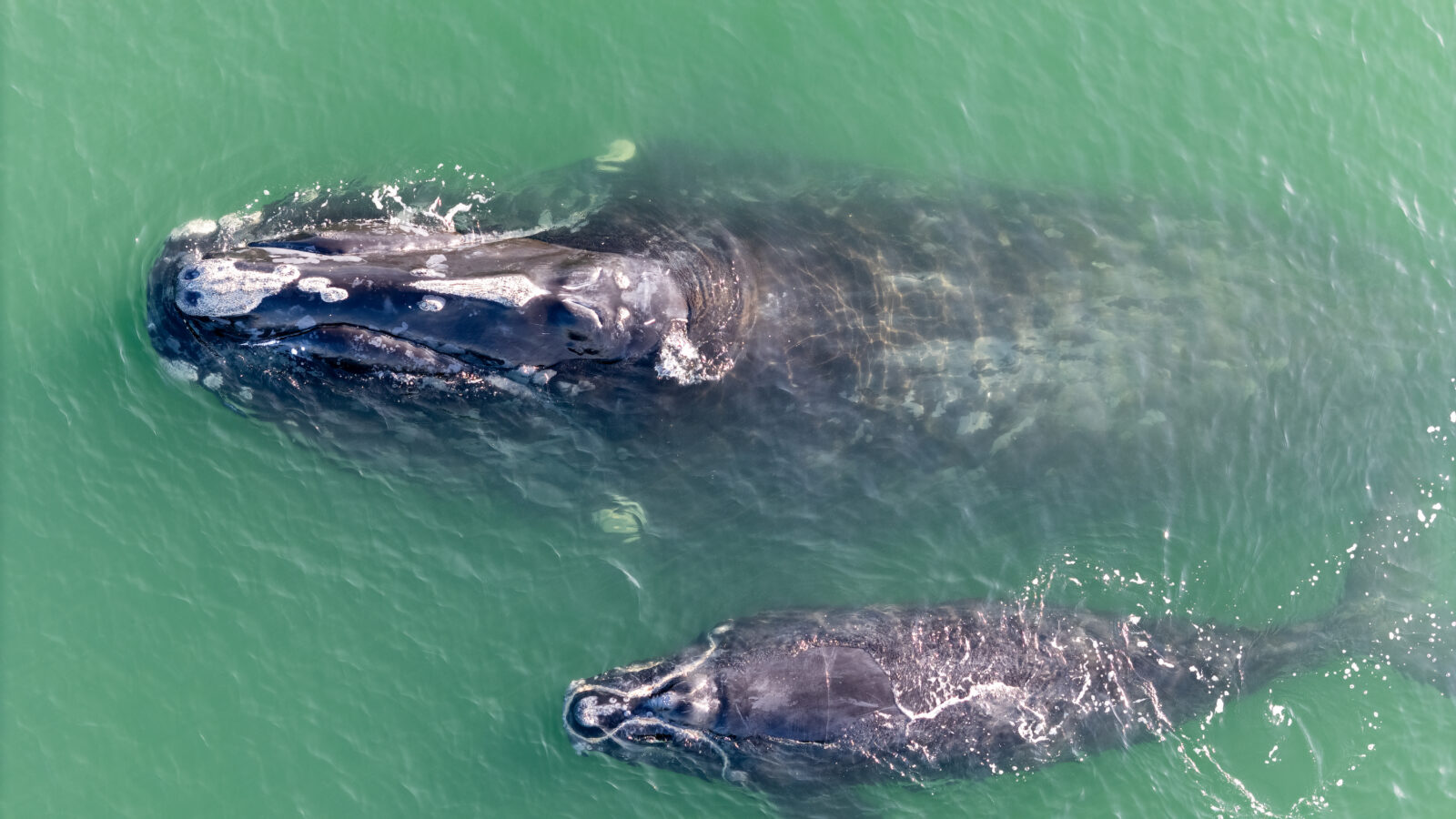
Photo: Marineland Right Whale Project, taken by Jeff Greene under NOAA permit #26562
Ghost swims beside her ninth calf near Flagler Beach, Florida, on January 30.
“These animals are not dying from old age. They are dying from human-related activities,” says Melanie White, director of the North Atlantic Right Whale Conservation Project at the Clearwater Marine Aquarium Research Institute. In other words, right whales may be able to live decades beyond fifty—if we let them.
Long Live the Whales
Right whales once cruised North America’s Atlantic coast by the thousands. Nearly hunted to extinction in the late 1800s before an international agreement banned the practice in 1935, the species has ebbed and flowed in number—but mostly ebbed—ever since, with fishing rope replacing harpoons as a deadly threat.
The biggest offender is lobster pots, says Greg Breed, a right whale researcher at the University of Alaska Fairbanks. Used widely off the coast of New England, they typically consist of a seafloor trap tethered to a buoy via vertical rope line. The masses of lines are “so dense that these animals can’t swim by. And they get one wrapped around their fin, and they just cut in,” Breed says.
Although ropeless lobster traps exist, the cost of retrofitting existing gear has prompted many in the fishing industry to lobby against their widespread adoption. “We have that technology. We could, if we wanted to, solve it,” Breed says.
In her five decades traversing the Atlantic, Ghost has only become entangled in fishing gear once, as far as researchers know. That makes her an outlier among her brethren, most of whom are “serially entangled through their whole lives, one after another,” Breed says.
The impact on a dwindling population is exponential. Besides killing whales outright, entanglements curb the ability of survivors to reproduce. “They have to use a lot of calories to carry the rope and any fishing gear that might be attached to that rope, and so because of the stresses, they don’t have the blubber preserves to carry the pregnancies,” Rowley explains.
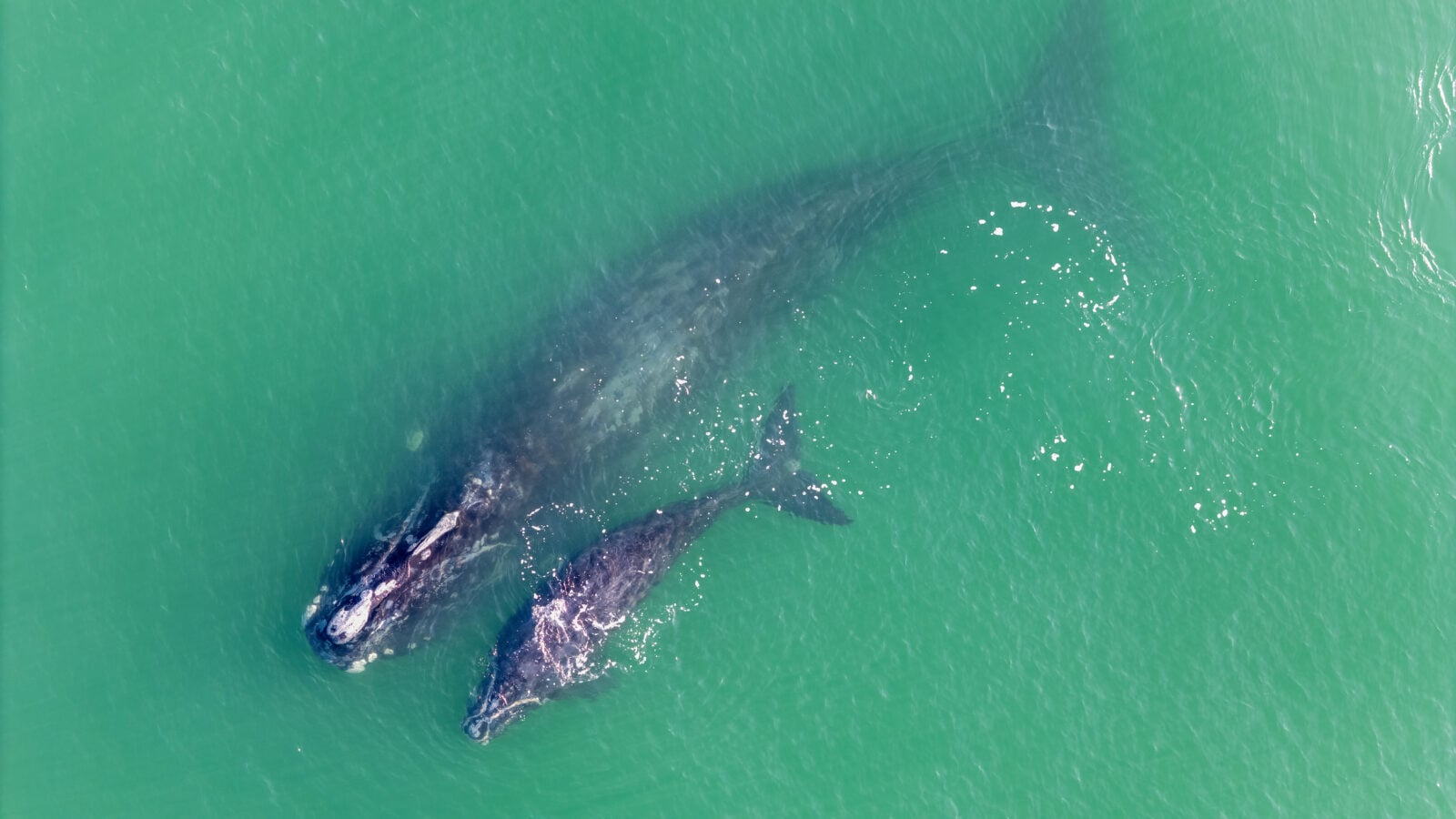
Photo: Marineland Right Whale Project, taken by Jeff Greene under NOAA permit #26562
Right whale calves can measure up to twenty feet long.
Researchers know from similar species of right whales from around the world that Ghost shouldn’t be an anomaly. “The North Atlantic right whale should really be living as long as the Southern right whale,” Breed says. “Which is to say, some large fraction of them should be over one hundred years old. They’re just dying much, much, much, much younger than they historically have.”
Indeed, Ghost isn’t the only older North Atlantic right whale mother on conservationists’ radar. Although not accompanied by newborns this year, Pediddle, Grand Teton, and Medusa—all first spotted in the 1970s and 1980s—join her in a small cohort of “senior” mothers believed to still be breeding. “This should be the norm,” Breed says. “They should all be living this long and calving into their fifties, sixties, and seventies.”
Eyes in the Skies
Between November and April, female right whales make their annual migration to the waters of the American Southeast, a kind of marine maternity ward where they birth behemoth babies that weigh around a ton and stretch nearly twenty feet long. Given that there’s no food source in the region, researchers aren’t sure exactly why the whales head south—perhaps it’s a combination of salinity, temperature, and calmer seas. Whatever the draw, it’s worth it enough for the expectant mothers, who starve themselves for months as they await their newborns.
During this time, from North Carolina down to Florida, researchers patrol the ocean by plane. “We can’t tag whales the way we can tag sharks or manatees,” Rowley says. “You can’t put an E-Z Pass or SunPass on them.”
Instead, aerial teams monitor their movements and alert nearby vessels to avoid collisions. “When you do find them, everybody in the plane gets giddy,” White says. Even more exciting? Spotting the (relatively) little ones swimming beside their mothers—a scene observed twenty-two times this calving season.
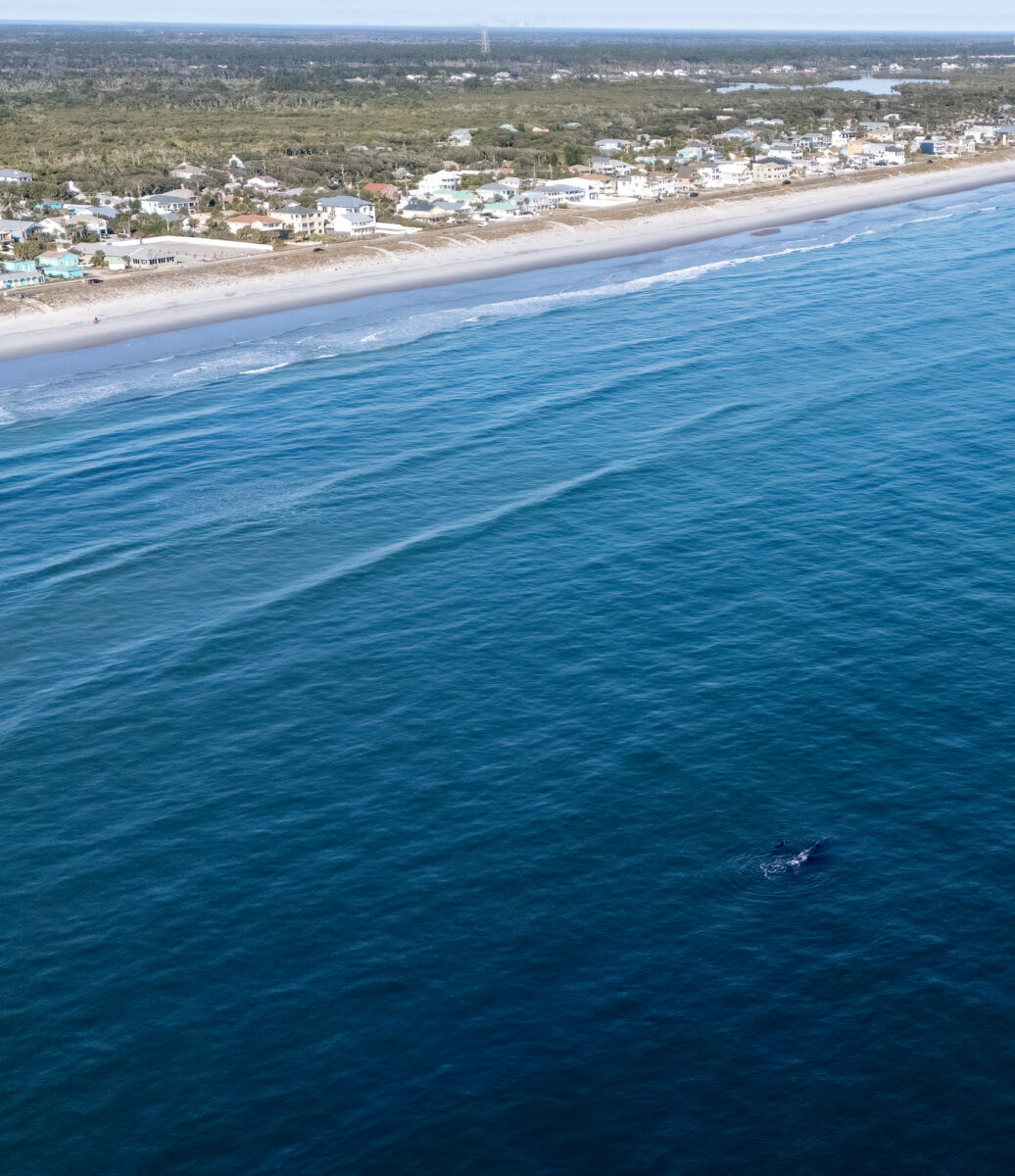
Photo: Marineland Right Whale Project, taken by Jeff Greene under NOAA permit #26562
An aerial view of Ghost and her calf.
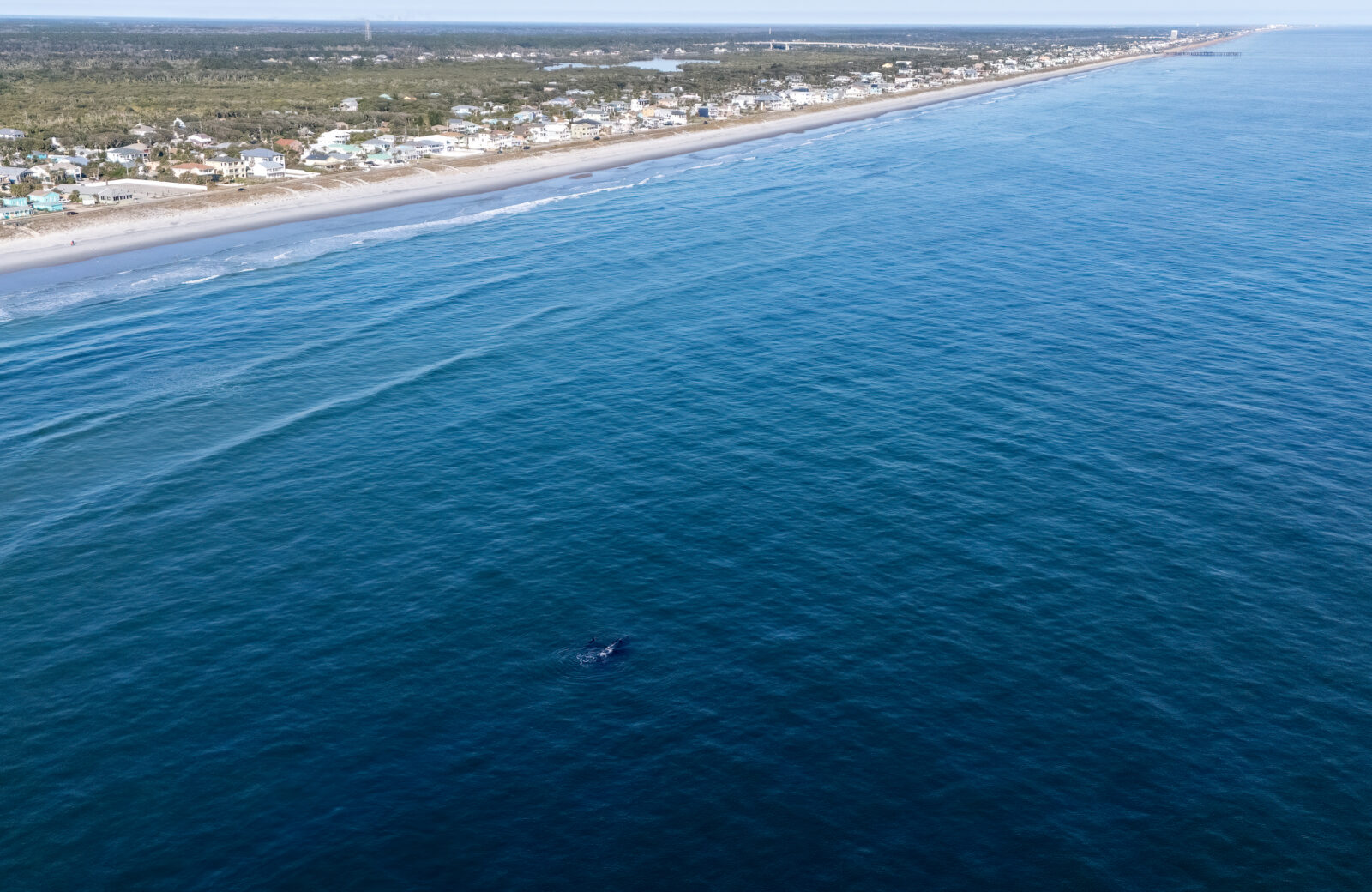
Photo: Marineland Right Whale Project, taken by Jeff Greene under NOAA permit #26562
An aerial view of Ghost and her calf.
“We’re thrilled,” White says. “That is up from what we’ve seen in previous years. We need these animals to be producing more calves more frequently. If they can stay healthy, they are capable of building this population.”
Few have done more for that cause than Ghost, who’s had a calf at her side in nearly every sighting since 1985. Still, her case alone isn’t enough to signal a brighter future for the species. “It would be more hopeful if we were seeing more positive things about the individuals in their twenties and thirties—a decline in entanglement rates, increased calving rates, decreases in time between consecutive calves,” Breed says.
More than anything, Ghost is a reminder that there should be far more whales like her swimming our shores. She is a symbol of what’s been lost and what, perhaps, could still be.
“It goes to show that these animals are capable of living extremely long lives,” White says. “We just need to keep them safe so they can do so.”
If you spot a right whale in North Carolina, South Carolina, Georgia, or Florida, contact NOAA’s hotline at (877) WHALE-HELP/(877) 942-5343
Helen Bradshaw is a freelance writer and a born-and-raised Floridian. As such, she has an aptitude for finding alligators and an affinity for the weird and wonderful stories of the South. She graduated from Northwestern University with a focus in environmental journalism.
Related Stories:
Conservation
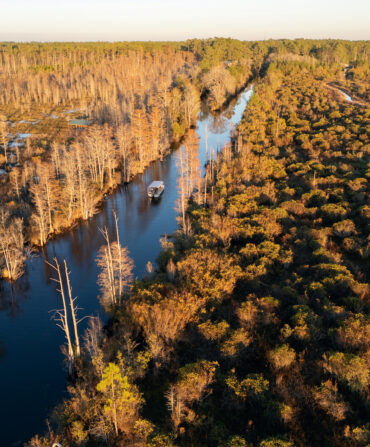
Through the tales of those shaped by its waters, shaded by its cypress trees, and calling for its protection, Georgia’s ancient swamp still speaks

Sporting
Elmer Crowell miniatures, a life-size bronze pointer sculpture, and Ernest Hemingway’s marlin catch flag
Conservation
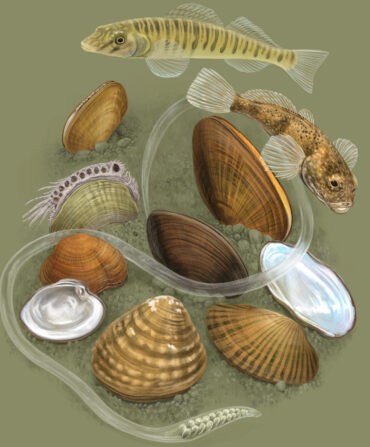
Why the region’s secret—and imperiled—freshwater ecoweapons deserve your respect
Trending Stories:
Land & Conservation
The future of conservation in the South just got a little bit brighter—and not just for salamanders

Land & Conservation
The mounds may look insignificant, but they’re the craftsmanship of local crustaceans called lawn lobsters

Arts & Culture
The drawls are receiving a lot of flak across the internet, but a North Carolina linguist argues they’re actually pretty accurate