

Sporting
On the Hunt for the Wily Rio Grande Turkey in the Hills of Central Texas
After decades of hunting wild turkeys through the Southeast’s bottomland swamps and hardwood forests, the author heads deep into the Lone Star State’s sandy, mesquite-strewn heart
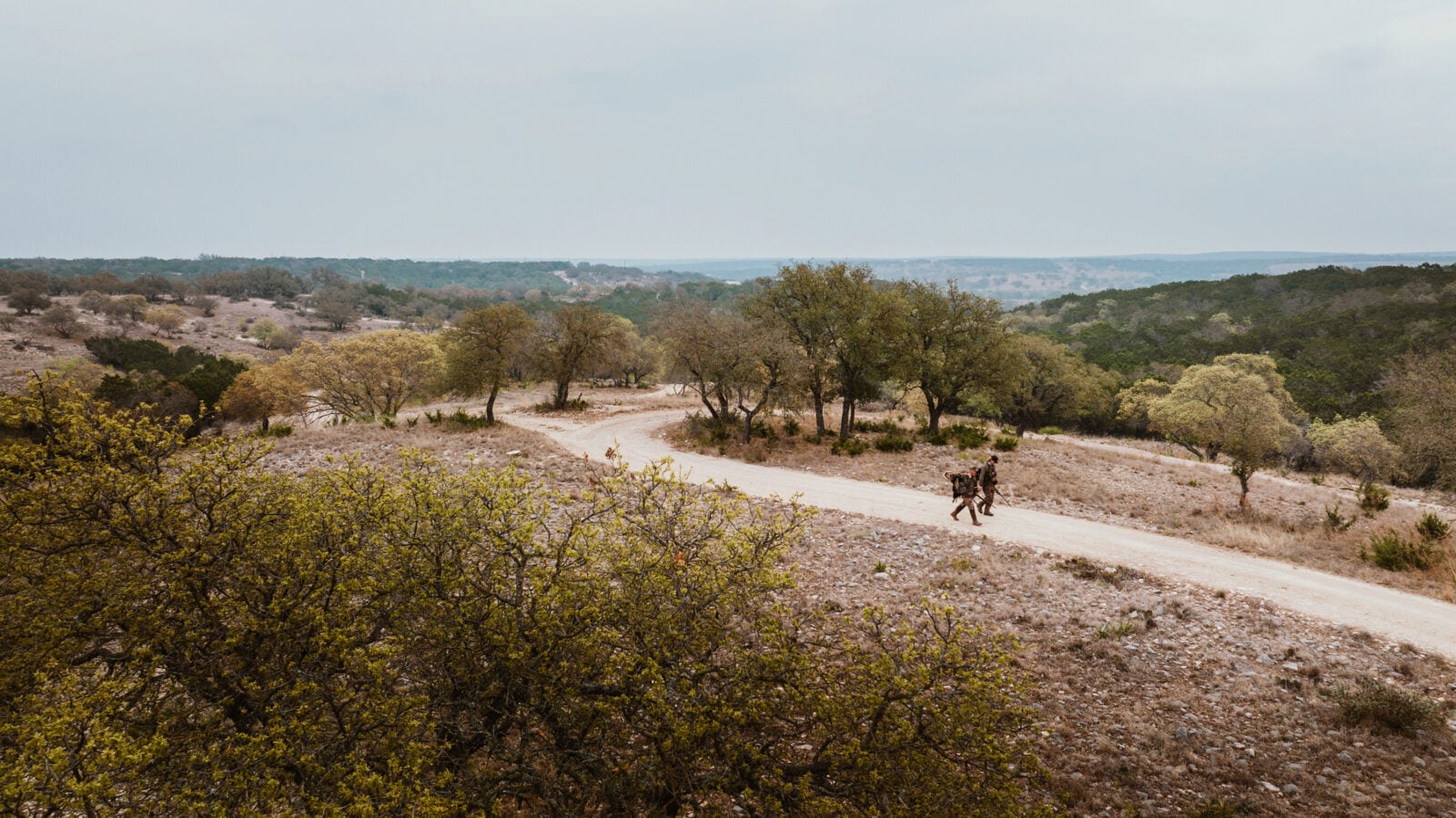
Photo: NICK KELLEY
The author and Jared Larsen at Two Dot Ranch, in the Texas Hill Country.
We came down from the ridgetop in the early light so we could walk without flashlights—the last thing we wanted to do was bump the roost. Hunt turkeys often enough, and you develop a sixth sense about how far you can push your luck around a bunch of sleepy-eyed fowl at dawn. You can gauge their mood by the timbre and pitch of their soft, muffled tree yelps and clucks. If you hear that kind of pillow talk, you know the birds are undisturbed and unalarmed.

The day before, my buddy Brooks Hansen and I had walked nearly six and a half miles around this Texas Hill Country spread, enough to soak through our shirts three times. We heard wild turkeys everywhere. By the end of the day, as we washed Two Dot Ranch dust from our throats with bourbon and beer, I estimated I had heard three hundred, maybe even up to four hundred, turkey gobbles. So many it was hard to be sure. Coming up with a precise figure for how many turkeys Brooks and I had actually seen, however, was a snap: never a one. All that yakking, and not a single bird ever showed.
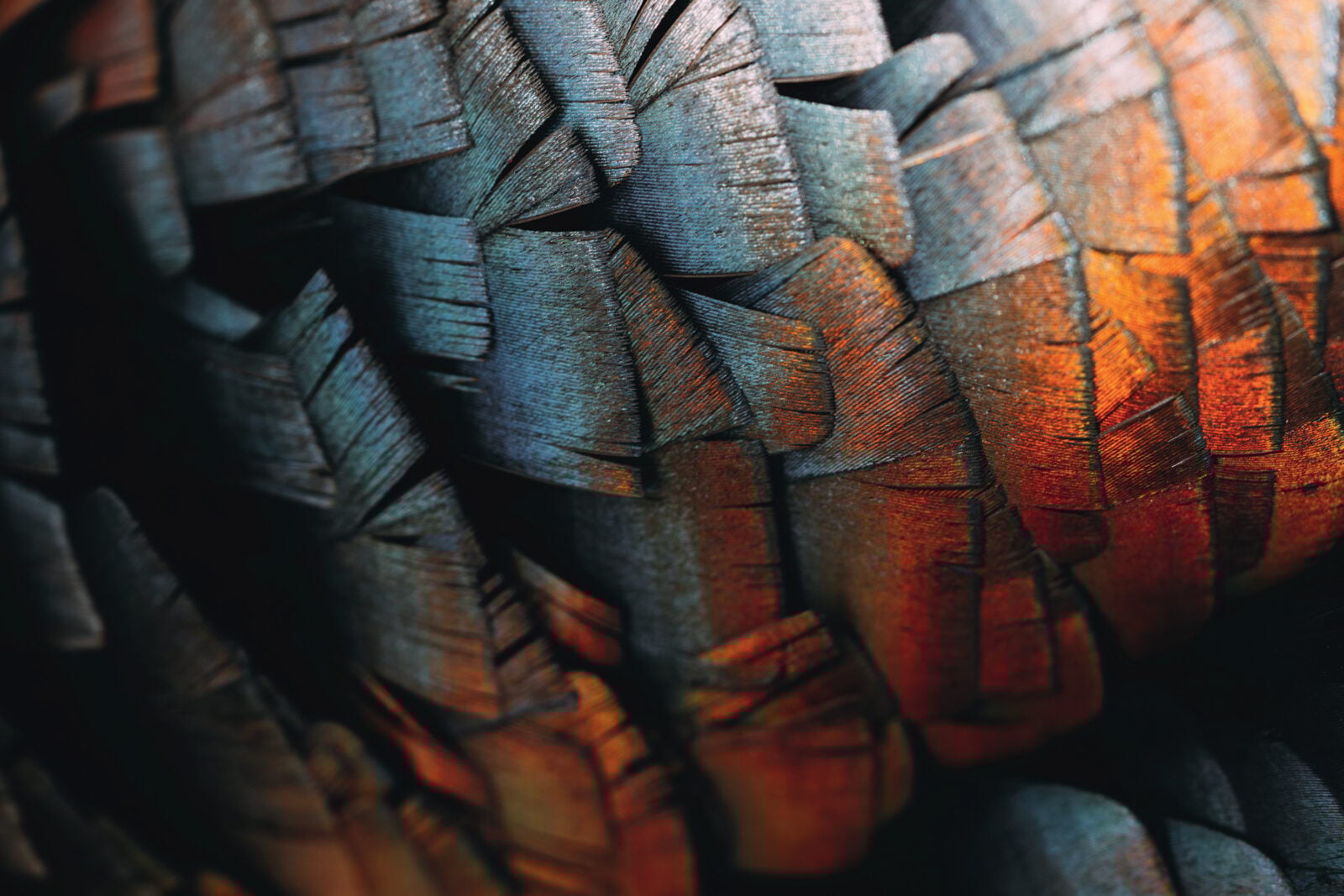
Photo: NICK KELLEY
Iridescent blue-bronze turkey feathers.
I was a little uptight, then, as Jared Larsen and I moved the next morning as close to the roosting trees as we dared. Larsen was down from Montana, where he runs marketing for onX, a popular mapping app used by hunters and other outdoors-people (he also happens to be perhaps the best turkey caller I’ve ever heard). Together we found a perch at the base of a scrubby mesquite. As I tried to still my heart from the walk in, the turkeys began yelping and gobbling like crazy, flying down from the tree to start their day. Wild turkeys everywhere tend to roost in flocks, but Rio Grande wild turkeys, the subspecies we were after, can establish communal roosts with more than a hundred birds. I listened for a few moments, awed. It was the most turkey sound I’d ever heard coming from one spot. Larsen leaned over with a corroborating assessment, wild strawberry-blond curls framing his face. “That’s a lot of shit talking,” he whispered.
I found the birds in my binoculars, so many in a single tree that it looked as if it had been taken over by mistletoe clusters. For twenty minutes, who knows how many wild turkeys chattered away, just on the far side of a tall ranch perimeter fence. My heart sank. In my experience, wild turkeys don’t like crossing fences. Or creeks. Sometimes, all it takes to stop an eastern wild turkey in its tracks is a weird-looking stick on the trail.
Then all of a sudden, one of the birds launched from the ground and, in an ungainly move—part flop, part flight—flew up and over the fence. “Well, I’ll be damned,” Larsen muttered, the fence-hopping turkeys just as much of a surprise to him. And the damnation continued as ten more birds hopped, skipped, and flapped over the fence and beelined toward us. Within two minutes, Larsen and I had turkeys in front of us, on both sides, and behind. But not the right turkey. In the height of breeding season, eleven hens had strolled in without a single gobbler trailing behind. Not a longbeard in the bunch; we would have settled for even a straggly-goateed turkey, but nothing doing.
“Are you kidding me?” Larsen hissed.
It was ridiculous. Except for this: Hunt turkeys long enough, and you will eventually learn that everything you know about wild turkeys means nothing at all to the wild turkey itself.
At least Two Dot was a pretty place to learn just how little I can rely on what I know about turkeys. A two-thousand-acre chunk of rolling rimrock, gnarled mesquite woods, and grasslands, Two Dot was once part of the famed YO Ranch, a historic property purchased in 1880 to be the headquarters for the Schreiner Cattle Company, whose owner, Charles Schreiner, made more than a bit of pocket change over the years driving longhorn cattle from Texas up to Dodge City, Kansas. (Some seventy years later, Schreiner’s grandson, Charles Schreiner III, would be credited with helping bring back the Texas longhorn from near eradication.) The YO and the Two Dot therefore figure heavily in Texas history and lore. The Texas Rangers, an outfit the elder Schreiner had joined when he was just sixteen, even used them as a training ground and retreat. And in 1943, family members leased out much of the YO for deer hunting. It was the first ranch to do such a thing in Texas, kicking off a tradition of big-game and exotic-animal hunting that shapes the state’s landscape today as much as longhorn ranching did in the nineteenth century.
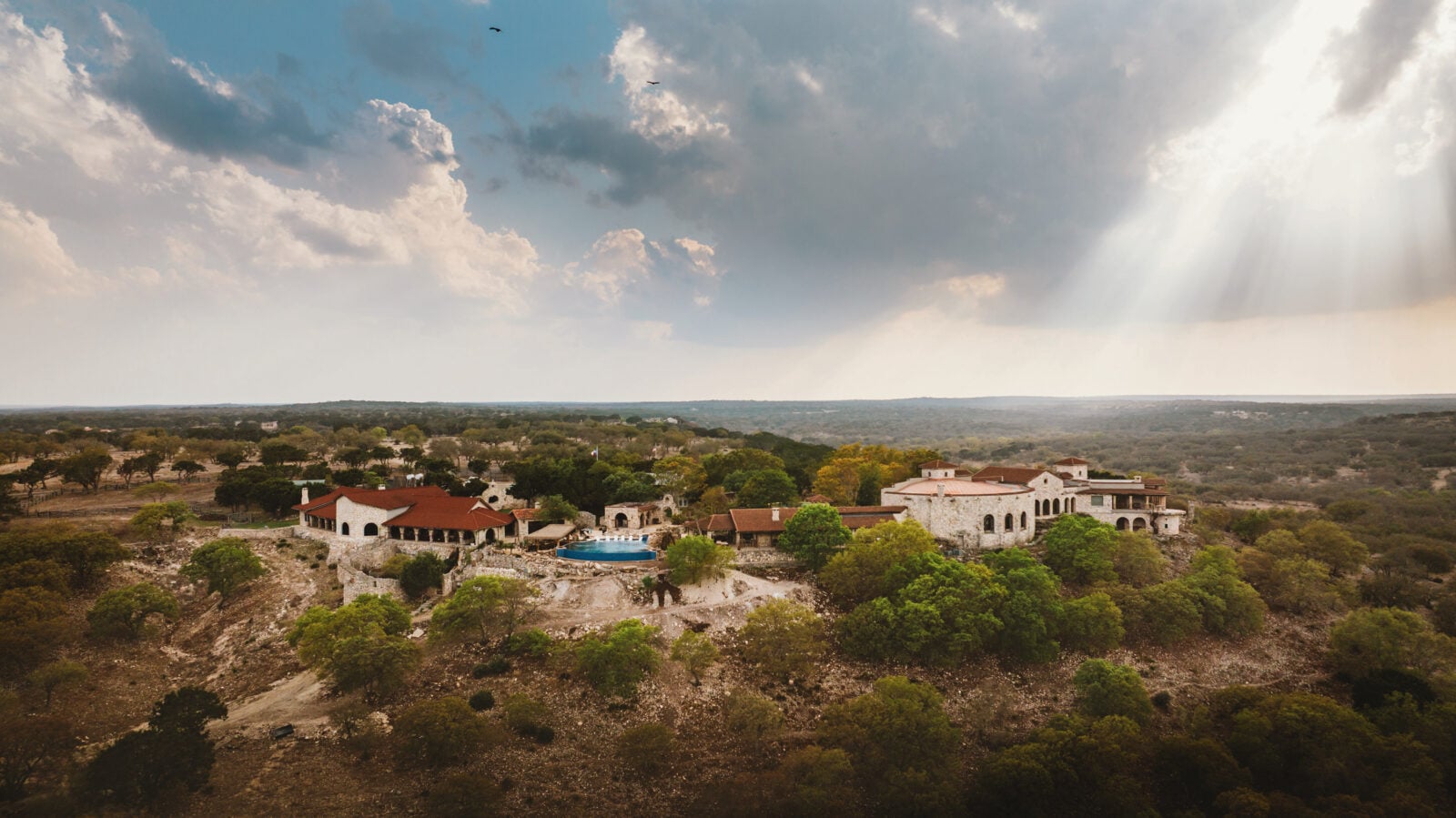
Photo: NICK KELLEY
Two Dot Ranch’s resort-style lodgings.
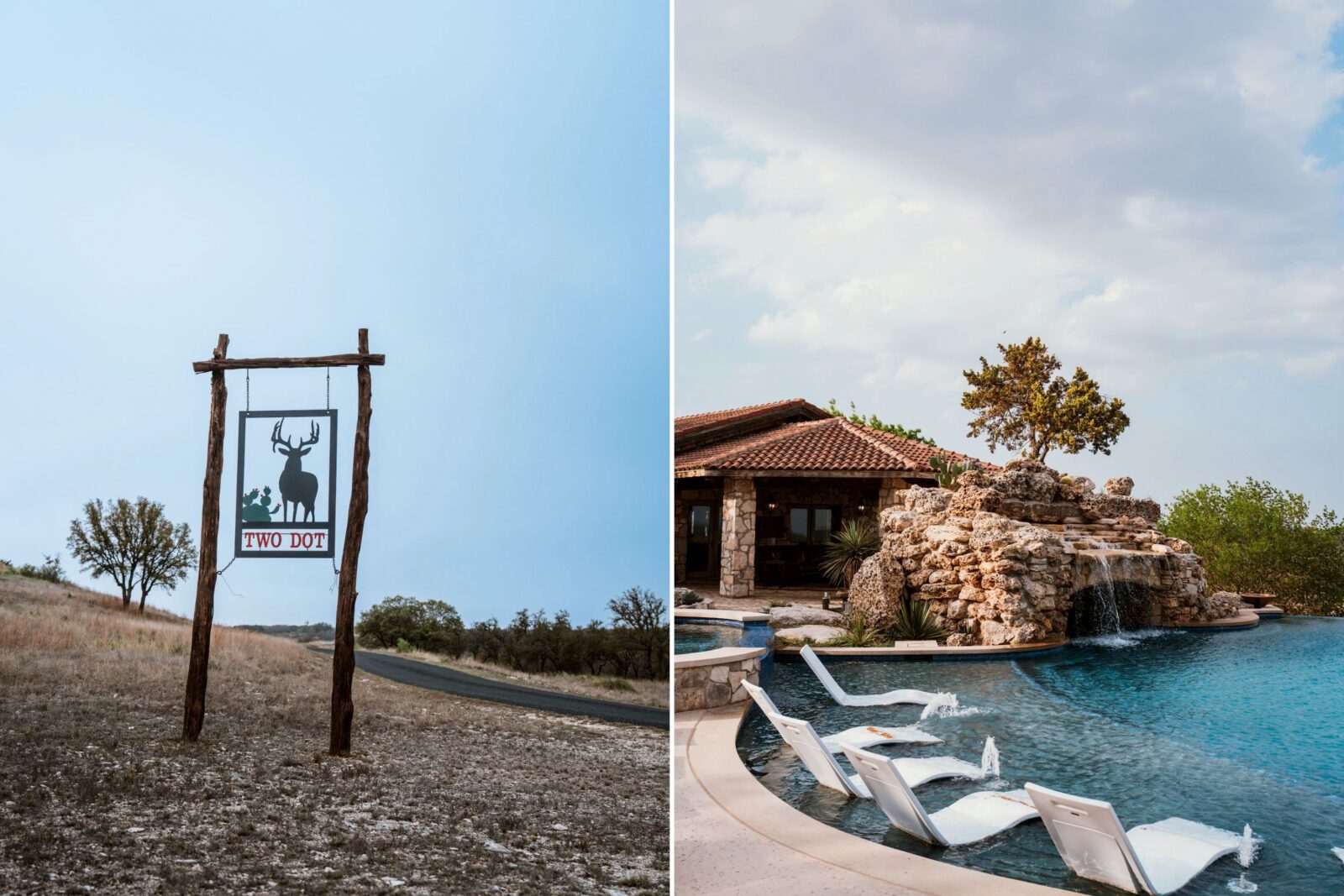
Photo: NICK KELLEY
Two Dot welcome signage; Two Dot’s infinity pool.
Two Dot Ranch now shares with the YO both a border and a reputation as a luxury hunting destination for such game, from Texas white-tailed deer to far-flung species that include African aoudad rams and Dall sheep. And in the case of Two Dot, it put my group in some seriously fancy digs. The main lodge soars from a high ridgetop with a Serengeti-like view—an infinity pool beckons. Room after room holds a trove of eclectic displays: ancient fossils found on the property. Texas Rangers memorabilia. Massive paintings of lions and elephants. A trophy room furnished with antique doors.
It was like no turkey camp I had ever wandered into.
Something was moving on the ground behind me, just behind the crest of a sandy hill. Something that stopped and then started and scurried. A serpent-y something, or rodent-y something. Possibly a turkey, but for all I knew, a roadrunner, a rattlesnake, or a chupacabra.
As I craned my head around the bole of a mesquite, slow and easy, to get a look, I pressed my palm into an unseen cactus and muffled a yelp. This was some funky turkey country. There wasn’t a white oak in sight. The nearest greenbrier thicket was who knows how many miles away. Ditto a bottomland swamp. I was tucked under a rocky rim, snaggletoothed with more sticky, spiny things, and shattered white limestone spackled the ground.
The something moved off, and I may have heard, or perhaps just imagined, the cluck of a turkey. But the gobble that came next was unmistakable: loud and long and pretty far off, high-pitched and laugh-like as Rios sound. I shook my head, unsure of my next move. A strong wind was blowing, and back home in North Carolina, in that kind of wind, turkeys tend to move into fields to avoid swaying tree branches and rattling leaves that blunt their ability to spot predators. Here, with so much open country, I wondered if the birds might instead seek out thick cover to get out of the wind. Should I call with more volume, to punch through the gusts? Try to move through this rangeland without sounding like the Tin Man? As I pondered, seven white-tailed deer gave us a wide berth. We were pinned down, and not for the first time.
Earlier in the day, Jared Larsen and I had picked our way through a dry, rocky creek bottom to close the distance on a gobbler with a big mouth. As we crept the last few feet to the edge of the riparian woods, a blackbuck antelope met my gaze forty yards away. I eased up my binoculars. He stared back with white-spectacled eyes. Between us and the gobbling turkey, a scattered dozen-odd blackbucks and axis deer grazed on the savanna. A lone red stag emerged from the brush. There was no way to even twitch without having all those eyeballs catch us.
We backed down the creek, defeated. I was feeling more out of my element than ever before. Ironic, considering I might have been closer to the ancestral home of the North American wild turkey than anywhere else I’ve ever hunted. About three and a half million years ago, an early form of wild turkey expanded from Mexico into the central United States. Stymied by deserts, those birds then moved east, ultimately splitting off into five distinct subspecies: Gould’s, Merriam’s, eastern, Osceola, and Rio Grande. I may chase easterns through classic hardwood and piney-flat habitats, but they are relative newcomers to my corner of the continent. The mother range of wild turkeys in North America was marked by mesquite, not white oaks, and Larsen and I are chasing birds that are closer to the very essence of what a wild turkey is than any other variety I’ve had the good fortune to be made a fool by.
These Rio Grande birds also represent a relatively bright spot during a tough time for wild turkeys, which have experienced a well-documented period of decline across the Southeast and Midwest. As Jason Hardin, the wild turkey program leader for Texas Parks & Wildlife, told me later, “If you look at Texas, we’ve actually held our own, except for the Rolling Plains and portions of North Texas.” And Rio Grandes in the Hill Country, he notes, most recently benefited from a pair of back-to-back years with excellent spring breeding conditions.
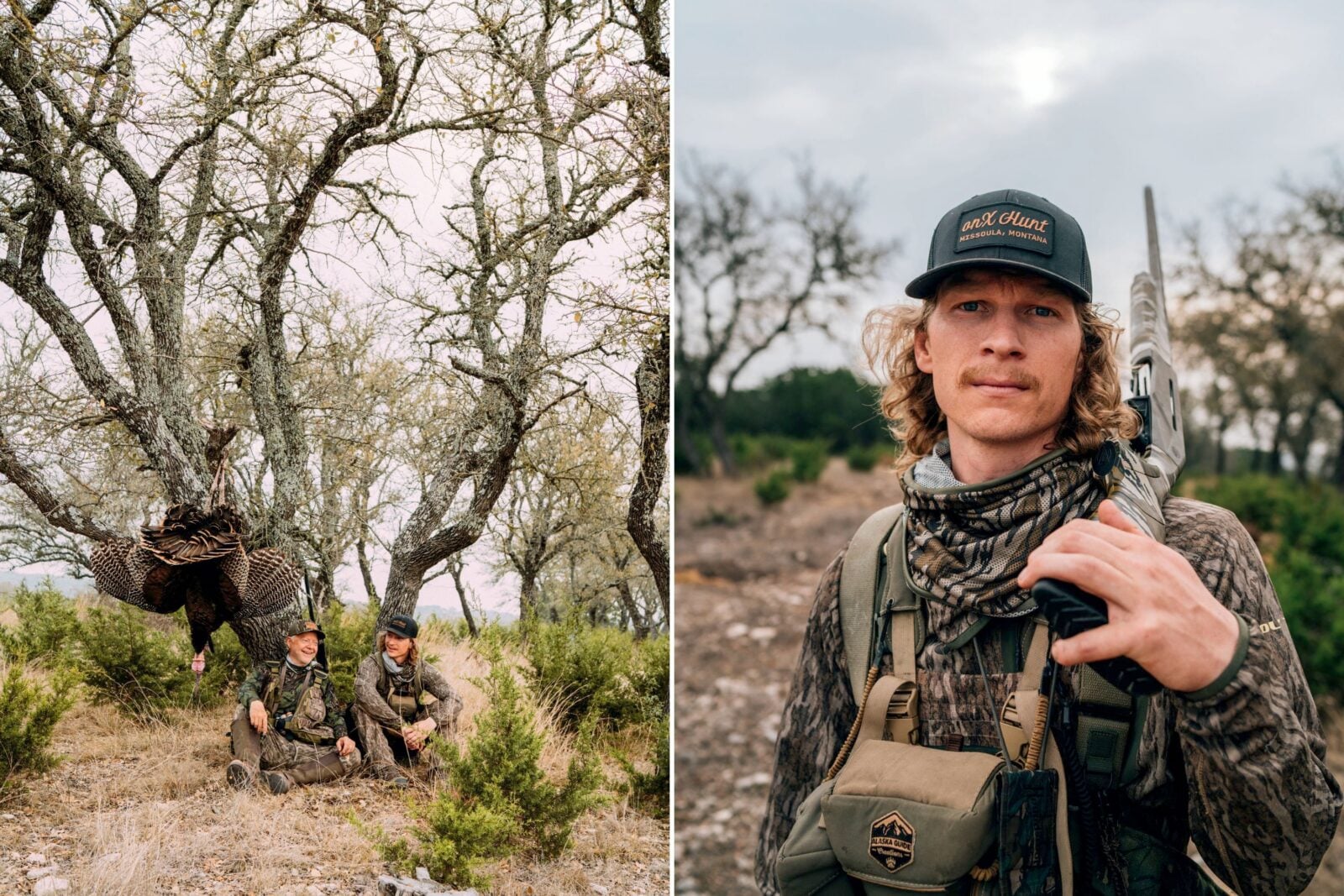
Photo: NICK KELLEY
The author and Larsen with a downed tom; Larsen at the ready.
When Larsen and I took a break for lunch back at the ranch, we were greeted by two such Rio Grandes lashed to a live oak. Big birds, with dusty feet and significant spurs, beards dangling toward the ground. Two of our fellow hunters had hit the jackpot, and they were still wild with excitement. “It was the whole show,” crowed an exultant Adam Heggenstaller, who as the director of communications for the Rocky Mountain Elk Foundation has seen a wildlife show or three. “They came in side by side, gobbling the whole way. It was incredible. Everything you could ever imagine in a turkey hunt.”
I spread one of the bird’s tail feathers into a fan to see the difference between these turkeys and the more familiar birds back east. Rios are slightly smaller than easterns, but the primary difference lies in the off-white tail feather tips and the tips of the tail coverts, those feathers that cover the lower portion of the tail. I ran my hands along the black-and-ivory flank feathers and touched a fingertip to the spurs. The hunters were still chattering away, reliving every moment of the hunt. That’s one of the meaningful aspects of a hunt camp: Through the stories, one person’s success and excitement are passed on, like a flame. Anyone’s success is everyone’s success.
But only to a point. I had one chance left.
On my third and last morning in the Hill Country, I was the lone hunter in the group to remain turkeyless. Another hunter, Rachelle Schrute, had brought in a dandy of a bird, felled at long range but without a single sign of a pellet strike. I had a midafternoon flight home and a few hours on the road to the airport before that, so the clock was ticking. Hunting, of course, is about more than pulling the trigger. The chance to move through unfamiliar country is its own reward, and companionship and making new friends are significant payoffs in any hunting camp. But it’s also true that I didn’t come to Texas for a nature hike.
We started that day in a familiar cadence, posting up in a spot overlooking a wide flat, in open country that would allow us to hear any turkey within a couple of miles. Larsen showed me the onX map on his phone; he had dropped waypoints on the estimated locations of nearly every bird he’d seen or heard these past three days. I could see four different gobblers marked in our general area, plus an outlier waypoint that indicated a bird Larsen had heard the day before. Our calls, however, were met by silence.
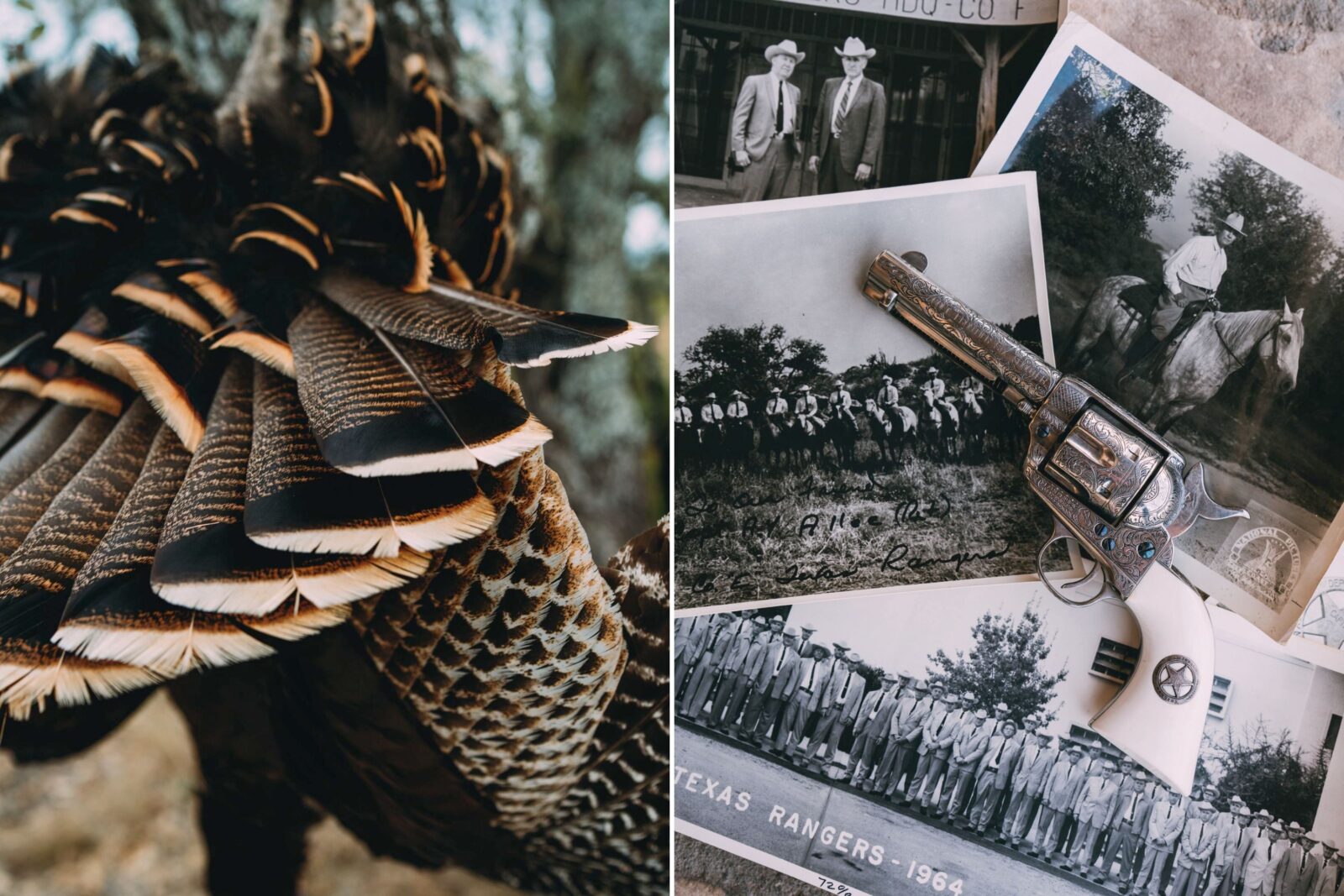
Photo: NICK KELLEY
Rio Grande tail feathers; Texas Ranger memorabilia.
Larsen tossed out a last-ditch yelp, one raspy and accusatory like he was double-dog daring a gobbler to answer. From far off, in the direction of that outlier waypoint, came a gobble.
Larsen looked over. “Your call,” he said. “What’s in your turkey brain right now?”
I hesitated for a few brief seconds. It was now or never.
“Let’s chase that bird,” I said. There is a moment in every difficult hunting or fishing trip when you know that it simply isn’t going to happen. That the thing you’d planned and prepared for is out of reach, and the red gods are against you, and you have to make a choice: Do I leave defeated, or do I find comfort in the defeat, a kind of solace from the knowledge that wild animals still hold an ace or two? It’s a mental switch, and a shifting of spirit.
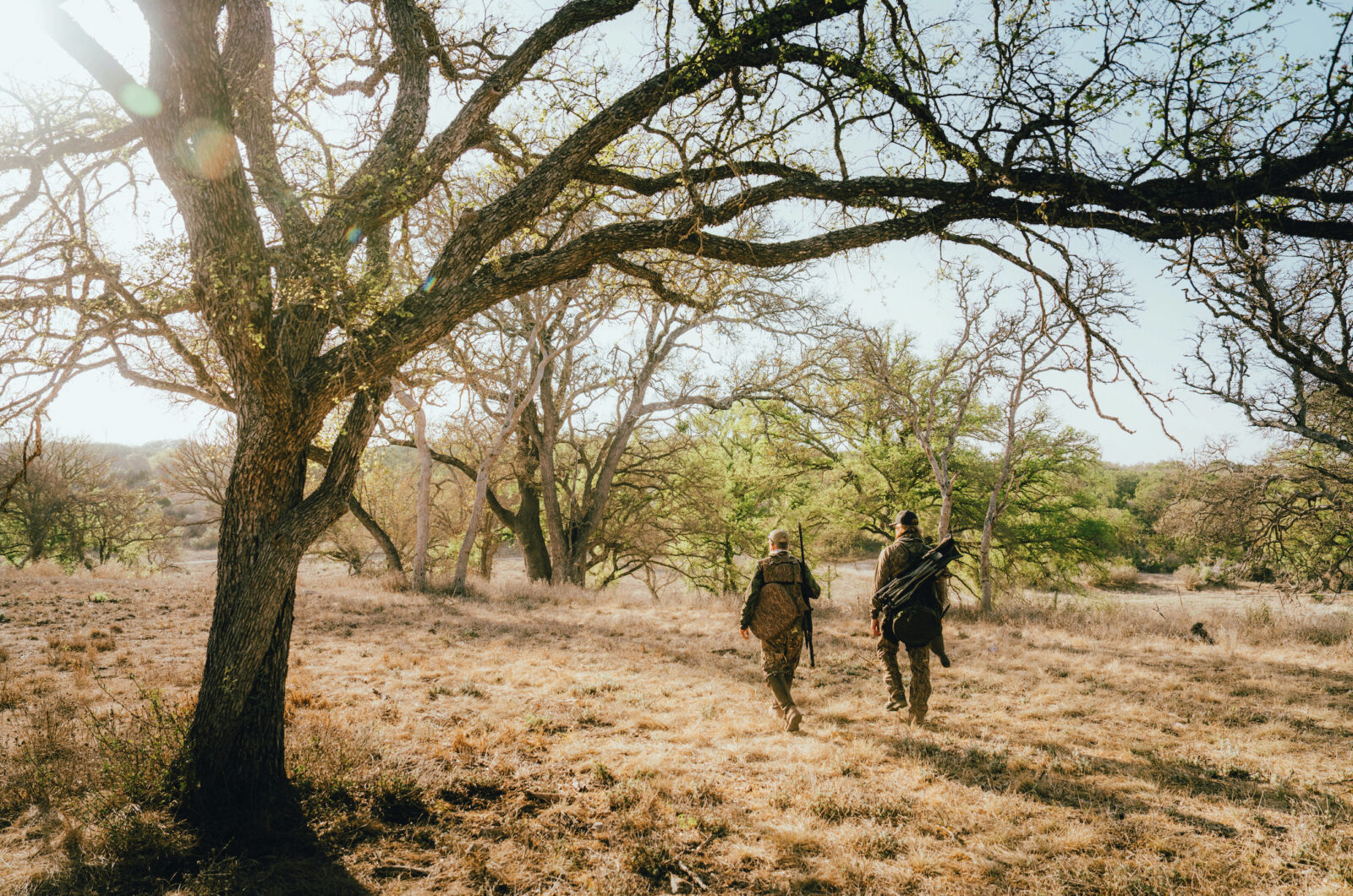
Photo: NICK KELLEY
The author and Larsen make a late-morning move in search of more gobblers.
I made that switch as we climbed out of scrub woods to the top of the ridge and double-timed toward the long-distance bird. It’s not that I’d given up. Still, I was reassembling memories so that the story I would recall of my Texas turkey hunt would center around achieving an even greater respect for the bird and a deeper appreciation of this rugged country. That’s what getting skunked does for you: forces you to choose which story you will tell yourself.
And that’s when I saw the turkey.
I was in front of Larsen and looked to my right and the strutting gobbler was in full unobstructed view. He stood in a sandy opening in broken mesquite and juniper, fan fully extended, sunlight caught in the tips. He was facing away.
I threw my hand up and hissed: “Bird!” Larsen halted mid-stride, his left foot in the air like a pointing dog cocked at a covey.
I looked down at the ground, tucked in my arms, and tried to make myself as small as possible. The gobbler was twenty yards away behind dense brush. He gobbled. Another bird answered. They were close. Very close.
I eased up my face mask over my nose, and we crab-walked to cut the distance until Larsen hung behind. “If I cluck fast, just rise and shoot,” he whispered. “That’ll be the only play we have.”
Now both birds were tangling on the far side of the trees. Ten yards away, I could hear the fight, the wings flapping, the sound of grappling.
A few more yards of belly crawl, and the sound of the fighting began moving away. I slowly rose, and over the tops of the brush, I could see the birds, necks crossed like swords, the fleshy throat wattles backlit and as red as cherry ICEEs.
When the swords uncrossed, I pulled the trigger. Last day, last minute.
Who would want it any other way?
T. Edward Nickens is a contributing editor for Garden & Gun and cohost of The Wild South podcast. He’s also an editor at large for Field & Stream and a contributing editor for Ducks Unlimited. He splits time between Raleigh and Morehead City, North Carolina, with one wife, two dogs, a part-time cat, eleven fly rods, three canoes, two powerboats, and an indeterminate number of duck and goose decoys. Follow @enickens on Instagram.
Related Stories:
Conservation
Her longevity hints at a century-long lifespan most of her species will never reach
Conservation
Through the tales of those shaped by its waters, shaded by its cypress trees, and calling for its protection, Georgia’s ancient swamp still speaks
Sporting
Elmer Crowell miniatures, a life-size bronze pointer sculpture, and Ernest Hemingway’s marlin catch flag
Trending Stories:

Recipe
Garlic, white wine, and a hint of umami from anchovies kick up the childhood comfort food in a new cookbook all about butter

Distilled
Where to belly up for “dusties” in the South and beyond

Home & Garden
Let ’mater master Frank Hyman narrow the field to a delicious quartet