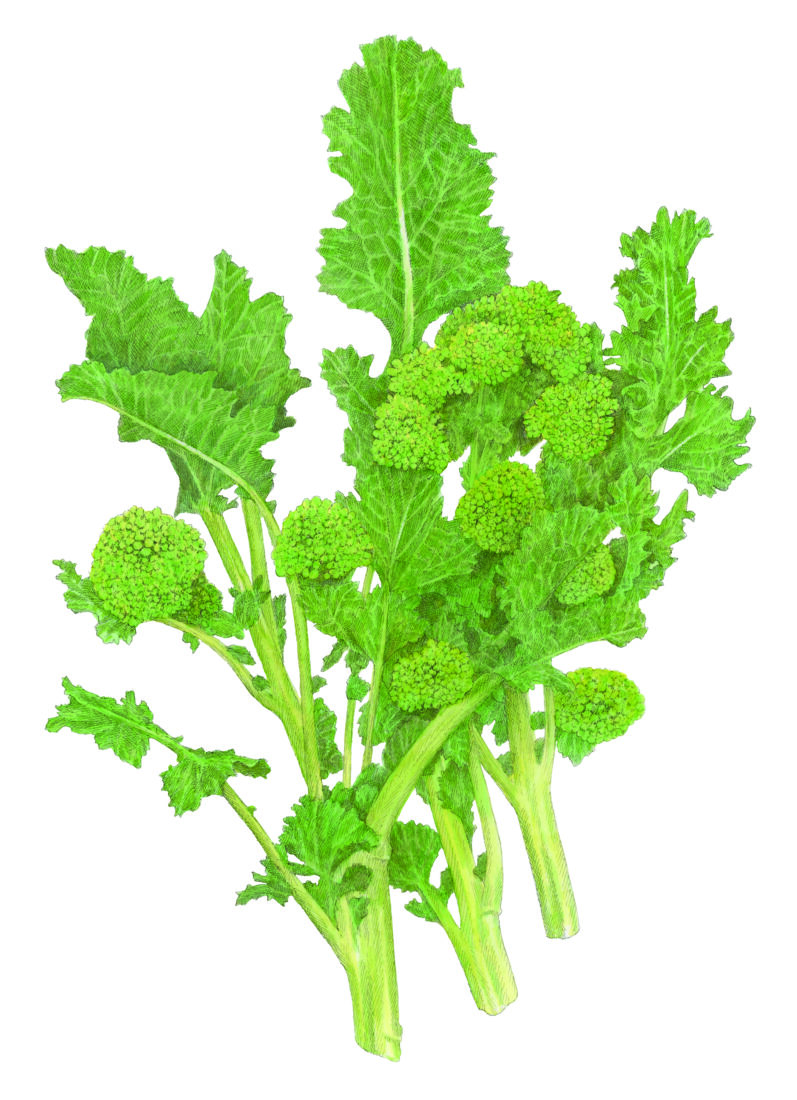
With its think green stalks and small florets, broccoli rabe looks like the waifish sibling of broccoli. But the similarities end there. Though both are cruciferous vegetables, broccoli rabe, a.k.a. rapini, is most closely related to peppery turnips. “Broccoli is sweet and mellow and loves to be coaxed into a gentle flavor,” says Kendall Moore, executive chef at the recently opened Spaghett in Charlotte. “Broccoli rabe insists on standing out. It’s delicate in texture and appearance but spicy and bitter, serving almost like a palate cleanser while you enjoy bites of whatever you pair with it.”

Moore first encountered rapini while studying at South Carolina’s College of Charleston, during a visit to the renowned, now-defunct fine-dining spot McCrady’s. “There was a pork dish with a puree of broccoli rabe, and the flavor was so intense, I didn’t know what to do,” he recalls. “Soon after, I worked with a chef who made a cavatelli dish with broccoli rabe and sausage, and I really learned to love it then.” At the Italian-oriented Spaghett, Moore follows that playbook, often pairing rapini with fresh pasta and cheese, or working it into pork dishes. “I like to make it into a sauce, not unlike how I first tried it.” One of his favorites is a pistou (similar to pesto, minus the nuts) that he creates by blending the rabe with tangy Howard’s Gap cheese from North Carolina’s Looking Glass Creamery, which he serves over dense pasta like cavatelli (see recipe).
When selecting a bunch of broccoli rabe from the grocery store or farmers’ market, make sure it isn’t wilting and has no little flowers on the ends (a sign that it “bolted” and may be overly bitter). At home, wrap the rapini in lightly dampened paper towels and store in the refrigerator. Whether you’re blending it into a sauce or using it in a salad, blanching it for a few minutes will tame some of the bite. Rapini also sweetens a bit after the first frost, making it a perfect choice around the holidays. “The pistou represents my personal philosophy,” Moore says. “Source great produce, and use techniques to highlight what makes it great.”