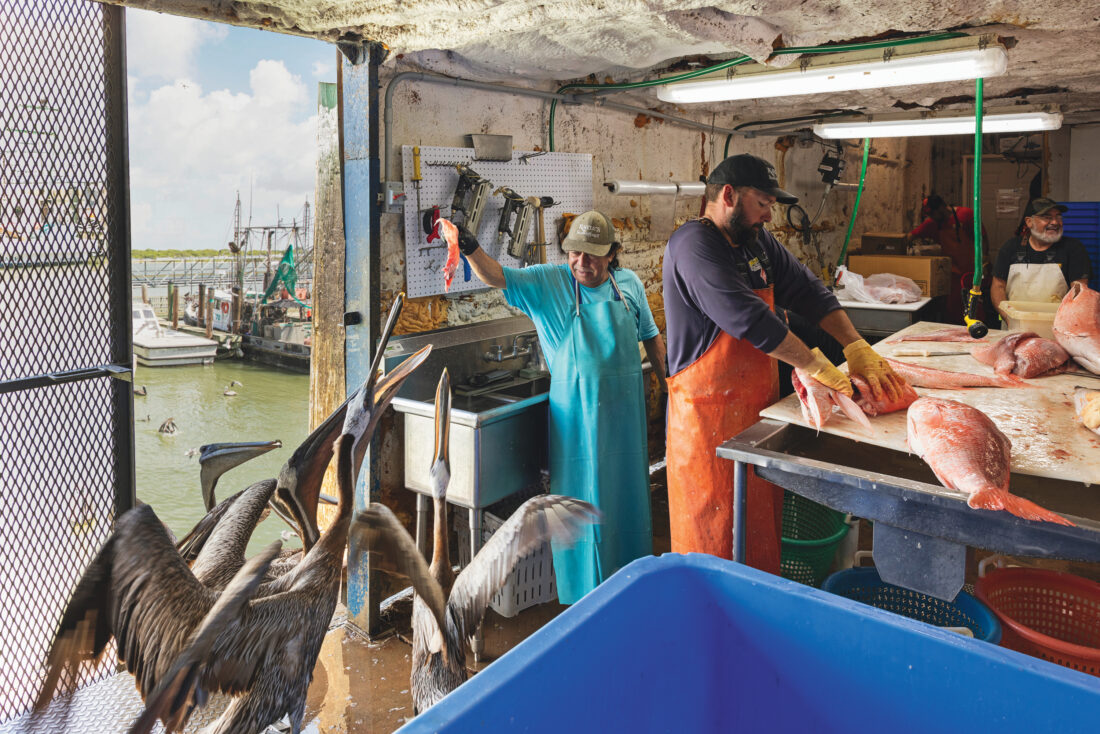
Pelicans waddle and hop around a stainless-steel table, worked by two men wearing aprons that nearly graze the cement floor. Behind them, shrimp boats and trawlers bob in the rippled current. Seen through the screened doors that frame the scene, the boats turn pointillistic, like a painting Georges Seurat might have made if he’d spent a summer on the Texas Gulf Coast. After a late lunch at Katie’s Seafood House, which straddles piers 19 and 20 on the Galveston Channel, I’ve walked two doors down to survey the market, owned by the same family, where the restaurant sources its fish and shrimp.
At the rear of a corrugated metal building lined with bins of crushed ice and clear-eyed fish, I watch those men behead red snappers that could pass for zeppelins, slicing along spines and through pinbones to release opalescent fillets edged in ruby. As they cut, they toss hunks of bone and offal toward hampers stashed beneath the table. Three-quarters of their tosses land there. The rest quickly disappear into the pelicans’ pouches.
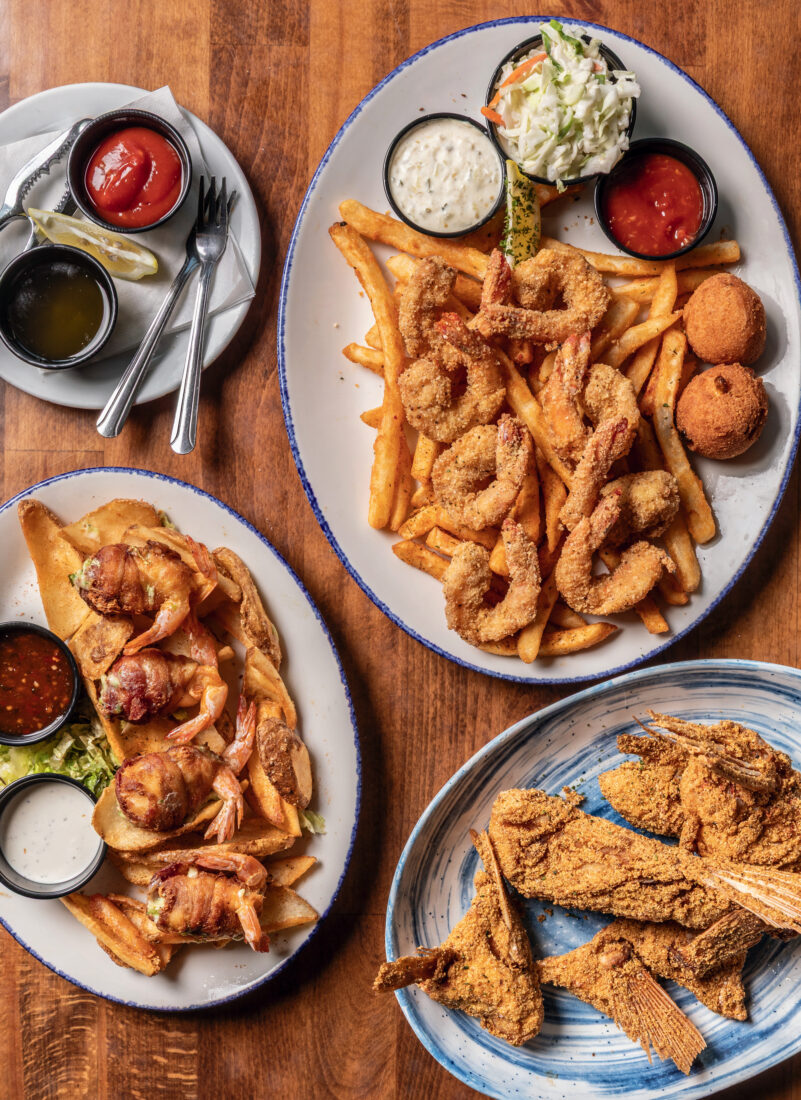
I harbor a deep suspicion of coastal restaurants designed to make their money off tourist throngs. Katie’s, a big rectangular box set on pilings, looks like one of those restaurants. But that lunch, in a packed dining room, outshone the usual tourist fare, starting with snapper wings, wedges of sweet white meat cut from the collar and fried to a greaseless crisp, followed by a dark-roux gumbo bobbing with pink shrimp, and a boil bag of blue crabs and shrimp drenched in garlic butter.
So I return twice to eat my way through an eighty-plus-dish menu that includes fried shrimp in a crushed cracker crust, snapper ceviche in a fishbowl, and golden tilefish in tikka masala sauce. Along the way, I also get to know the people who run the place.
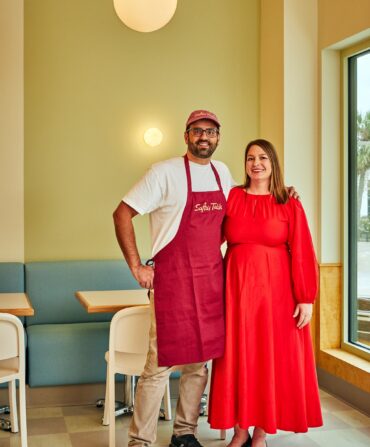
Before Buddy and Katie Guindon bought the building in 2017, it was home to a franchise in the Joe’s Crab Shack chain of faux joints. Any resemblance, except for a seating capacity of three hundred, ended the day Buddy opened this restaurant to honor his wife, with a kitchen fed by the local catch the family has sold since 1998.
Born in Minnesota, Buddy fell for the Gulf during a childhood fishing trip to Galveston with his father. After discharge from the Marines, he bought a bar, Streater’s Place, which became famous for staging cockroach races on a plywood track. That’s where he met a young Texas native named Katie Nesbit. They’ve since raised four boys, founded three businesses, and emerged as fierce advocates for local and regional fisheries.
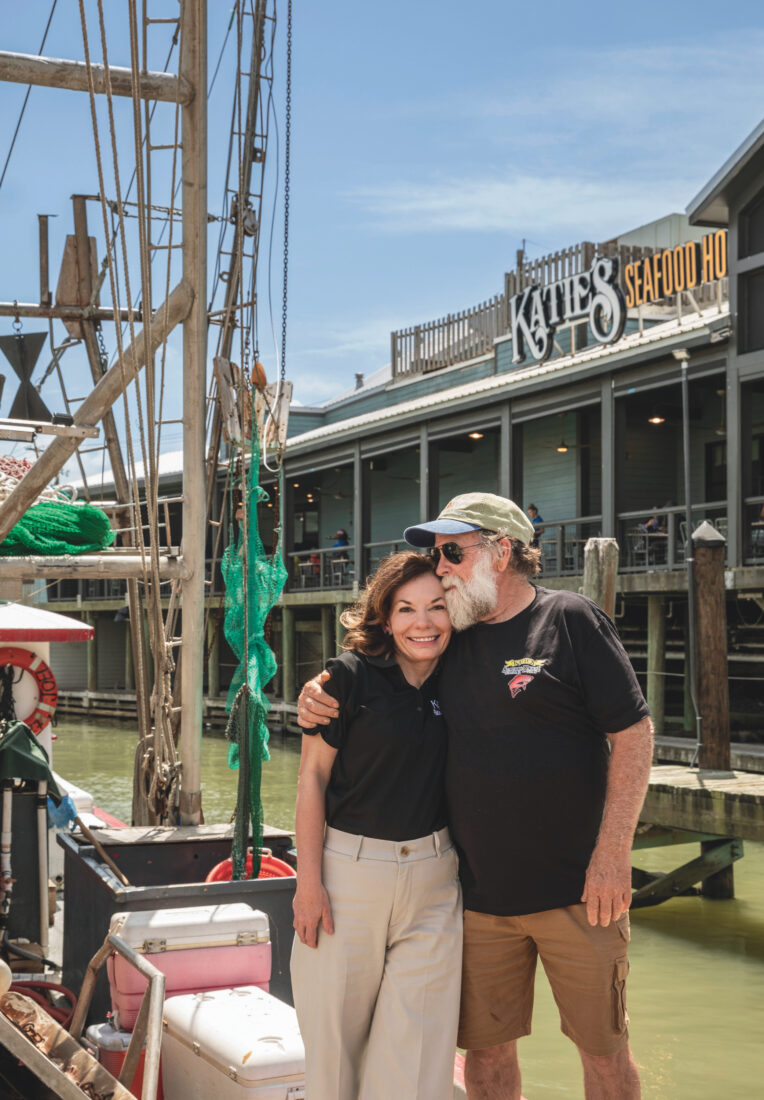
A smart fellow with a big personality, Buddy talks about commercial fishing with enlightened self-interest. It’s easy to see why National Geographic producers tapped him for the series Big Fish Texas, where, in what sounded like a boast, he told viewers that he holds the rights to harvest one of every twenty commercially caught Gulf red snappers. Buddy pours himself into lobbying governments and government agencies to better manage fishing rights. That sometimes puts him at odds with recreational anglers who argue that commercial fishermen like him hog too much of the catch. “Eighty percent of those guys hate me,” Buddy says, smiling. “But lots of them still eat with me.”
The reason for their allegiance hits tables seven days a week at Katie’s, where the menu lists the seven boats, including Hull Raiser and Cap’n Willie, that supply the restaurant. General manager Brett Otteman, who took his first restaurant job at fourteen, transforms dishes from Katie Guindon’s home kitchen into restaurant plates like “shrimp frogs,” made by deep-frying bacon-wrapped shrimp stuffed with chiles and pepper jack.
Otteman and his team, which includes Buddy and Katie’s son Derrick Gutierrez, get the classics right, too, serving al dente boiled shrimp on a bed of crushed ice, tails pointing high like sails in the wind. The menu also reflects the various people who now call Texas home, like that tikka masala sauce for the golden tilefish, which calls to mind the doctors and students of Indian descent drawn here by the University of Texas Medical Branch in Galveston.
Not long before I landed at Katie’s, a Texas-based organization called SeaD Consulting began rolling out reports, backed by DNA testing, that revealed that restaurants in Southern coastal cities along both the Gulf and Atlantic were fraudulently mislabeling shrimp. SeaD found that 60 percent of restaurants it tested in Galveston and nearby Kemah that were advertising Texas wild-caught shrimp were serving cheap imported stuff. The reports listed only restaurants that served what they claimed. Katie’s was in that number.
As Buddy and I talk about what it will take, in the face of issues such as climate change and frequent spikes in operating costs, to make a living fishing or shrimping or cooking local catch in a restaurant, a Carnival cruise ship passes behind Katie’s, the white hulk blocking the view of the fish and shrimp boats. To my eyes, that massive ship looks like a floating metaphor for the changes bearing down on this spit of an island.
When I turn toward the dining room, though, I spy a woman wearing a full-on Cowboy Carter getup, taking apart a crab, pulling sweet meat from a leg in one long luscious ribbon, while a man who looks to be her husband eats fried shrimp by the fistful. Before I can point them out to Buddy, a sunburned family in polo shirts bursts up to our table to say how much they loved the blackened red snapper, and how much they admire the work he and his family do.
Plus: An All-Day Galveston Stop
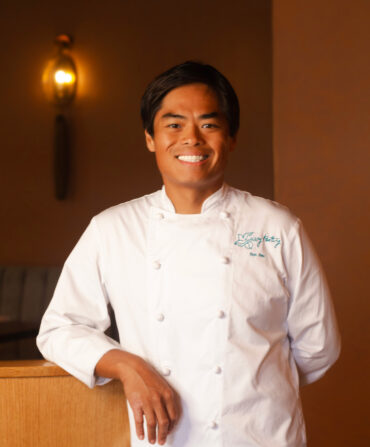
Tucked behind the registration desk of the Hotel Lucine, a rebranded Galveston motel with a courtyard pool, the Fancy claims a mod wedge of a space, where chef Matt Sweeney and crew serve three meals a day. Begin with sweet potato and brown sugar kolaches. For dinner, start with a Caesar salad orbited by crouton-y fish croquettes, and follow up with blackened redfish in onion-paprika sauce. Or just step to the bar for a midday bite of shrimp rémoulade with fried saltines and a glass of sparkling rosé.
John T. Edge, writer and host of the television show TrueSouth, began contributing to Garden & Gun in its first year of publication. He is the author of The Potlikker Papers: A Food History of the Modern South and House of Smoke.