

Land & Conservation
In Pursuit of Alligator Gar, the Ancient Giant of the Shallows
The prehistoric fish with a toothy grin is fueling floodplain restoration efforts on the Mississippi River
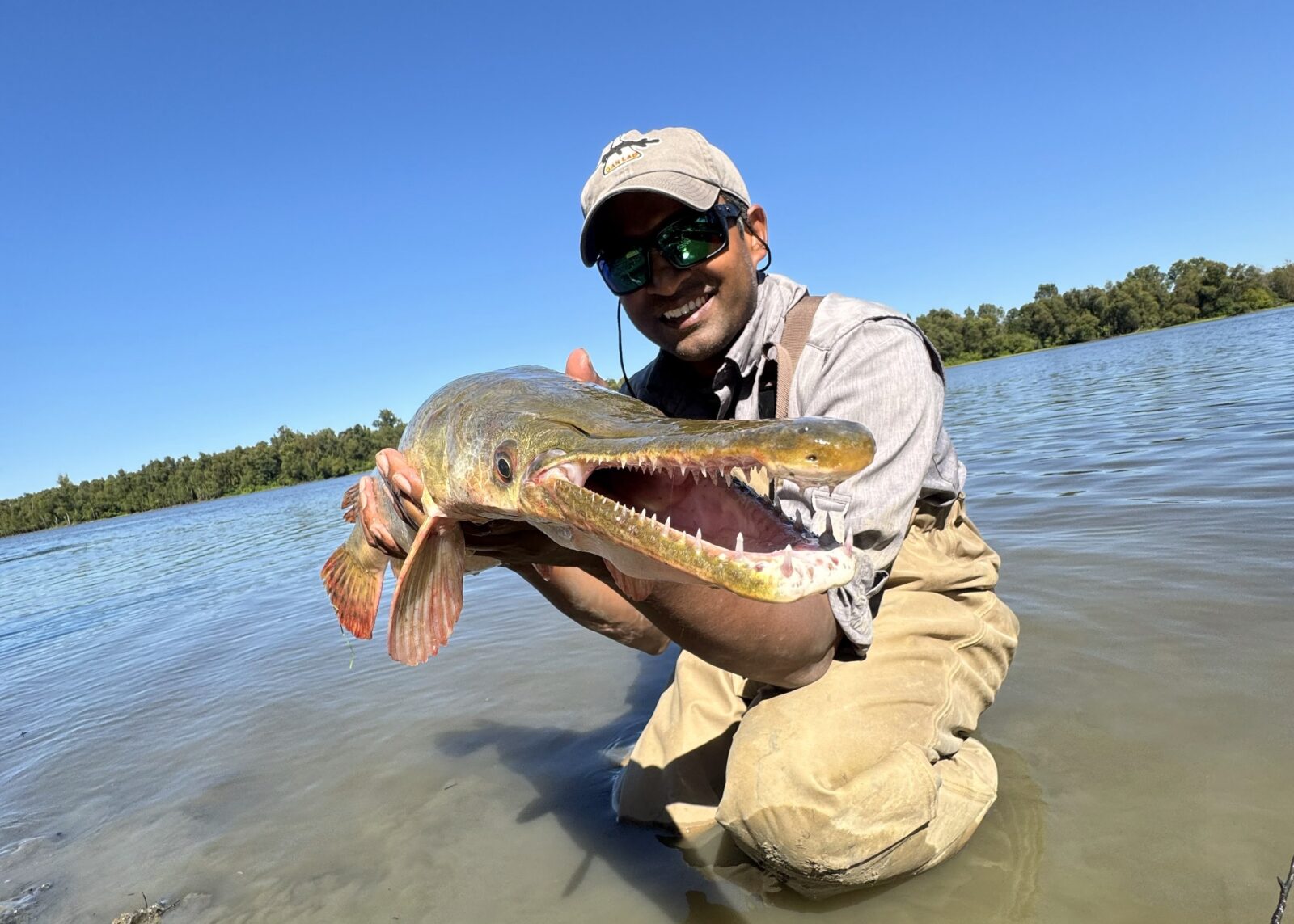
Photo: Luxia Feyereisen/GarLab
Solomon David holds a freshly caught alligator gar at Loch Leven in Mississippi.
Solomon David stands at the front of a jon boat in Mississippi, shaking out lengths of net to toss into the water, while Kayla Kimmel steers the boat in reverse to make his job easier. Catching gar—an ancient, needle-toothed fish that looks like it hails from the deep sea but actually inhabits shallow freshwater environments in the Southeast—is as much an art as a science, as these two biologists know well. And today they’re going after big gar using a gill net, which looks pretty much like a volleyball net only with buoys on top, weights on the bottom, and four-foot holes that let smaller quarry go on its way.

Alligator gar are fascinating on the basis of appearance alone, reaching over eight feet, weighing more than three hundred pounds, and sporting a distinct “dinosaur face,” as David describes it. Besides a trademark toothy snout, they boast a specialized swim bladder that allows them to gulp air at the surface and thus thrive in oxygen-poor waters. David, a cheerful, pun-prone ichthyologist based at the University of Minnesota, formed GarLab to study and conserve these “boopable nightmare fish,” and multiple times a year he makes the trip to Mississippi’s Loch Leven, the best place in the country to catch them.
Not coincidentally, Loch Leven is also the site of the largest floodplain reconnection project in the Lower Mississippi River. On a cold winter morning, a group of a dozen or so conservation partners, including representatives from the National Fish and Wildlife Foundation, the Nature Conservancy, International Paper, and the U.S. Fish and Wildlife Service, have gathered to see this 6,000-acre river island along with the gar—alligator, shortnose, longnose, and spotted—whose presence is a bellwether.
After David sets out the last of the nets, Kimmel, a gar expert with the U.S. Fish and Wildlife Service, tells me, “Now we’ll just let it fish. When one hits, we’ll know.” The water we’re trawling is so murky I could believe it’s many feet deep when really, it would only hit my chest if I jumped out of the boat. And the surface is so smooth it’s hard to imagine that huge, prehistoric fish swim below us.
Gar have existed for well over a hundred million years. That means they lived alongside tyrannosauroids, flying pterosaurs, early small mammals, and the first flowering plants. The kicker is that they look pretty much the same today as they did back then: scales so thick they’re essentially wearing a coat of armor, a saw-like snout with a smattering of tiny, pointy teeth for ensnaring other fish. One of David’s students paints a particularly colorful picture of their hunting technique: “Imagine swimming around with chopsticks covered in Velcro and having to snag live, moving prey with them.” But it worked a hundred million years ago for this apex predator of riverine systems, and it still works today—that is, if the system isn’t broken.
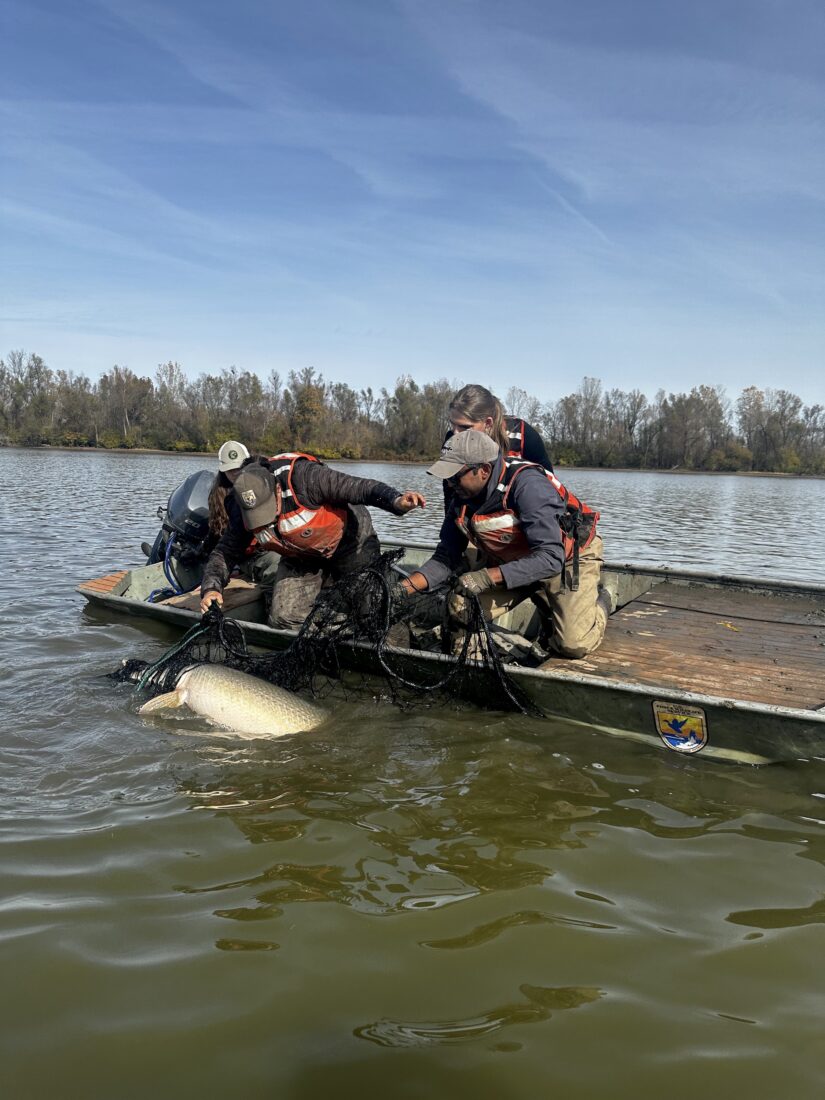
Photo: Caitlin Luby
Biologists pull a six-foot-long, hundred-pound female alligator gar into the boat.
The Mississippi River Basin touches thirty-two states; the river itself is the lifeblood of the country in terms of commerce, and we have drastically altered its flow. When it coursed unchecked down the country to the Gulf, it meandered, doubled back, and formed oxbows, and its floodplain reached as many as eighty miles across. Healthy floodplains are essential to healthy rivers, which, when they exceed their banks, flow into the surrounding land—depositing sediment and nutrients and creating vital habitat for spawning fish and all manner of foraging animals—and then drain away.
“Alligator gar are the poster children for floodplains,” David explains. They are Goldilocks-level picky about their spawning conditions: The water must be the right temperature and around three feet deep. It needs to have terrestrial vegetation that’s been flooded over, so the eggs can stick to something. In our haste to control the Mississippi, those conditions have become more and more elusive, and the species is in steep decline across its range.
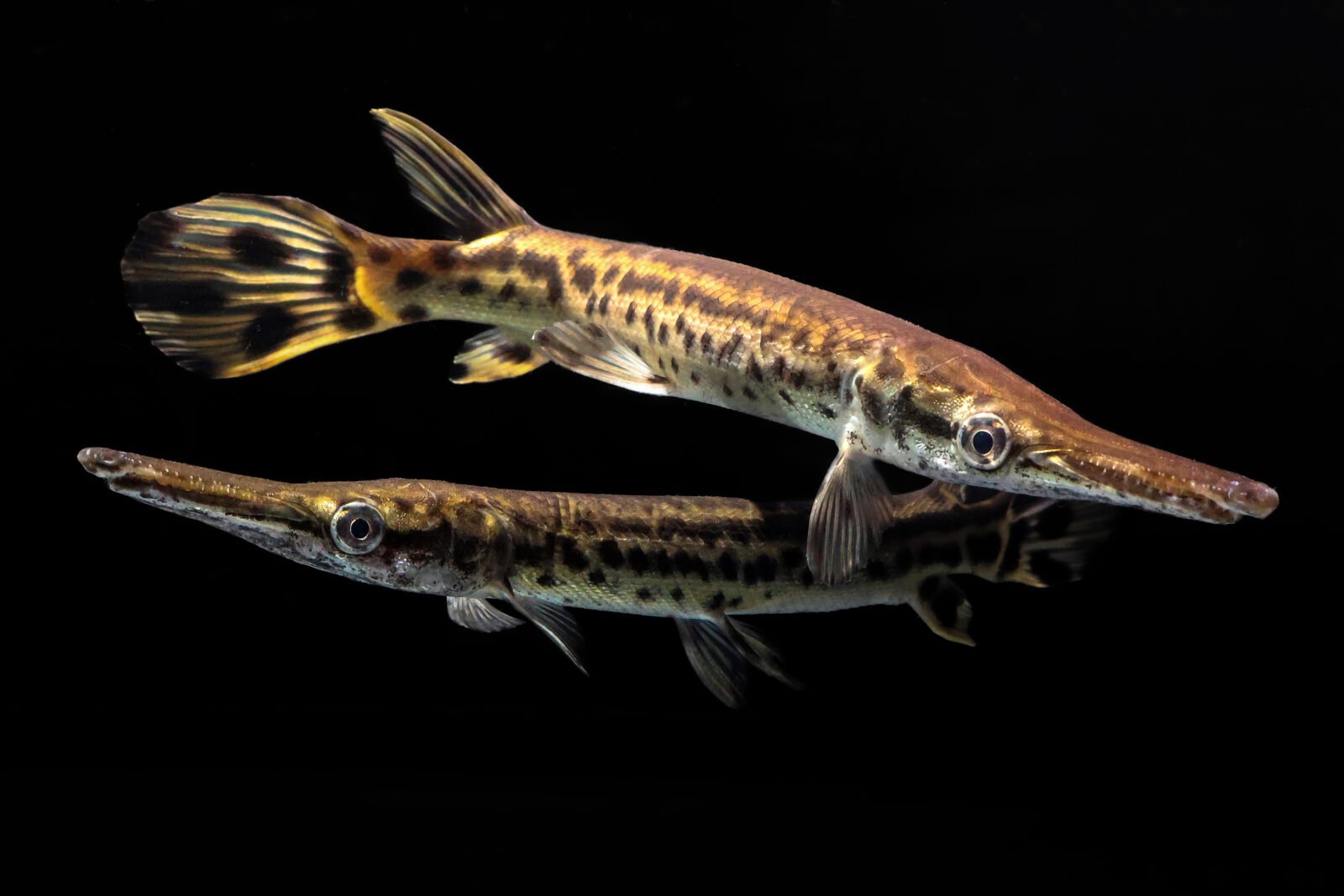
Photo: Raine Flynn/GarLab
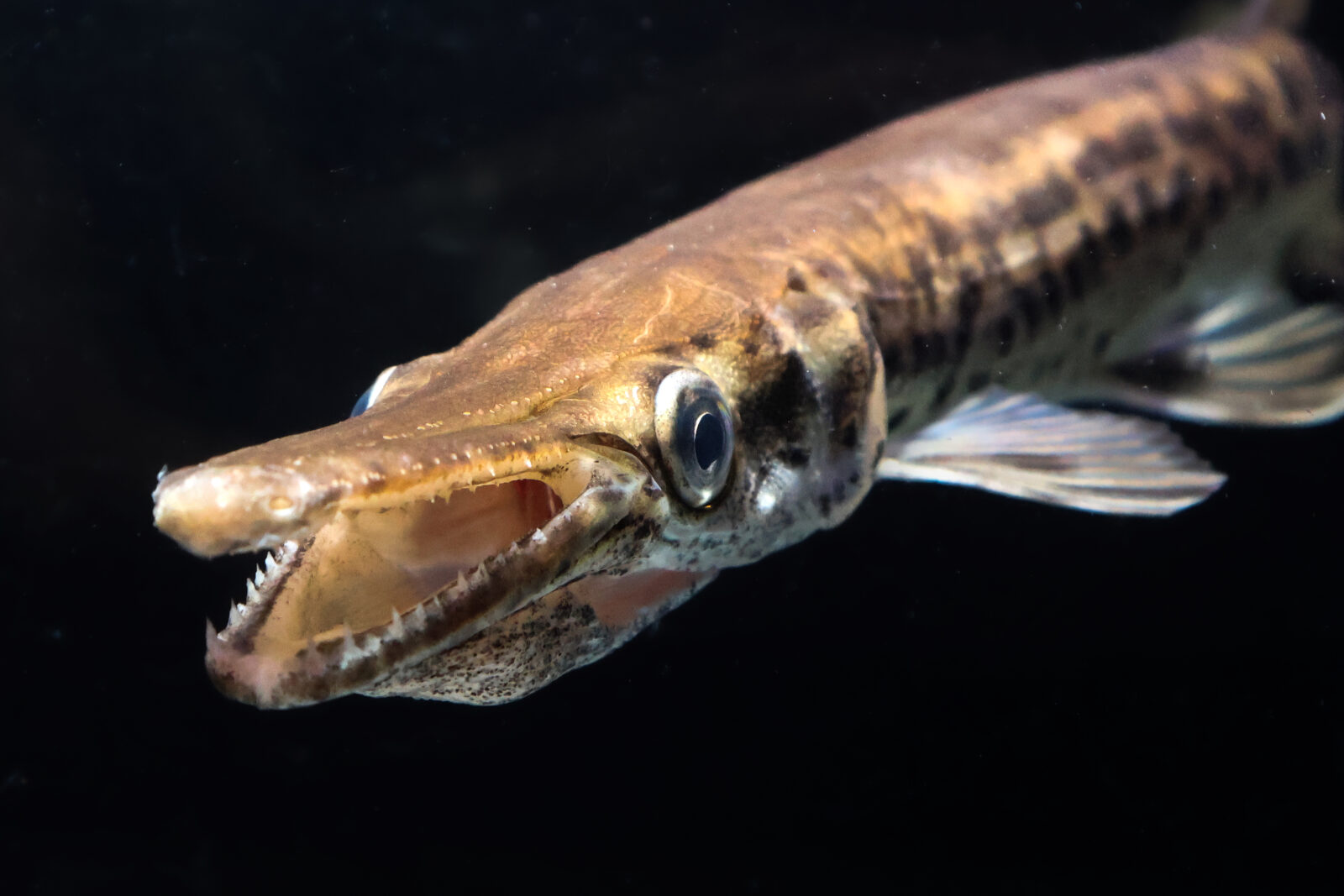
Photo: Raine Flynn/GarLab
Juvenile alligator gar.
For the last 150 years Loch Leven—formerly a soybean farm, then a pecan operation—has been disconnected from the Mississippi River. In 2016 its private owner called Scott Lemmons, now the Nature Conservancy’s state director in Mississippi, in desperation; the floodwaters that poured in when the river was high or during storms had no way to return to the river. During one particularly bad flood, hundreds of deer drowned on the island, trapped.
“Loch Leven was turning into a big bowl of water without a drainage plug,” Lemmons recalls, “and I knew immediately we had a big opportunity.” He spent the next years raising funds from some fifteen partners, including a grant from the National Fish and Wildlife Foundation, and engineering the infrastructure to reconnect the floodplain to the volatile and mighty waterway. “Anything the Mississippi can throw at you, it will,” he says. “I know now that if I think I need a thirty-six-inch pipe, I need a forty-eight-inch one. If I think I have enough rock, I need to add an extra two tons.”
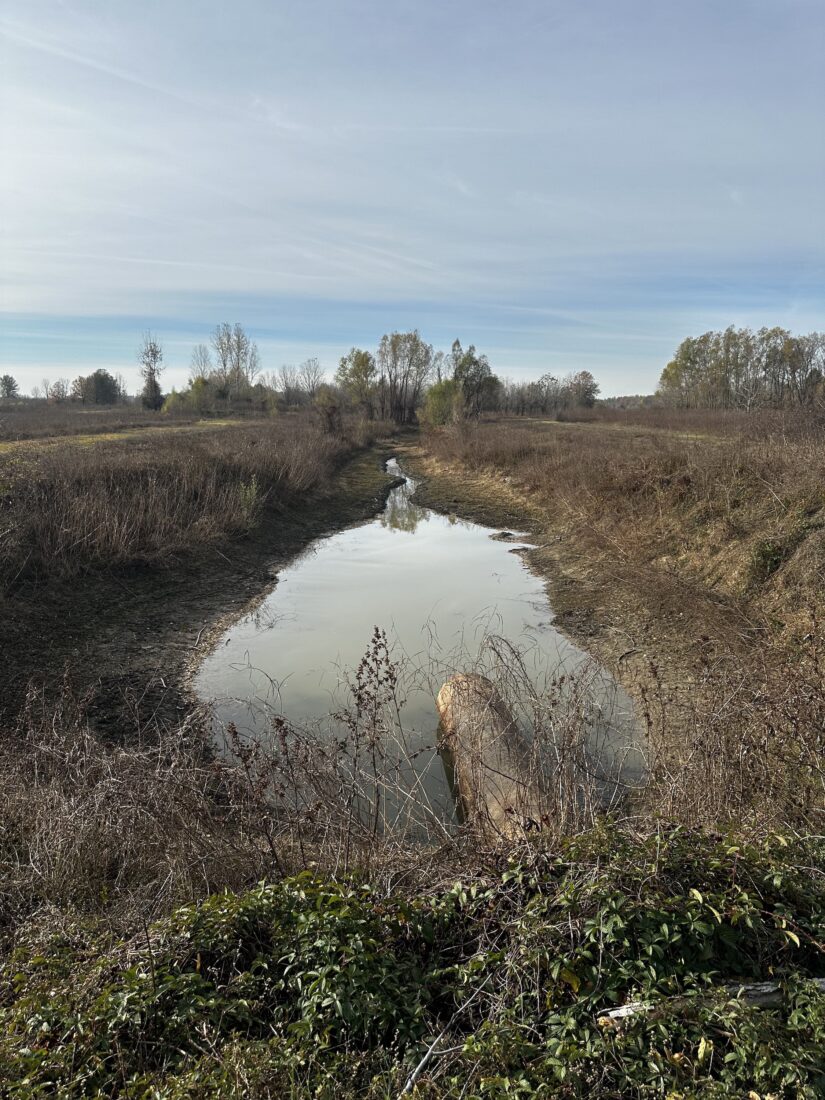
Photo: Caitlin Luby
Loch Leven is now reconnected to the Mississippi River via a system of levees and culverts.
On a tour of the island, we visit the result of those efforts, a box culvert through a levee that connects directly to the river. Today, the water is low enough that I can walk through the concrete passageway, imagining the tons of water that rush in when a gate is lifted and then course through the property via a system of other levees and smaller culverts. At its full capacity Loch Leven can hold 72,000 acre-feet of water, which arrives “muddy and thick,” Lemmons explains, but drains off clear after the sediments and nutrients seep into the soil, leaving fertile ground in their wake, cleansing the water bound for the Gulf, and creating irresistible conditions for gar. “I expected the reconnection to be good for the ducks and shorebirds, but I didn’t anticipate the scale of the fisheries response,” Lemmons says. Almost immediately after the box culvert installation, he stood on the platform and watched the water flow in and with it, huge gar.
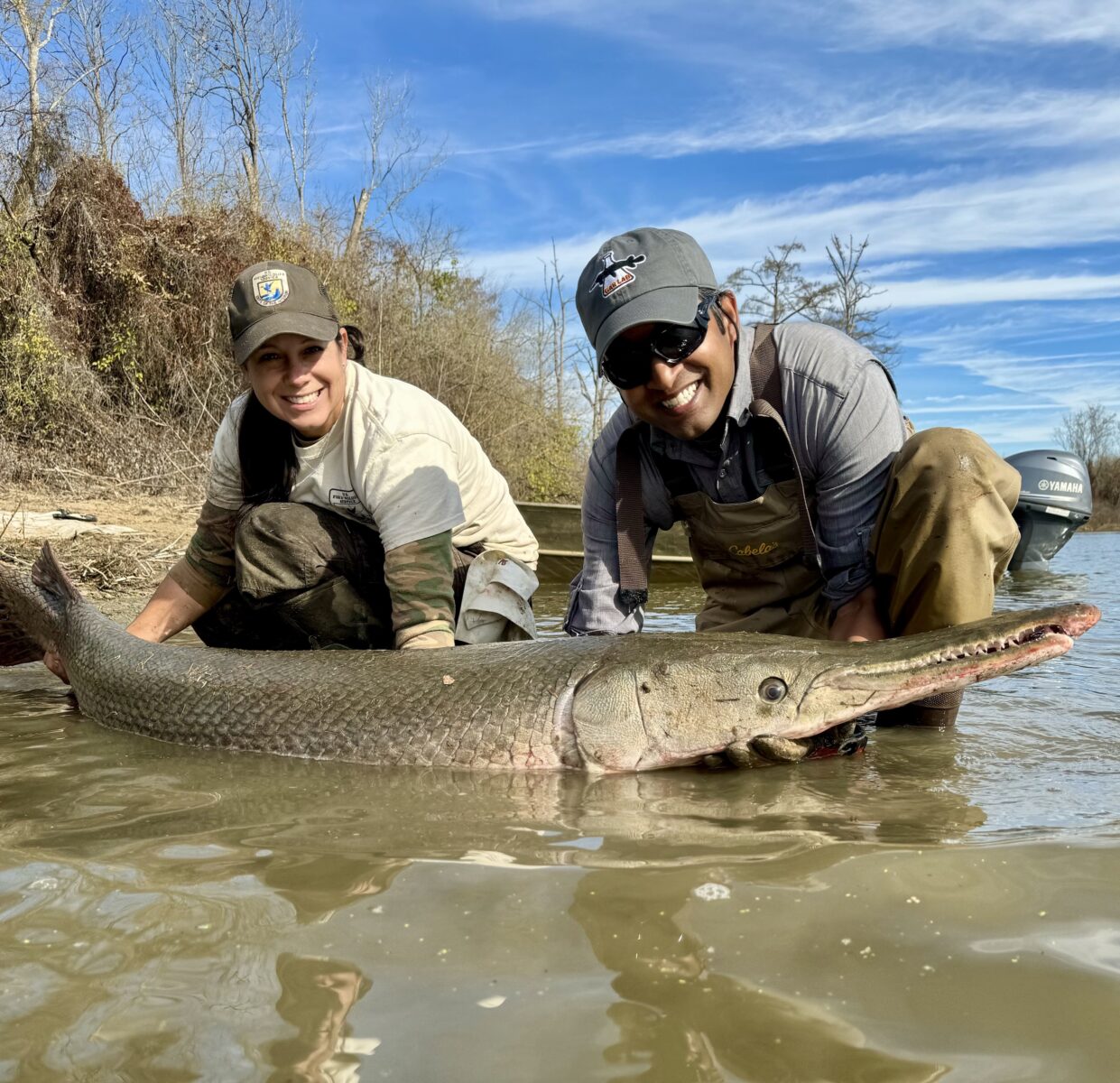
Photo: Solomon David/GarLab
David and Kayla Kimmel with a catch.
I soon get the chance to see one for myself. Back on the bank of the floodplain, someone calls out, “We’ve got one!” We all rush to the water’s edge and watch one of the buoys jerk as the fish fights the entangling net, spraying water in every direction. In no time we’re back in the jon boat and heading out to pull in the catch.
David, Kimmel, and a graduate student lean over the side of the boat to lift the net. I position myself on the other side as a counterweight and watch them hoist up a creature I wouldn’t believe real if it weren’t in front of me. She’s longer than I am, the color of mud, with circular, staring eyes before a long, tapering snout dotted with two nostrils. “If you’re gentle with them, they don’t put up much of a fight,” Kimmel says as they lift the alligator gar and lay her in the bottom of the boat, where she waits quietly, watching us. Suddenly, she gasps—an unearthly sound from her prehistoric lung.
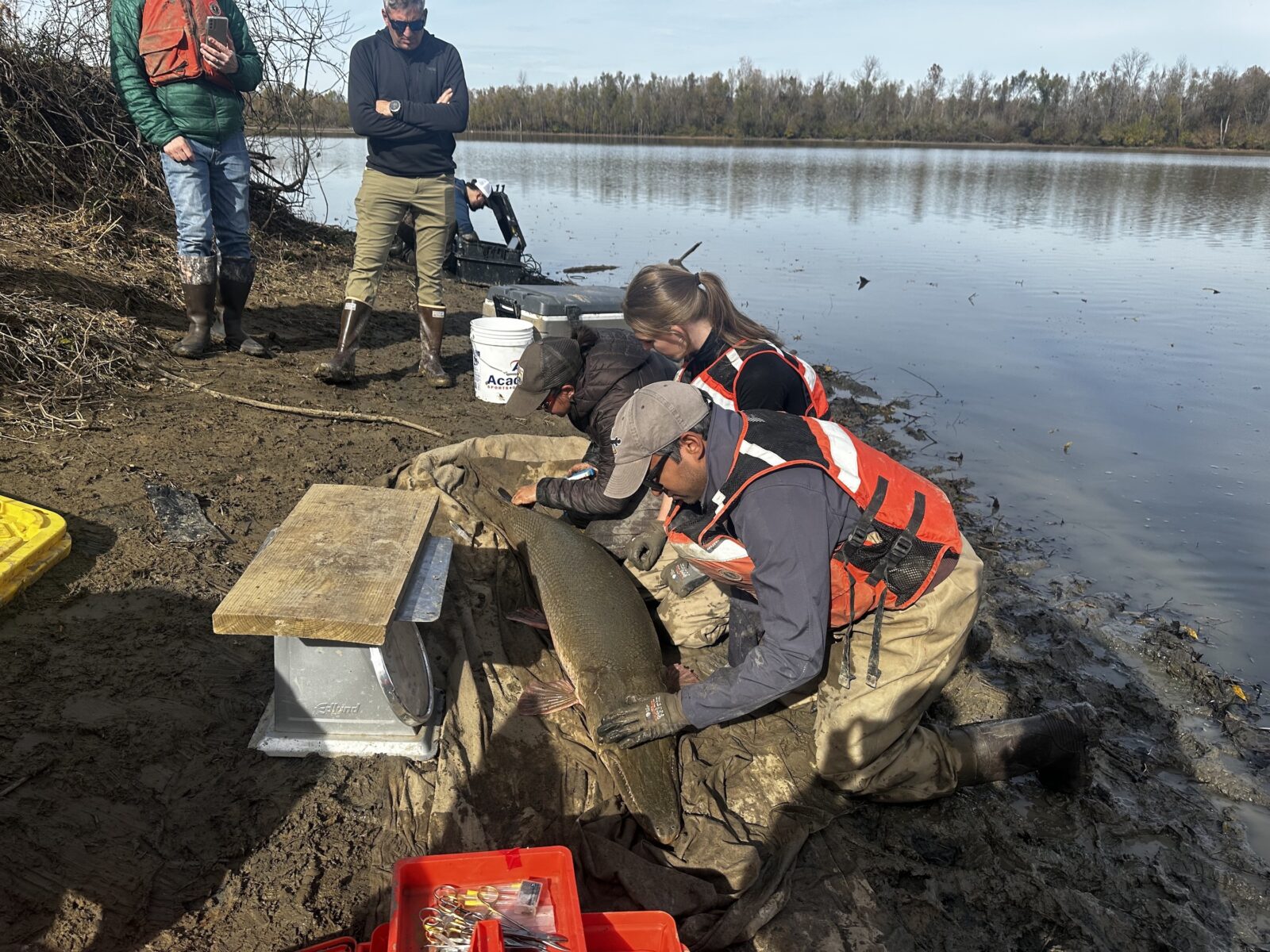
Photo: Caitlin Luby
David and his student, Raine Flynn, measure an alligator gar.
Once on shore, the biologists take a DNA sample and measurements; the fish’s large size—over a hundred pounds and almost exactly six feet long—indicates she’s female. They insert a tracking device to monitor her movements and, most importantly, take a clipping from her fin, which they will use to analyze its stable isotopes and determine what she has been eating. From that information they can further establish the importance of floodplains like this one. David has been sampling fish here since 2020, building a dataset that for Lemmons is proof of concept. Already he has a similar project in the works, this time for a 10,000-acre swath of floodplain at St. Catherine Creek National Wildlife Refuge. But really, he stresses, reconnection efforts need to be happening farther up the river, too, at key points along the Mississippi’s journey.
It takes two people to carry the female alligator gar back into the water. They set her down in front of an underwater sonar camera, which takes data on her shape so that eventually scientists will be able to estimate gar populations without ever catching them. Then she swims away unhurriedly—one living, breathing example of what floodplain restoration can do.
Lindsey Liles joined Garden & Gun in 2020 after completing a master’s in literature in Scotland and a Fulbright grant in Brazil. The Arkansas native is G&G’s digital reporter, covering all aspects of the South, and she especially enjoys putting her biology background to use by writing about wildlife and conservation. She lives on Johns Island, South Carolina.
Related Stories:

Sporting
Elmer Crowell miniatures, a life-size bronze pointer sculpture, and Ernest Hemingway’s marlin catch flag
Conservation
Why the region’s secret—and imperiled—freshwater ecoweapons deserve your respect
Land
In flooded fields amid a waterfowler’s paradise, the Isbells are reimagining how to use the land—and gaining the attention of sake brewers worldwide
Trending Stories:
Land & Conservation
The future of conservation in the South just got a little bit brighter—and not just for salamanders
Land & Conservation
The mounds may look insignificant, but they’re the craftsmanship of local crustaceans called lawn lobsters
Arts & Culture
The drawls are receiving a lot of flak across the internet, but a North Carolina linguist argues they’re actually pretty accurate