
Food & Drink
The Guiding Light of Blackberry Farm
Ten years after his tragic death, Sam Beall’s farm-to-table vision and gospel of Southern hospitality continue to resound across—and beyond—the resort, now celebrating fifty years of family ownership
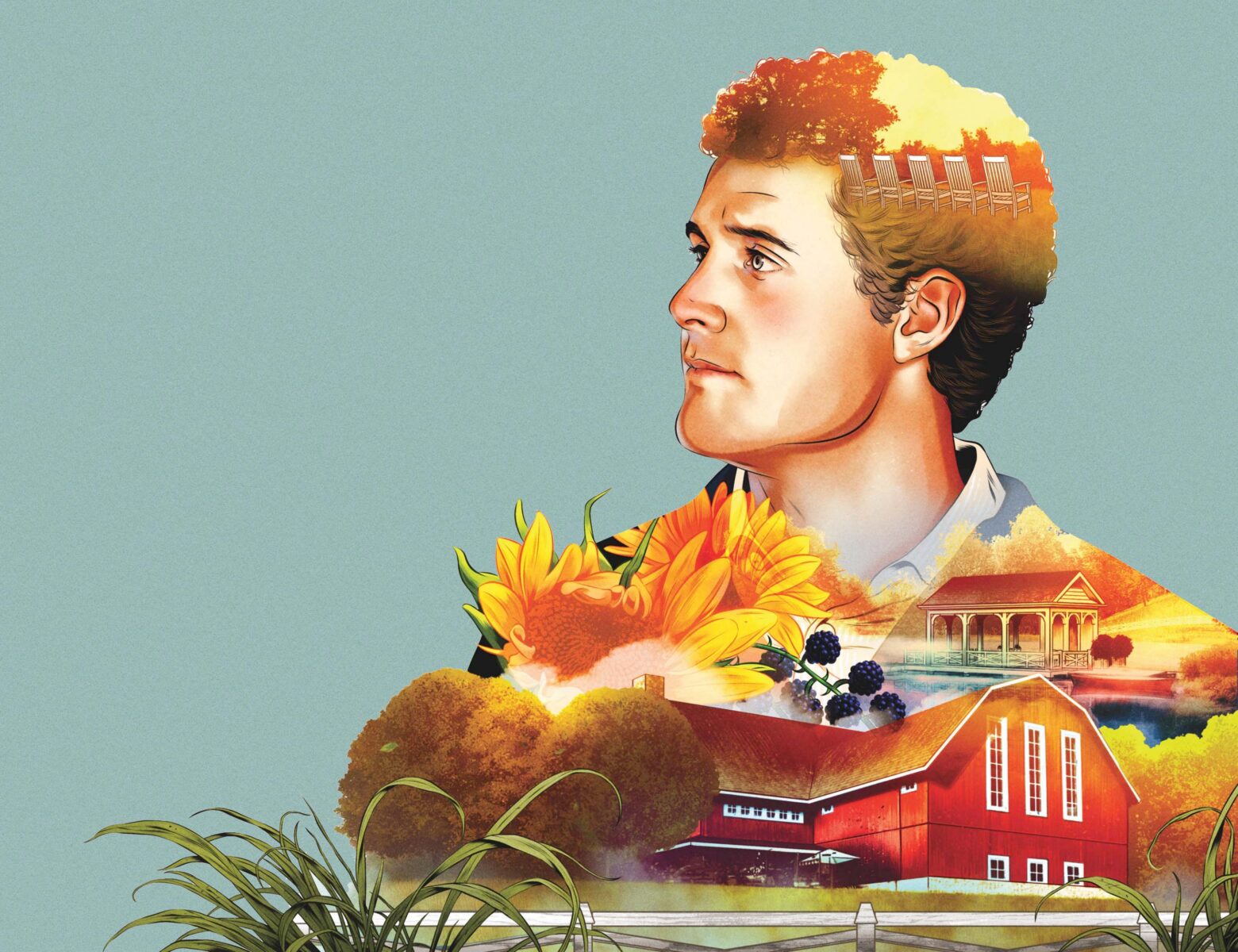
Illustration: ALEXANDER WELLS
EGGS 4 SALE, reads the handmade sign tacked to a guardrail at the turn onto West Millers Cove Road, a narrow blacktop that winds toward the 4,200-acre Relais & Châteaux resort known as Blackberry Farm. A mile deeper into the oak- and poplar-steepled cove, past a Missionary Baptist church, before a Primitive Baptist church, the woodstove from a tin-roofed house pumps soft gray smoke into a hard winter sky.
That drive through real-life Appalachia has grounded visitors to this place of unreal beauty since 1941, when Florida and Dave Lasier, who made their money in Chicago making doorstops, opened a stone-and-clapboard guesthouse thirty miles south of Knoxville, Tennessee, on a ridgeline at the edge of a blackberry thicket reached by a gravel road.
Now famous for intuitive service, elegant food that elevates local traditions, and a 150,000-bottle wine cellar, Blackberry Farm did not become synonymous with farm-to-table luxury until Sam Beall (pronounced Bell) became proprietor in 2003. Born four months before his parents, Kreis and Sandy Beall, bought the property in December 1976, Sam was supposed to turn fifty this year as the family marks five decades of ownership.
Then came February 25, 2016. At around 2:00 in the afternoon, Sam stood at the top of Blue Bell, an intermediate slope at Beaver Creek Resort near Vail, Colorado. He wore orange pants and a black vest with BLACKBERRY FARM on the back. A black helmet covered his springy blond hair. Slope conditions were good; the sky was blue. Sam was an experienced skier. He pointed downhill. By 2:41 an ambulance was en route. Sam had skidded off course and slammed so hard into a six-foot trail marker that the impact tore his heart.
Five days later, I joined more than 1,600 mourners at Cedar Springs Presbyterian Church in Knoxville. Beech trees, their root balls wrapped in burlap, fronted the chancel. Robbie Ventura, a fellow cyclist, eulogized Sam’s obsessive efforts to wedge everything possible into every day, recalling the afternoon that Sam, waylaid by a meeting, booked a helicopter to fly 150 miles so he could catch his son’s lacrosse game. The band Little Big Town played “Go Rest High on That Mountain.”
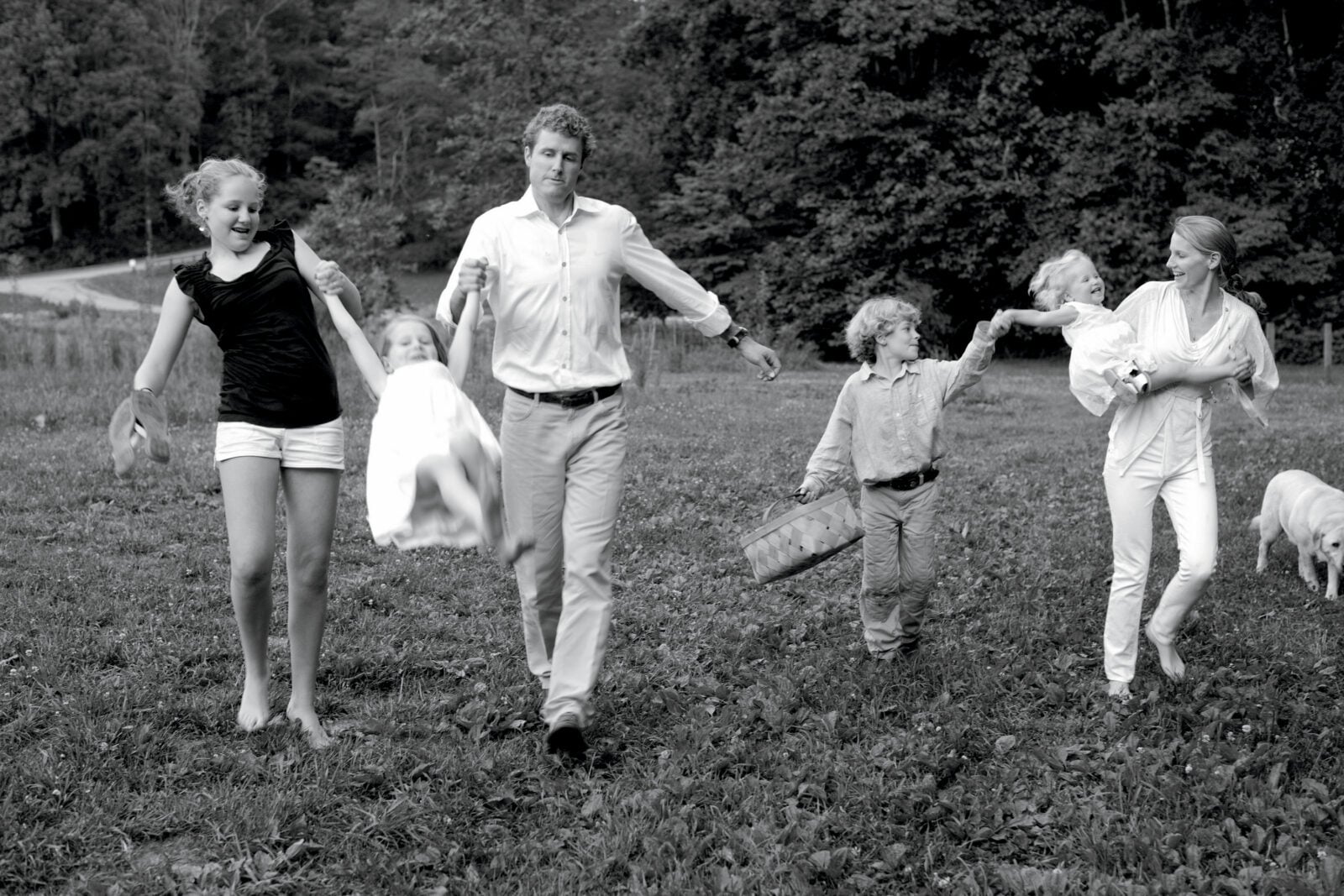
Photo: Beall and Thomas
Sam and Mary Celeste Beall with their eldest four children at Blackberry Farm in 2010.
Gathered later in the fellowship hall, though, most of us seemed to talk about the strength of his daughter Cameron, then a high school senior, the oldest of five children ages three to eighteen. With a gentle humor that rippled through the congregation, she recalled a father-daughter outing to mark her upcoming birthday in which Sam cranked cell phone calls to business colleagues while she drove a Range Rover and trailer loaded with two ATVs eight hours south to a Mississippi duck camp.
Long after that moment, we all talked of Mary Celeste, Sam’s wife, Cameron’s mother, who stepped to the pulpit without notes to speak from her own broken heart. “I’m so thankful that Sam and I have woven all these people into our lives,” she said, speaking to her children—Cameron, Sam V, Rose, Josephine, and Lila—in a voice that was warbly but insistent. “These people are going to be here for us,” Mary Celeste promised, gesturing toward friends and family. “Sam was preparing us,” she said, reaching her Blackberry Farm colleagues at the back of the sanctuary. “He was preparing us to be independent, to do this.”
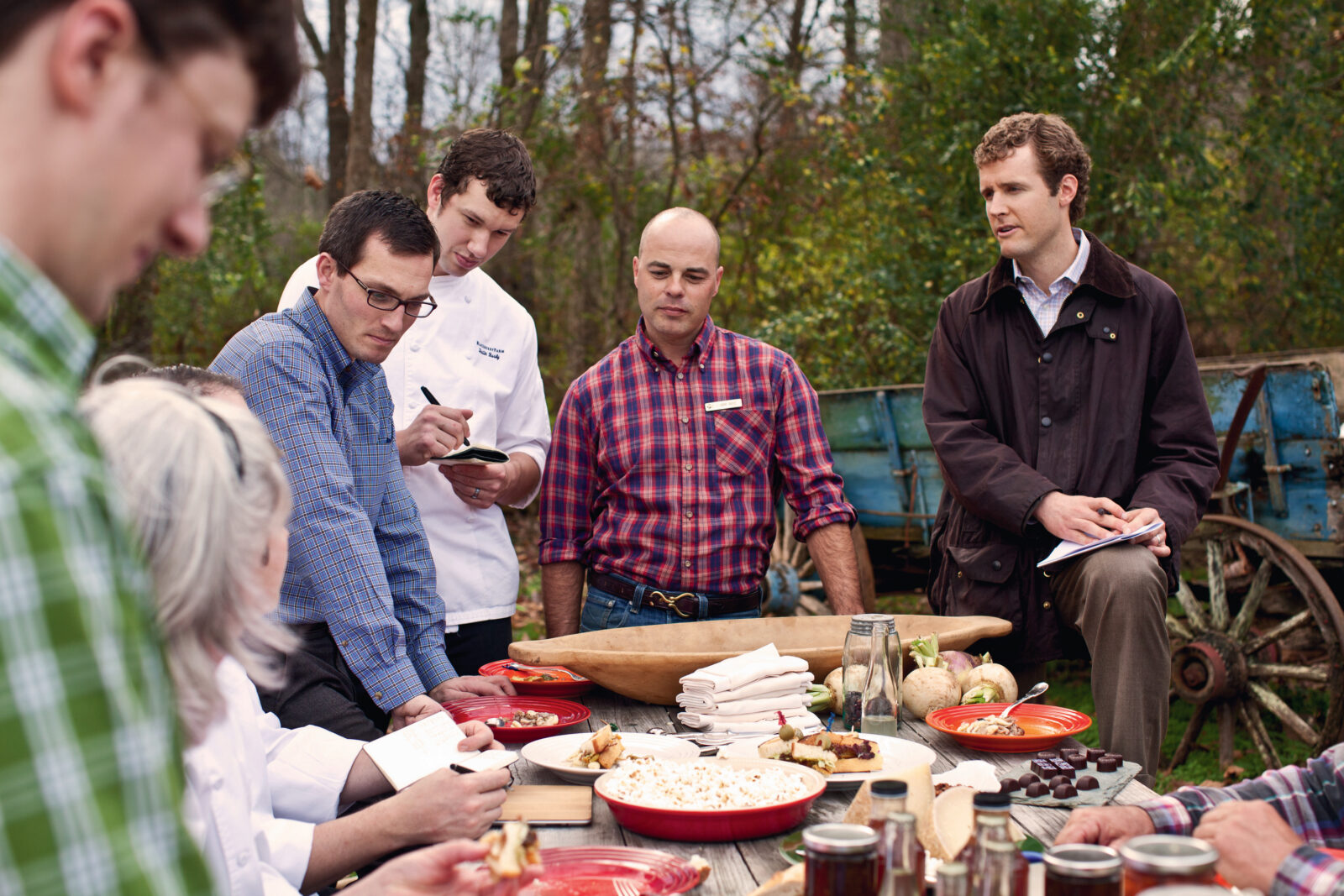
Photo: Beall and Thomas
Sam (far right) and Andy Chabot (with glasses) chat through artisan products during a tasting in the garden.
Walking out of the church, Sandy Beall, who founded the Ruby Tuesday restaurant chain in 1972 while studying finance at the University of Tennessee and went on to fund many of Blackberry Farm’s aspirations, patted Mary Celeste on her shoulder and suggested they talk soon. Nine days after the family buried Sam beside a small white chapel in a wooden coffin, as a rain shower played out and a rainbow spanned the farm, the family-owned company announced that Mary Celeste would assume Sam’s role as proprietor.
Each winter for twenty years, beginning in 2004, I traveled to Blackberry Farm for Taste of the South, a gathering of the region’s most accomplished farmers, artisans, and chefs that doubled as a fundraiser for the Southern Foodways Alliance. Buoyed by connections made and money raised at those events, the SFA, which I then directed, emerged in the early 2010s as the nation’s leading food-focused documentary and media nonprofit.
In that same moment, Blackberry Farm became our nation’s premier showcase for chefs and winemakers, a laboratory for the uplift of culinary culture. Sam and his colleagues celebrated pioneering winemaker Daphne Glorian of the Clos Erasmus estate in the Priorat region of Spain. With the same fervor, they trumpeted the work of traditionalist ham and bacon curer Allan Benton of nearby Madisonville, Tennessee. In the Blackberry cosmos, both mattered. Sherry Guenther of Muddy Pond Sorghum, down the road in Monterey, clogged beneath the gambrel where French-born chef Daniel Boulud of New York City later stood to rhapsodize about Périgord truffles. As Blackberry grew, the restaurant community in Knoxville also blossomed, fueled by a deep bench of talent drawn here to work for the Bealls.
Nearly ten years after Sam’s death, I returned late last year to reckon what Blackberry has become and his legacy has begotten since that terrible moment at the bottom of Blue Bell slope.
Andy Chabot collapsed to his knees when his wife, Sarah, who is now vice president of marketing, shared news of the accident. Andy joined Blackberry in 2002 as a food runner. Now he serves as vice president of food and beverage for a company that has grown to include Blackberry Mountain, seven miles east of Blackberry Farm, owned by the Beall family, and High Hampton in Cashiers, North Carolina, a mountain resort founded in 1922 and now affiliated with Blackberry. In the winter of 2016, though, Andy says, things were different. “No one was quite sure how all this would keep going.” Sarah, who worked so closely with Sam that she knew his blood type and jacket size, planned big undertakings with him. She remembers wondering, “Who am I going to dream with?”
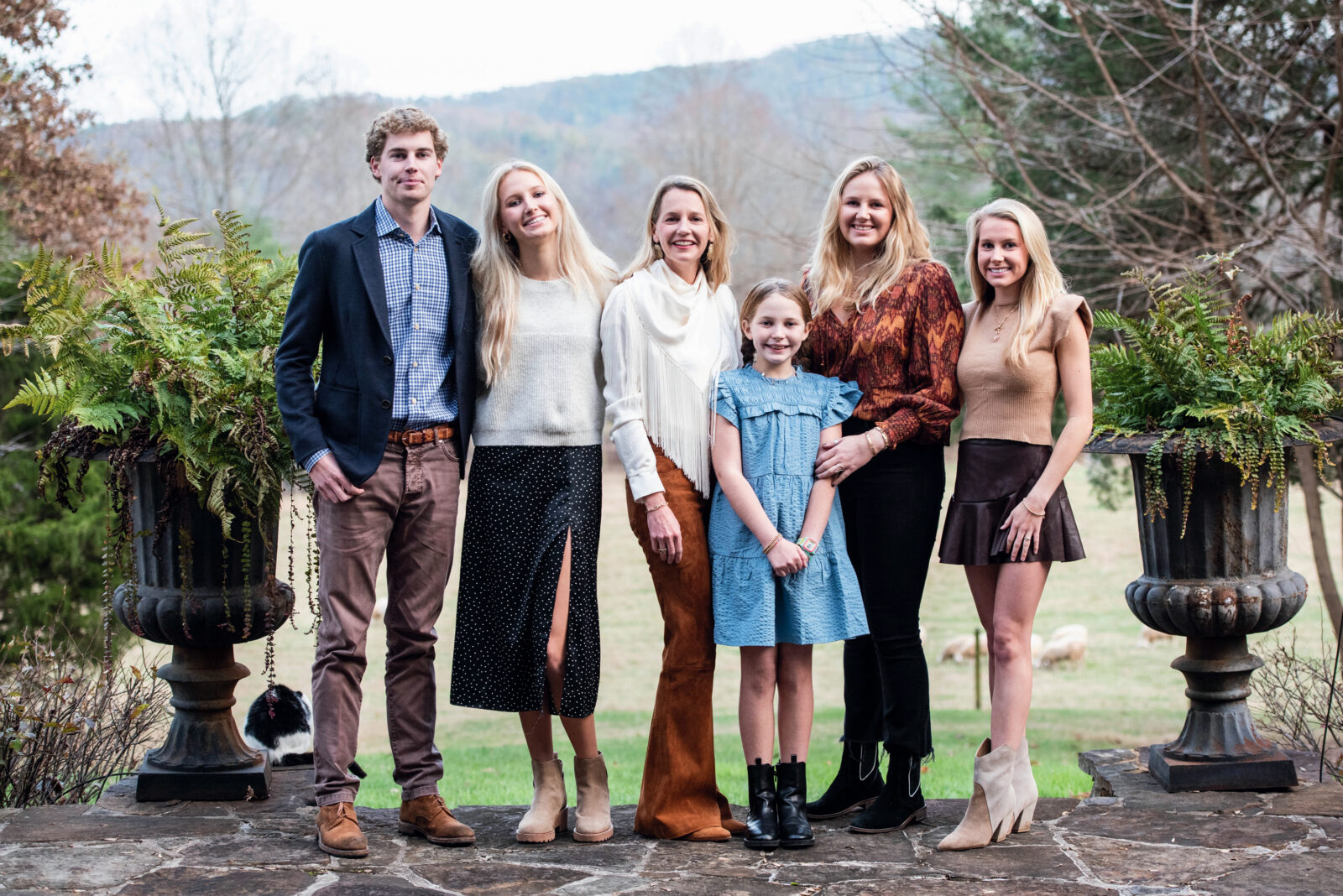
Photo: Sarah Rau
Mary Celeste with the five Beall children (from left: Sam, Josephine, Lila, Cameron, and Rose) in 2022.
Walking the tunnel that connects the Barn, the soaring dining room at the entrance to Blackberry Farm, to Bramble Hall, the event space where Emmylou Harris once headlined a yearly show, Andy passes through an underground corridor that Sam imagined but never saw. Back in 2007, as crews worked to complete the reassembly and elaboration of that barn, moved south from Pennsylvania, Sam halted construction to redesign the cellar so it could be expanded and connected to the tunnel he planned.
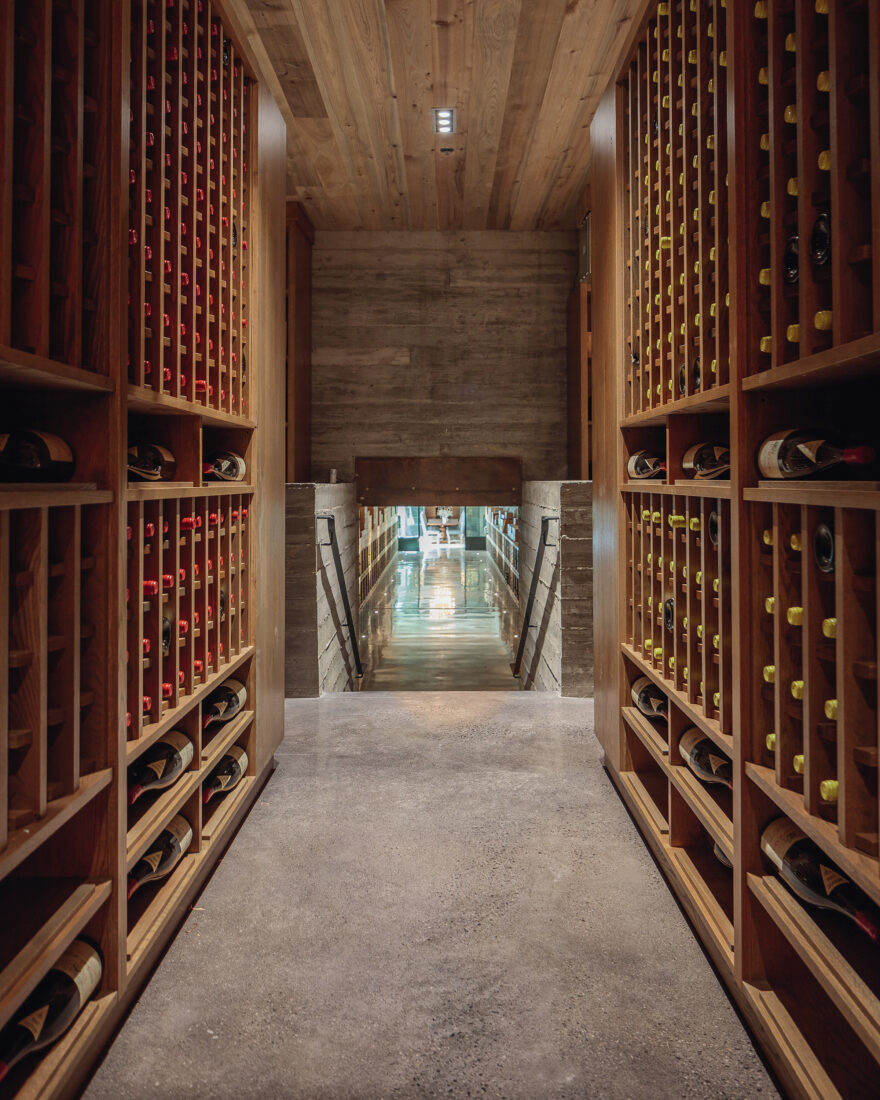
Photo: ingalls Photography
The tunnel connecting the Barn to Bramble Hall.
The idea behind the project seemed far-fetched, even for Blackberry, which built its reputation around Kreis Beall’s mantra, “Yes is the answer; what is the question?” Perspectives on the tunnel shifted in the summer of 2016, when Bramble Hall opened and guests glimpsed Sam’s vision to link the two largest buildings at the resort via a passageway that doubles as a warren of wine cellars and speakeasy-cool dining and drinking spaces. “Sam was unencumbered by the word can’t,” Andy says, marveling at this feat of structural and social engineering. “He was like a fast truck passing you on the highway; we all got caught in his slipstream.”
After friends or family members die, especially when they leave us too early, we beat back sorrow and grope for a way to carry their spirit forward through a sort of repertory theater of shared remembrances. Ventura and Cameron began that process in the sanctuary. In restaurants across the country led by Sam’s colleagues and friends, stories about his ferocious curiosity and maximalist pursuit of experiences are still traded like currency.
Riding shotgun on the way to a meeting in Boulder, Colorado, where he and his partners run six restaurants including Frasca Food and Wine, Bobby Stuckey talks via cell about the early 2000s, when Sam, Mary Celeste, and a young Cameron lived in Napa Valley while Sam recruited wineries to sell their best to Blackberry and learned the restaurant business. Stuckey was polishing his skills as a sommelier at the French Laundry. Sam was working a volunteer stage there that had him hollowing and trimming eggshells to hold the restaurant’s truffled custard appetizer.
Stuckey remembers that Sam, instead of doing his prep work in the kitchen, got Mary Celeste to help him hollow out the eggshells at home and biked them to the restaurant each morning before anyone else showed. Freed of his quota, Sam walked the kitchen during service with his finger in an egg, pretending to work. But he was actually watching chefs cook and plate dishes. He was learning every minute of the day, Mary Celeste tells me, laughing. “Although it looked a lot like he was just lurking.”
Reverb from Sam’s tenure at Blackberry Farm echoes across Knoxville. Standing by the counter at Potchke Deli downtown, co-owner Laurence Faber, who worked as a pastry chef at Blackberry, talks about the impact of the Bealls’ hospitality-above-all ethos on his business. Six months after Potchke opened in 2022, a mother in New York City called the Jewish Ukrainian–inspired restaurant. “Her son, a student at UT, had a bad head cold,” Faber remembers. “And she was desperate to get him matzo ball soup.” Thirty minutes later, Faber met her son in the lobby of his dorm with a container of chicken broth and dumplings.
From the beginning, the Beall family has spoken of Blackberry as their home. That approach has been literal as well as metaphorical. In the late 1970s, when Blackberry had just six rooms to book and Kreis and Sandy lived on-site, Kreis shopped at Kroger and served guests on their wedding china. Young Sam soon learned to deliver those plates to diners in his red footed pajamas. After he and Mary Celeste built their own house on the grounds, they hosted generous staff dinners, says Joseph Lenn, the chef at the Barn for five years before opening J.C. Holdway, his restaurant eight blocks south of Potchke. “Sam would say go pick something out of his home cellar,” Lenn recalls. “He meant anything. It was like he was inviting you to a Ferrari dealership and telling you to pick out a color.”
Sam lived for grand gestures, Lenn says. And he reveled in getting every detail of those gestures right. When the SFA honored the chef Sean Brock during the 2013 Taste of the South, Sam booked one of Brock’s favorite songwriters, Patterson Hood, of the Drive-By Truckers. After Lenn, who shared Brock’s love of professional wrestling, suggested a sort of demonstration match to close out the weekend, Sam booked sixteen-time world champion Ric Flair and had a ring installed at the center of the Barn. During the free-for-all that followed, Julian Van Winkle, who supplied the weekend’s bourbon, went looking for a folding chair like wrestlers wield on TV. He grabbed a sheet pan, and Lenn soon left the ring with a bloody nose.
Sam seemed to be tireless, but the stamina he showed took effort. Over dinner at the Dogwood, the more casual restaurant in the Blackberry Farm main house, Mary Celeste and Sarah Chabot swap stories of visiting New York City in the late 2000s and gathering with friends in a booth at Milk & Honey, the bar that ignited the American cocktail renaissance. The hour was late and Sam was sleepy. Rather than go back to the hotel and miss out, he ducked behind a velvet curtain toward the rear of the bar and did a few push-ups to pump up his energy for the night ahead.
The next day, I walk a small pasture in the shadow of the Barn with Cassidee Dabney, who began there in 2010 and succeeded Lenn as executive chef the year before Sam died. The menu, now playfully sophisticated and deeply regional, reflects her sensibilities. Amuse-bouches of hoecakes topped with caviar arrive atop polished steel blades removed from hoes. Lobes of Hudson Valley foie gras, cut into cubes, swim in bowls of pinto beans and cabbage, backbone ingredients in the Appalachian larder.
Moving through the stubby grass, Dabney and I keep our heads down, sidestepping donkey turds, in search of arrowheads that sometimes show after big rains. I tell her the stories I’ve been hearing. She looks up, her eyes searching. It was like a tree fell in the forest, she says of Sam’s passing. “And the little seedlings are reaching up. Without all that shade, they get the light and nutrients they need to grow.”
That afternoon, as the sun falls, Mary Celeste drives us past those churches and that house with the woodstove to the other side of the four-lane where the 5,200-acre Blackberry Mountain rises from the forest. As we spiral upward, passing through flanks of leggy rhododendrons, she talks about how she met Sam after Sandy Beall sold his Ruby Tuesday restaurant group to a company in Mobile, Alabama, took on an executive role, and moved the family to an old house in Point Clear.
As Mary Celeste remembers, her voice turns warbly, as it did at the funeral. Nine months apart in age, she and Sam lived on opposite ends of two streets that dead-ended into each other and went to rival high schools. Sam asked her out at sixteen. By the time Mary Celeste turned twenty, they were married and living at Blackberry Farm.
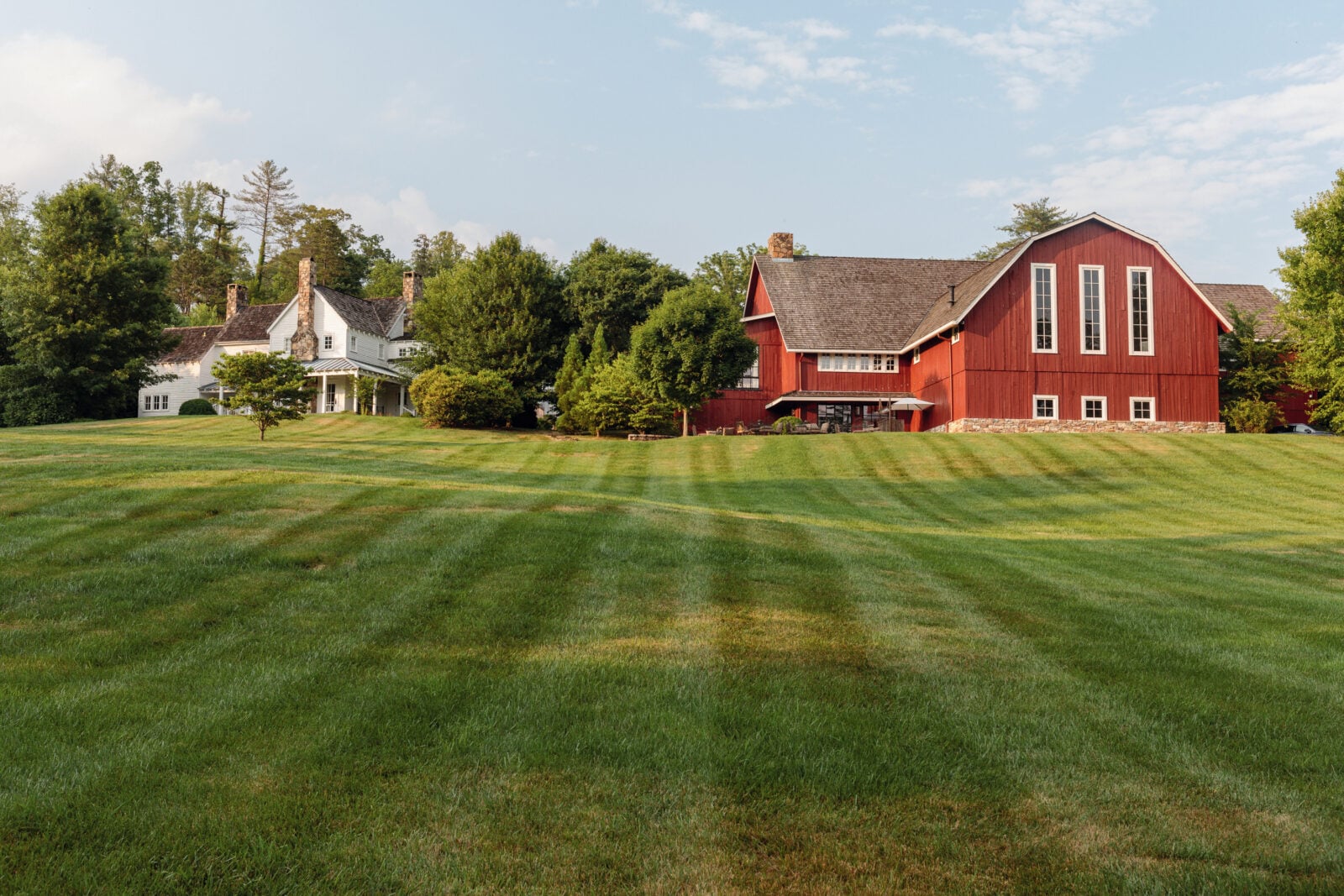
Photo: ingalls Photography
The Farm House (left) and the Barn.
Sam never saw the completion of Blackberry Mountain. The Cotswolds-in-the-Smokies look of Blackberry Farm came from his mother. The business model came from his father. Mary Celeste and Sandy Beall designed Blackberry Mountain to be modern and rustic, reflecting the love she and Sam shared for outdoor adventure. Opened in 2019, the resort suggests a Bauhaus take on the WPA lodge style. The amenities complement the look: Promises of truffle hunting at Blackberry Farm have given way to mountain biking and rock climbing at Blackberry Mountain.
The big dreams that drove Sam and inspired his colleagues live on. Now, though, the burdens and rewards of those dreams are shared. “We couldn’t ask someone to do all that Sam did,” Mary Celeste says, remembering nights that he fell asleep at his desk after a day of meetings followed by an evening of dinner service at the Barn. “So we’ve delegated.”
Mary Celeste took on design, retail, and marketing. Each unit, from housekeeping to the farmstead, now operates something like a department within a university, focused on educating staff and serving guests. That delegation has made growth possible. When Sam led Blackberry, the company employed 500 people and managed one property. Now the family employs 1,200 and manages two more. Recently, Blackberry introduced the Sam Beall Fellows program to benefit the Culinary Institute of America. Students there get to learn and work at Blackberry Farm and Blackberry Mountain, and Blackberry gets the chance to mentor the next generation who will carry forward the principles Sam lived by. In his absence, under Mary Celeste’s care, the seedlings Dabney talked about are taking root. And the Beall family is flourishing, as Mary Celeste promised that day in church.
Early in my visit, Mary Celeste and I stood in the stone-walled cellar of their family home. Three country hams hung in the corner. All showed the deep burgundy patina that comes with age. One had a deep divot at the top, a sign that someone had cut into the cured meat. For a long moment, we puzzled over why that half-eaten ham had been rehung on the wall. Mary Celeste said she had an idea, but our conversation soon ricocheted in another direction.
Now, as we reach the old fire tower at Blackberry Mountain, which stands at the center of one of its two restaurants, she tells me that, after talking to her children, she has an answer. The ham remains from a wake at their house before the big church service. Or maybe after. For want of a proper slicing stand, they cradled the ham in an empty wine crate. Sam V, then thirteen, now an investment banker in New York City, made the first cut. No one remembers who hung the ham back up after dinner, but everyone seems glad that it remains, a relic of the last feast before Sam’s family and his family business began to learn how to do this without him.
John T. Edge, writer and host of the television show TrueSouth, began contributing to Garden & Gun in its first year of publication. He is the author of The Potlikker Papers: A Food History of the Modern South and House of Smoke.
Related Stories:
Travel
Just in time for the Spring Meet, the storied track is welcoming back visitors with four stunning dining rooms and a rooftop bar
Travel
Interior designers, tastemakers, and locals share all their favorite shops, boutiques, and venues for epic small-town Texas treasure hunts
Travel
Riding the revived line from New Orleans to Mobile (or vice versa) takes about four hours. But for a dedicated and hungry train-iac, it’s also an opportunity to explore the Gulf Coast flavors along the way.
Trending Stories:
Recipe
Garlic, white wine, and a hint of umami from anchovies kick up the childhood comfort food in a new cookbook all about butter
Distilled
Where to belly up for “dusties” in the South and beyond
Home & Garden
Let ’mater master Frank Hyman narrow the field to a delicious quartet