Last June, at a South Carolina coroners’ conference, a fellow county coroner handed Sumter County’s Robbie Baker a cardboard box, which Baker carried to his car to open. What he found inside gave him chills: fragments of a skull and bones—recovered after decades of misplacement—belonging to Martha Ann Dicks, a nineteen-year-old Sumter woman last seen alive in 1972. Chills, because Dicks was one of thirteen confirmed victims of Donald “Pee Wee” Gaskins, the South’s most prolific serial killer—“the redneck Charles Manson,” some called him—who’d left a trail of shattered lives and shallow graves in the Palmetto State. Chills, Baker says, because a half-century-plus after Gaskins’s first murder and thirty-four years after his execution, “Pee Wee is still haunting us.”
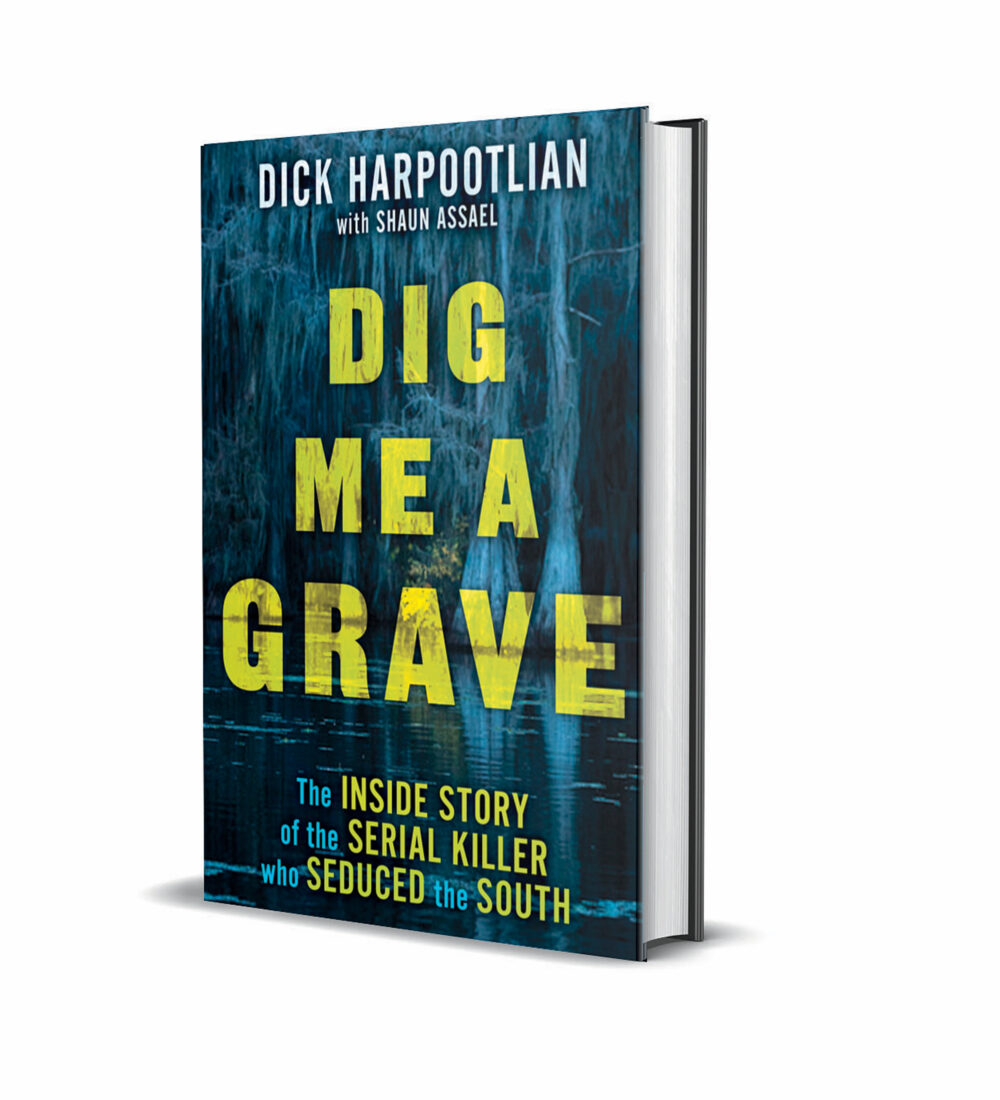
Dick Harpootlian is familiar with those chills. Harpootlian is a trial lawyer, most notably representing infamous Lowcountry lawyer turned convicted murderer Alex Murdaugh. Forty-some years before that, however, Harpootlian was the deputy prosecutor who sent Pee Wee Gaskins to the electric chair. Dig Me a Grave, cowritten with Shaun Assael, is Harpootlian’s account of that prosecution intertwined with a chronicle of Gaskins’s crimes. It’s a haunted and haunting read.
“During the 1970s,” Harpootlian writes, “hiding in plain sight as a roofer, [Gaskins] built a crime family out of the detritus of the rural South—teenage runaways, deadbeats, and lost souls. He collected more wives and mistresses than he knew what to do with and more ex-cons than he could possibly hide. Eventually, they rewarded him with intrigues and affairs, jealousy and betrayal. Things became so unwieldy, in fact, that he had to dismantle the outfit that he created by killing them—sometimes two at a time.”
“Shot. Drowned. Poisoned. Strangled,” goes his grim inventory. Gaskins killed serially, though unlike his contemporaries Ted Bundy and Jeffrey Dahmer, he didn’t seem to derive pleasure from the act of killing. He just didn’t mind doing it, and he enjoyed getting away with it. He even drove a black hearse, a sight that “quickly became a running gag around town,” Harpootlian continues. “If anyone pressed him on why he needed the hearse, Pee Wee shrugged. ‘I kill so many people, I need it to haul them to my private cemetery,’ he’d say.”
What locals took for a joke was actually true. But “I’m not one of them guys who go out there and kills without reason or whatnot,” he once protested. Instead, Gaskins murdered people he deemed to be in his way, or those he thought had violated him: two half brothers to whom he owed money for stolen guns; a thirteen-year-old girl, to prevent her from reporting him to the police; a twenty-two-year-old friend pregnant with a biracial child who upset Gaskins’s unrepentantly racist worldview, along with her biracial two-year-old daughter; and Martha Ann Hicks, a bisexual Black teenager whose time in Gaskins’s company sprouted rumors of a romance. “And I couldn’t allow that,” Gaskins later said of his reason for spiking her Coca-Cola with battery acid. A state psychiatrist, having interviewed Gaskins when he was a teen inmate at the Industrial School for White Boys (for attacking a girl with a hatchet during a burglary), put it most succinctly: There wasn’t much wrong with him; he was “just plain mean.”
Gaskins’s imprisonment in 1976 didn’t stanch his killing. His final murder was the one that got him strapped to the electric chair: the for-hire death-row bombing, via smuggled-in C-4 and what can only be described as diabolical ingenuity, of a fellow inmate, at the behest of the son of the inmate’s murdered victims. Harpootlian recounts that killing, subsequent trial, and eventual execution with taut immediacy, in part because Harpootlian had previously wavered on capital punishment. But “sometimes,” he concluded, “there is no choice.” During jury selection at Gaskins’s final trial, Pee Wee called to Harpootlian from the defense table: “Dick, you know what? You’re a lot like me. You’re gonna enjoy killing me, Dick. I know you will.” Not true, Harpootlian shot back, adding, “What I’m trying to get is justice.” Gaskins leaned back in his chair to issue a crude prison-rape metaphor. “Your feeling about it,” he said, “depends on whether you’re giving it or getting it.”
Plus: New Memoirs Start at Home

Common threads run through three new memoirs, including a childhood sense of place. In House of Smoke (Crown), John T. Edge wrestles with Southern identity, confronting tropes he inherited growing up in Clinton, Georgia, and his sometimes-rocky path to expanding that story through food. The Virginia reporter Beth Macy describes in Paper Girl (Penguin) how the delivery route she biked in Urbana, Ohio, shaped her curiosity for what can divide or unite neighbors. “My particular place has been Virginia, and the South in general,” writes the photographer Sally Mann in Art Work (Abrams). “The collapsing farmhouses, ruinous outbuildings, parishless churches, kudzu-claimed telephone poles, long-forgotten cemeteries, and, all around us, hillsides and mountains greenly serene… This is my landscape, beating inside me like a second heart.” —CJ Lotz Diego
Jonathan Miles, a Garden & Gun contributing editor, has been the magazine’s books columnist since 2012. He is the author of three novels, including Anatomy of a Miracle, which was a finalist for the Mississippi Institute of Arts and Letters Award in Fiction. A former resident of Oxford, Mississippi, he is currently Writer-in-Residence at the Solebury School in New Hope, Pennsylvania.
Garden & Gun has an affiliate partnership with Bookshop.org and may receive a portion of sales when a reader clicks to buy a book. All books are independently selected by the G&G editorial team.