
The line between bourbon lover and bourbon hunter can be a fine one. On the morning a couple of summers ago when I stood in the rain for three hours, waiting for a liquor store to open so I could have a shot at buying a unicorn bottle of allocated Weller CYPB, I knew I’d crossed it. In the months that followed, I found myself making unnecessary stops at “my” store and driving a regular circuit of a half dozen others if the pings of my bourbon radar told me that allocated bottles might be hitting the shelves. I scored on occasion, but as that routine grew, well, a bit too routine, I became intrigued by the notion of boosting my bourbon cabinet with a couple of dusties.
For the uninitiated, “dusties” is liquor-collector lingo for decades-old bottles of either existing or discontinued brands. Unfortunately, the days of asking kindly liquor store clerks if they happen to have an orphaned case of these treasures collecting cobwebs in the storeroom are gone—and the prices paid for them on secondary markets have skyrocketed.
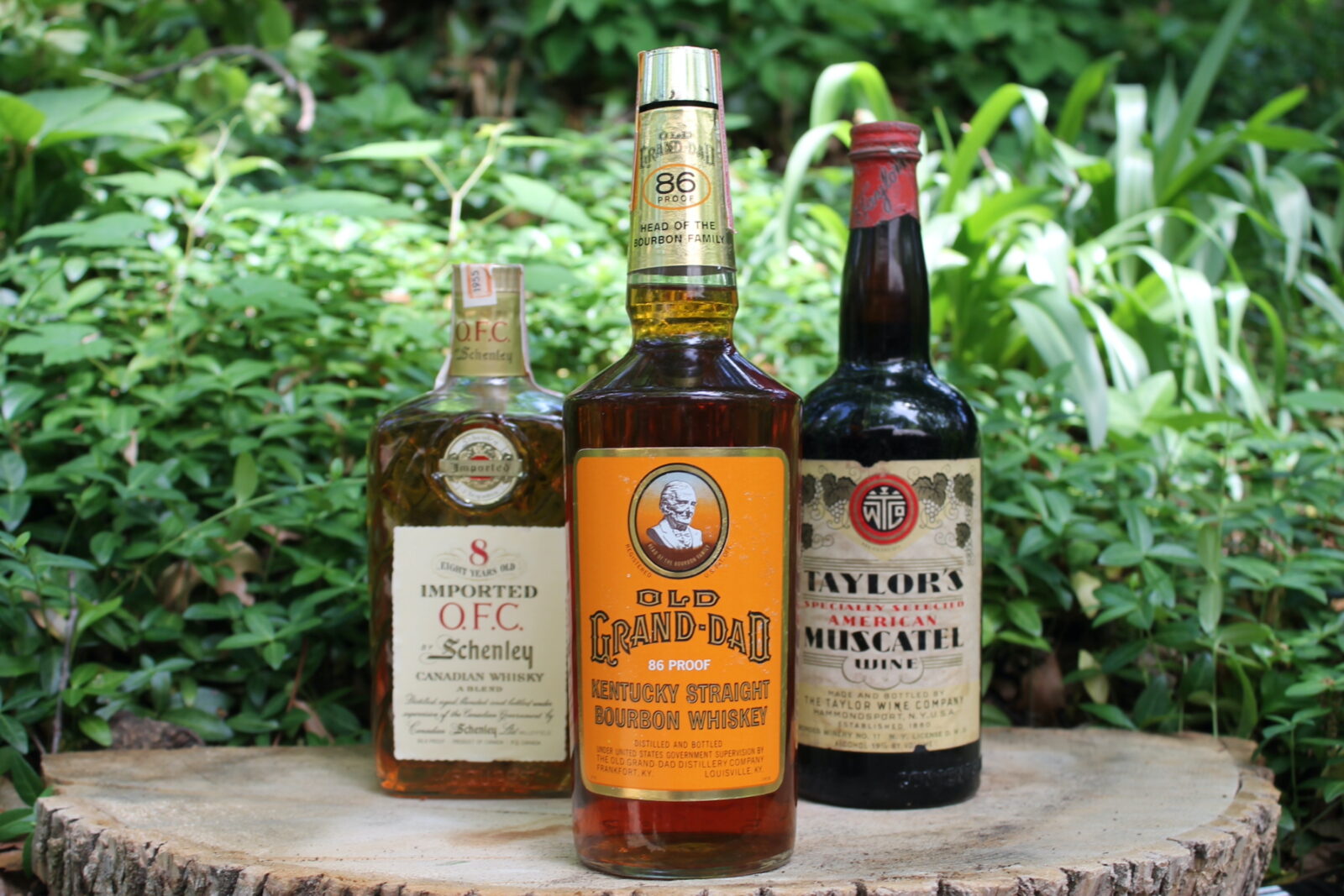
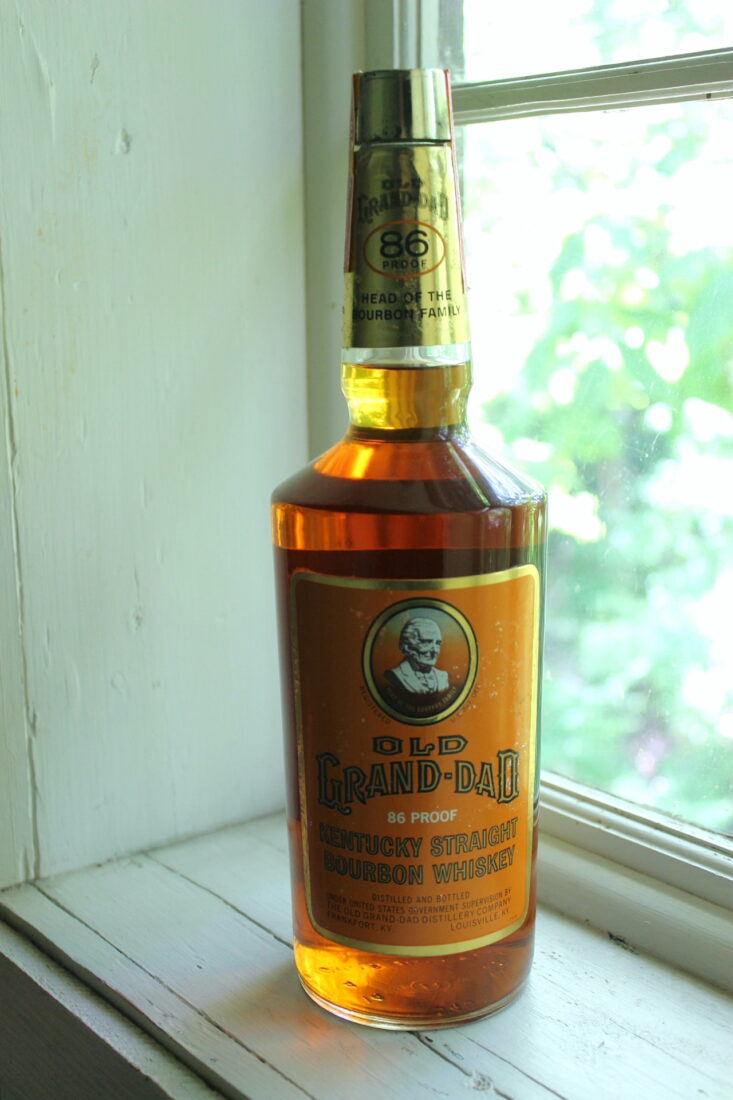
Of the shrinking dusty-hunting grounds, estate sales are regarded as fairly fertile. (Yes, they put us hunters in the awkward position of hoping the deceased forgot to open that vintage Old Fitzgerald or A.H. Hirsch Reserve. Our guilt is eased by knowing that heaven flows with bourbon rivers.) After hitting some local estate sales with no luck, I had an upcoming weekend free enough to widen my territory, so I went online to scout listings. Hours of surfing links and scrolling photos ensued until suddenly I found myself staring wide-eyed at a somewhat downscale estate auction heavy on hoarder bric-a-brac. There, among dozens of boxes of VHS tapes and Halloween decorations, and one Wankel Transparent Operating Rotary Engine (whatever that is), sat about ninety old liquor bottles. They were dusty, all right, even a bit moldy, the brands ranging from crème de menthe to sloe gin to a decidedly grungy bottle of Taylor’s Muscatel Wine. There was Canadian whisky, Scotch, and—huzzah!—a half dozen sealed bottles of Old Grand-Dad bourbon with tax strips that dated them to the 1960s and 1970s, bottlings now prized by us bourbon nerds.
The auction allowed online bidding, but the hitch was that my Internet leapfrogging had landed me on a sale that was several state borders from my Virginia home. I quickly dialed a bourbon buddy who resides in that state, whom we’ll call Dan. (If it seems I’m being circumspect with some details, you’re right—I’d rather not hand out a map to nick potential future finds out from under me.) Turns out that Dan lives less than thirty minutes from the auction house, and as a finder’s fee for tipping him off, he’d gladly pick up any bottles I might win.
We spent way too much time over the next two days figuring out how to register as online bidders, analyzing our competition from prebids already trickling in (whoever these bidders were, we despised them), and divvying up targeted lots to avoid inadvertently competing against each other. Dan has a thing for Canadian whisky and was excited by a 1943 bottle of Canadian Club, while I was zeroed in on those vintage OGDs. Indeed, I started referring to the auction as Operation Rescue Old Grand-Dad.
As the auction went live at 6 p.m. on a Friday, we each sipped a glass of bourbon while keeping the phone line open for our running commentary on the oddball lots of board games, souvenir refrigerator magnets, and PEZ dispensers zipping by. Finally, the first OGD lot, a 1960s, 100-proof bottle came up…and was speedily bidded beyond my self-imposed price limit. There was no time to second-guess myself, as next came an early 1970s, 86-proof bottle that I’d set my cap on. I clicked the bid button to take the lead at $130, only to watch that lead wrested away several times. How dare they lay claim to my bottle! Uncomfortably pushing my budget, I bid $190—and no answering bid followed. Going…going…gone—it was mine! Within minutes, I bid its twin up to $225 before reluctantly letting it go and also backed off the other 100-proof OGDs.
I urged Dan on as he won the WWII-era Canadian Club at $145. Then, after refilling our glasses, we lurked for bargains. Neither of us could resist handsome 1950s bottles of another Canadian whisky distilled by Schenley Ltd., a nearly forgotten booze behemoth that, in the decade after Prohibition, amassed a portfolio that included I.W. Harper, Old Charter, and George Dickel. (No, it’s not the sort of bottle that gets dusty hunters into a lather, but it’s exactly the sort of bottled history that I want to own, open, and taste.) Now bid giddy, Dan finished up by going eight dollars on a mysterious, half-filled glass liqueur decanter with a soiled label and a discolored, encrusted top. Not to be outdone, I ponied up five bucks for the muscatel. The auction had lasted three hours, the same amount of time that I’d waited in line at the liquor store last year, and flushed me with the same rush that I’d felt then.
A few days later, when Dan pulled up to a nondescript warehouse space adjacent to a martial arts studio, he confirmed our theory that this particular “estate” auction house specializes in selling off the contents of abandoned storage units—hence the hodgepodge of goods that had somewhat camouflaged our quarry. In the meantime, I’d learned that if my goal had been to flip dusties at a profit, I should have gone harder at the OGD lineup, especially the 100-proof bottles. Another surprise awaited: After Dan got the eight-dollar mystery decanter home and painstakingly cleaned it with rubbing alcohol and Q-tips, he discovered that it was not liqueur after all. It was a 1958 Old Grand-Dad, and despite the evaporation that had occurred over the decades, it remained sealed.
Several weeks later, I met him to claim my bottles as he passed through Virginia. Sitting at a picnic table next to a taco truck, he broke that seal and poured us a couple of fingers each. Not knowing what to expect, we burst out laughing upon realizing that this dusty time capsule had traveled into the future to bring us some of the finest bourbon either of us has ever sipped.
Editor’s note: For more on dusties, the author of this story has continued tracking down vintage bottles, and he’s started a YouTube channel, Drinking Dusties, devoted to tasting what he and a bourbon buddy find.
Steve Russell is a Garden & Gun contributing editor who also has written for Men’s Journal, Life, Rolling Stone, and Playboy. Born in Mississippi and raised in Tennessee, he resided in New Orleans and New York City before settling down in Charlottesville, Virginia, because it’s far enough south that biscuits are an expected component of a good breakfast.